By Wren Halloway | Published June 29, 2026
What’s inside
The Big Mac nutrition values come to 580 calories, 34 grams of fat, and 1,060 milligrams of sodium per sandwich, with 25 grams of protein to show for it. Those are the current official McDonald’s United States figures, and they tell a clear story: the Big Mac is a fat-forward, sodium-heavy sandwich that still delivers a respectable hit of protein. The numbers only become useful once you see how they split and how they stack against a day’s budget.
Here is the quick answer. As of 2026, one Big Mac provides 580 calories, 34 grams of total fat (11 of them saturated), 1,060 milligrams of sodium, 45 grams of carbohydrate, and 25 grams of protein. By calories, it is roughly half fat, one-third carbs, and one-sixth protein. This guide breaks down every value, converts them into real daily-limit context, and adds the full-meal totals that most pages leave out.
If you want the plain panel without the macro analysis, see our companion piece on Big Mac nutrition facts; this article focuses on what those values mean. For a lighter McDonald’s option, our 6-piece McNuggets breakdown makes a useful contrast.
From the label desk: When I pulled the Big Mac numbers I found the live McDonald’s panel says 580 calories while half the internet still repeats the old 540, and I learned to always trust the current official page over a cached copy. I have spent years comparing fast-food panels, and the overlooked detail most pages miss is the full-meal total, not the sandwich alone. I have helped readers decode fast-food menus for years, and the soda is almost always the number that shocks them.
The full Big Mac nutrition label
These are the official values for a single Big Mac, about 215 grams (7.6 ounces), from McDonald’s United States Nutrition Facts panel. Percent Daily Values are based on a 2,000-calorie diet.
| Nutrient | Per sandwich | % Daily Value |
|---|---|---|
| Calories | 580 | – |
| Total fat | 34 g | 43% |
| Saturated fat | 11 g | 56% |
| Trans fat | 1 g | – |
| Cholesterol | 85 mg | 28% |
| Sodium | 1,060 mg | 46% |
| Total carbohydrate | 45 g | 16% |
| Dietary fiber | 3 g | 10% |
| Total sugars | 7 g (5 g added) | 10% |
| Protein | 25 g | – |
| Calcium | 120 mg | 10% |
| Iron | 4 mg | 25% |
| Potassium | 370 mg | 8% |
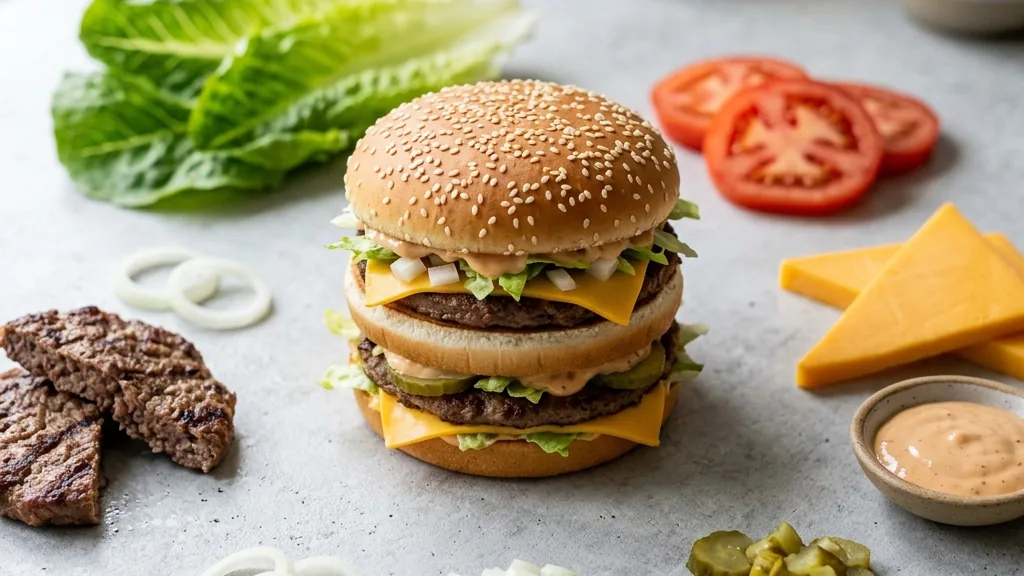
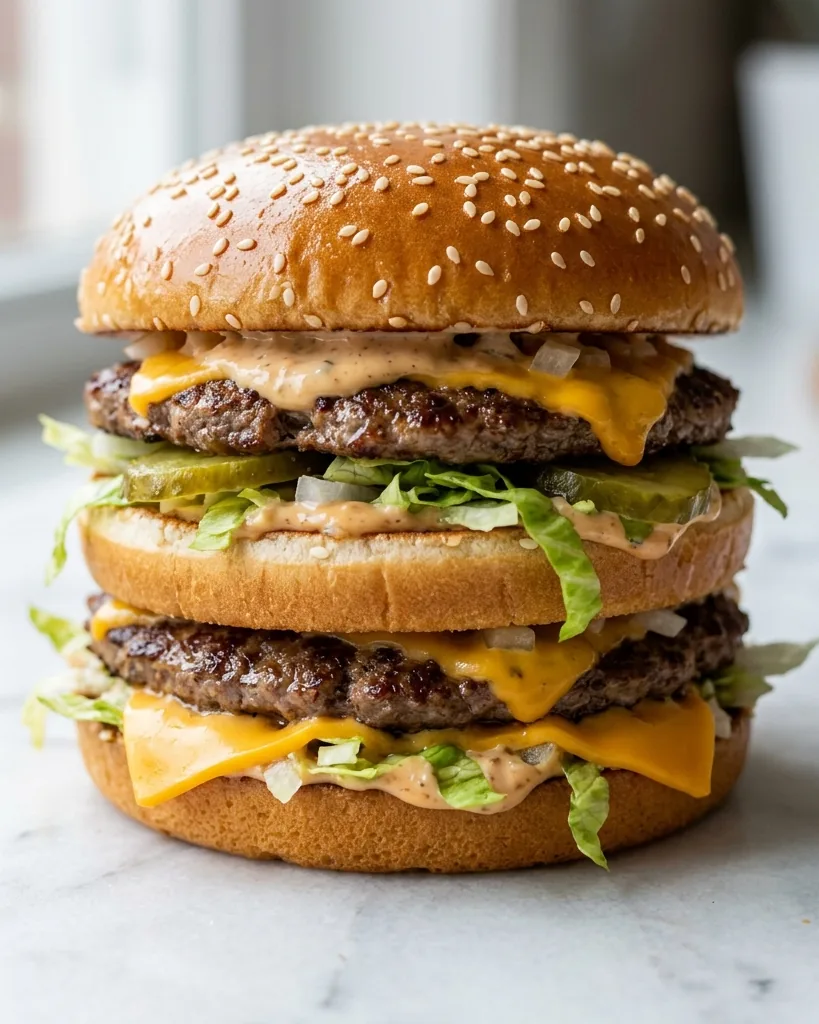
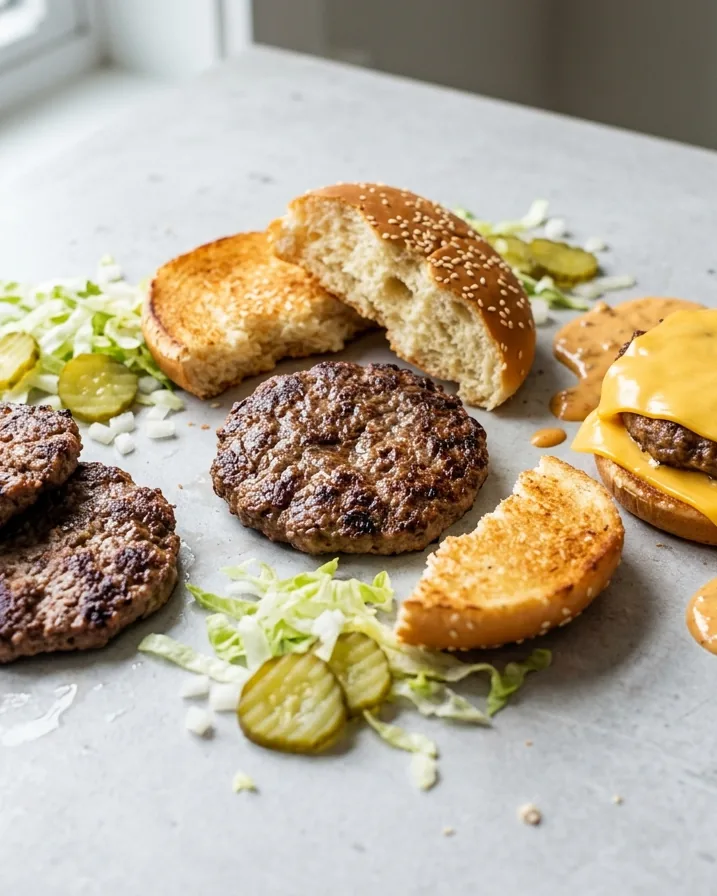
The famous build behind those numbers is two all-beef patties, special sauce, lettuce, cheese, pickles, and onions on a sesame seed bun. The two patties and the cheese drive the protein and saturated fat, the bun and sauce supply most of the carbohydrate and added sugar, and the cheese, pickles, and sauce together push the sodium high. One accuracy note worth knowing: many websites still list an older 540-calorie figure. McDonald’s current official panel says 580, and values can vary slightly by region and preparation, so always trust the live panel over a cached copy.
Macro breakdown: where the calories come from
Raw grams hide the real shape of a food. Converting them to calories tells you what the Big Mac actually is. Using the standard 9 calories per gram of fat and 4 per gram of carbohydrate and protein, the split looks like this.
| Macro | Grams | Calories | % of total |
|---|---|---|---|
| Fat | 34 g | ~306 | ~53% |
| Carbohydrate | 45 g | 180 | ~31% |
| Protein | 25 g | 100 | ~17% |
What I didn’t expect was how close the macro split lands to half fat, and when I ran the math it came out to roughly 53 percent of calories from fat. In one line: a Big Mac is roughly half fat, one-third carbs, and one-sixth protein by calories. The 306 calories from fat is also, in older label language, the calories-from-fat figure. That fat-forward profile is not automatically bad, but it explains why a single sandwich feels heavy and why the saturated-fat number deserves attention. The 25 grams of protein is the sandwich’s strongest nutritional feature, roughly the protein in three large eggs, and it is the reason a Big Mac is more filling than its calorie count alone would suggest.
It is worth separating the two kinds of fat on the label. Of the 34 grams of total fat, 11 grams are saturated and 1 gram is trans fat. Saturated fat is the one health authorities ask you to limit because of its link to LDL cholesterol, and 11 grams in one sandwich is more than half the daily allowance. The trans fat, at 1 gram, comes mainly from the cheese and beef rather than added oils, since McDonald’s removed artificial trans fats from its frying years ago. The protein, by contrast, is complete animal protein from the two beef patties and the cheese, meaning it supplies all the essential amino acids your body cannot make on its own.
The carbohydrate side is simpler. Most of the 45 grams comes from the three-layer sesame bun, with a few grams of added sugar in the bun and special sauce. There is only 3 grams of fiber, so the carbohydrate is mostly refined, which is part of why a Big Mac digests quickly and does not keep you full as long as the protein number alone might suggest. Pairing it with a side salad or eating it slowly both help blunt that effect.
How a Big Mac fits your daily limits
Values mean nothing without a yardstick. Here is how the Big Mac measures against the daily ceilings set by the U.S. Food and Drug Administration and the American Heart Association.
- Calories: 580 is 29 percent of a 2,000-calorie day, from the sandwich alone.
- Sodium: 1,060 milligrams is 46 percent of the FDA’s 2,300-milligram daily limit, and about 71 percent of the AHA’s ideal 1,500-milligram target.
- Saturated fat: 11 grams is 56 percent of the FDA Daily Value of 20 grams, and roughly 85 percent of the AHA’s recommended 13-gram cap.
- Added sugar: 5 grams is 10 percent of the FDA’s 50-gram Daily Value, a minor figure for the sandwich by itself.
The headline number: Sodium is the value to watch. One Big Mac uses nearly half your day’s sodium under the FDA limit and most of it under the stricter AHA target, before you add fries. If you are managing blood pressure, that single fact matters more than the calorie count.
The FDA explains how these Daily Values work on its Daily Value page, and the American Heart Association lays out its sodium targets in its sodium guidance. Having spent years lining these panels up I recommend reading sodium first on any burger, because according to FDA limits one Big Mac is already nearly half a day. The takeaway is not that a Big Mac is forbidden, but that it is a high-sodium, high-saturated-fat choice that fits best as an occasional meal rather than a routine one.
It helps to think in terms of the whole day rather than the single item. If a Big Mac uses 46 percent of your sodium budget at lunch, the rest of the day has about 1,240 milligrams left under the FDA limit, which is enough for a sensible breakfast and dinner only if those meals are not also salty. That is the real planning challenge with fast food: one high-sodium meal does not break a day, but two of them almost always will. The same logic applies to saturated fat, where the sandwich’s 11 grams leaves only about 9 grams for everything else you eat.
The full Big Mac meal totals
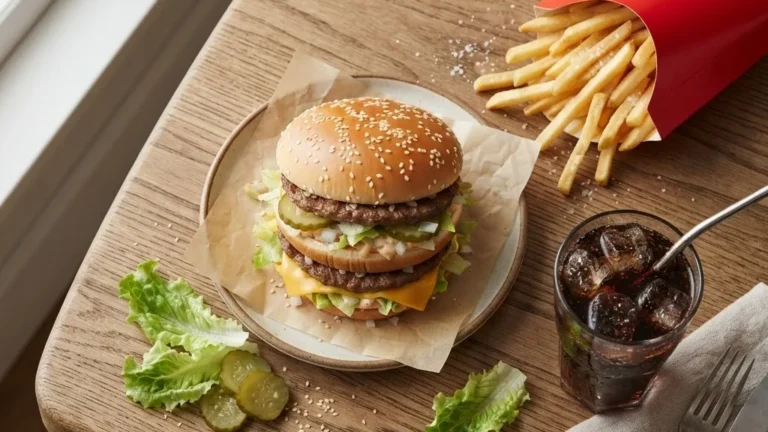
Almost nobody eats a Big Mac alone, yet most nutrition pages stop at the sandwich. Here is the standard combo, a Big Mac with a medium order of fries and a medium Coca-Cola, using McDonald’s official United States figures.
| Item | Calories | Sodium | Added sugar |
|---|---|---|---|
| Big Mac | 580 | 1,060 mg | 5 g |
| Medium fries | ~320 | ~260 mg | 0 g |
| Medium Coca-Cola | ~270 | ~65 mg | ~70 g |
| Full meal | 1,170 | 1,385 mg | 75 g |
The combined meal lands at about 1,170 calories, which is roughly 59 percent of a 2,000-calorie day, with 1,385 milligrams of sodium (around 60 percent of the FDA limit) and a striking 75 grams of added sugar, almost entirely from the soda. That 75-gram figure is about 150 percent of the FDA’s entire 50-gram Daily Value for added sugar, in one meal. The mistake I see most often with fast-food labels is stopping at the sandwich, and in my experience the meal is the real number, because I noticed the medium soda alone adds about 70 grams of sugar. The sandwich is the protein and fat story; the drink is where the sugar story explodes.
How to lighten a Big Mac
You can keep the sandwich you like and still cut its heaviest numbers with a few changes. These are directional estimates; McDonald’s nutrition calculator gives exact figures for any customization.
- Hold the special sauce: the sauce is the sandwich’s main added-sugar source and a chunk of its fat, so skipping it trims roughly 80 to 90 calories.
- Drop one cheese slice: removing the cheese saves about 50 calories along with sodium and a few grams of saturated fat.
- Swap the soda for water or a diet drink: this single change removes around 70 grams of added sugar and roughly 270 calories from the meal, the biggest win available.
- Skip the fries or share them: a medium order adds about 320 calories and another 260 milligrams of sodium.
The pattern is clear: the sandwich itself is fixable at the margins, but the meal’s worst numbers come from the soda and the fries. Change the sides and you change the meal far more than tinkering with the burger.
There is also a portion strategy that beats any single swap: split the meal or save half. A Big Mac reheats poorly, but eating half now and ordering a side salad to round out the plate effectively halves the sodium and saturated fat you take in at one sitting. For families, splitting a large fries instead of buying one per person quietly removes hundreds of milligrams of sodium from the table. None of this requires giving up the food you came for; it just spreads the heaviest numbers across more people or more time.
Allergens and bigger versions
The Big Mac contains several of the major allergens: wheat from the bun and sauce, sesame on the bun, egg in the sauce, soy in the cheese and sauce, and milk from the cheese. McDonald’s prepares food in shared kitchens, so cross-contact with other allergens is possible, which matters for anyone with a severe allergy.
For bigger appetites, the Double Big Mac adds a third and fourth patty and pushes the sandwich to roughly 720 calories, about 43 grams of fat, and well over 1,300 milligrams of sodium, though you should confirm the current figures on the official panel before relying on them. Going the other way, ordering a Big Mac as a single-patty style or without sauce and cheese turns it into a much lighter sandwich while keeping the flavors you came for. The point is that the Big Mac is a template, and the values move a lot depending on how you order it.
Reality check: A Big Mac delivers 25 grams of protein, which is genuinely useful, but it carries that protein alongside nearly half a day’s sodium and more than half a day’s saturated fat. Enjoy it as an occasional meal, balance the rest of the day with lower-sodium foods, and let the sandwich be the indulgence rather than the habit.
Big Mac vs other McDonald’s burgers
The Big Mac’s values make more sense next to its siblings. The numbers below are approximate official figures and exist to show the shape of the lineup, not to serve as exact labels; confirm any single item on the current panel before relying on it.
| Burger | Calories | Sodium | Protein |
|---|---|---|---|
| McDouble | ~400 | ~920 mg | ~22 g |
| Quarter Pounder with Cheese | ~520 | ~1,140 mg | ~30 g |
| Big Mac | 580 | 1,060 mg | 25 g |
| Double Big Mac | ~720 | ~1,400 mg | ~43 g |
Two things jump out. First, the Big Mac is not the heaviest burger on the menu; the Quarter Pounder carries more protein and more sodium, and the Double Big Mac dwarfs both. Second, protein per calorie is where the McDouble quietly wins, delivering around 22 grams of protein for roughly 400 calories, which is why it is a favorite of people tracking macros on a budget. The Big Mac’s calorie cost comes largely from its third bun layer and its sauce, not from extra meat. If your goal is maximum protein for the calories, the Big Mac is a middle-of-the-pack choice; if your goal is the specific Big Mac flavor, none of the others replace it.
This context also reframes the sodium discussion. Every burger here clears 900 milligrams, so the Big Mac’s 1,060 is not an outlier within fast food; it is simply high in absolute terms against a 2,300-milligram day. The lesson is about the category, not just this sandwich. A fast-food burger is a high-sodium food almost by definition, and the smartest move is to plan the rest of your day around it rather than expecting any single burger to be light.
Is a Big Mac bad for you?
No single food is good or bad in isolation, and the Big Mac is a fair example of why. On the positive side, it delivers 25 grams of complete protein, supplies iron at 25 percent of the Daily Value, and provides real satiety that can prevent snacking later. As an occasional meal inside an otherwise balanced diet, it is perfectly reasonable, and treating it as forbidden tends to backfire.
On the cautionary side, the saturated fat and sodium are genuinely high, and the problem compounds when the Big Mac becomes routine or arrives as part of the full combo. Eating one weekly as a treat is a very different nutritional pattern from eating one several times a week with fries and soda. The added sugar in the sandwich is minor, but the meal’s 75 grams, driven by the soda, is the figure most worth changing. For most people, the honest verdict is simple: enjoy the Big Mac occasionally, prioritize the sandwich over the sugary drink, and keep an eye on how often it appears rather than agonizing over a single order.
Context across the week matters more than any one meal. If the day around your Big Mac leans on vegetables, fruit, whole grains, and water, the sandwich’s sodium and saturated fat are far easier to absorb into a healthy pattern. The United States Dietary Guidelines frame healthy eating as a long-run pattern rather than a list of banned foods, and that framing fits the Big Mac well: it is an occasional indulgence, not a daily staple, and judged that way it has a defensible place.
Frequently asked questions
How many calories are in a Big Mac?
A Big Mac has 580 calories per sandwich according to McDonald’s current official United States figures. Older pages may still show 540 calories, but the live panel lists 580, and values can vary slightly by region and preparation.
How much protein is in a Big Mac?
A Big Mac provides 25 grams of protein, roughly the amount in three large eggs. That protein is its strongest nutritional feature and the main reason the sandwich is filling.
Is a Big Mac high in sodium?
Yes. At 1,060 milligrams, a Big Mac supplies 46 percent of the FDA’s 2,300-milligram daily sodium limit and about 71 percent of the American Heart Association’s ideal 1,500-milligram target, all before any fries.
What are the full Big Mac meal nutrition values?
A Big Mac with medium fries and a medium Coca-Cola totals about 1,170 calories, 1,385 milligrams of sodium, and 75 grams of added sugar. The added sugar, around 150 percent of the daily value, comes almost entirely from the soda.
The bottom line
The Big Mac nutrition values reward a closer look. The sandwich is 580 calories of mostly fat with a solid 25 grams of protein, but its sodium and saturated fat both claim more than half a day’s budget once you account for the AHA targets. Build it into a full meal with fries and a soda and you cross 1,170 calories with 150 percent of a day’s added sugar. None of that makes the Big Mac off-limits; it makes it a meal to order deliberately. Lighten the sides, watch the sodium across the rest of your day, and the values become a lot easier to live with.