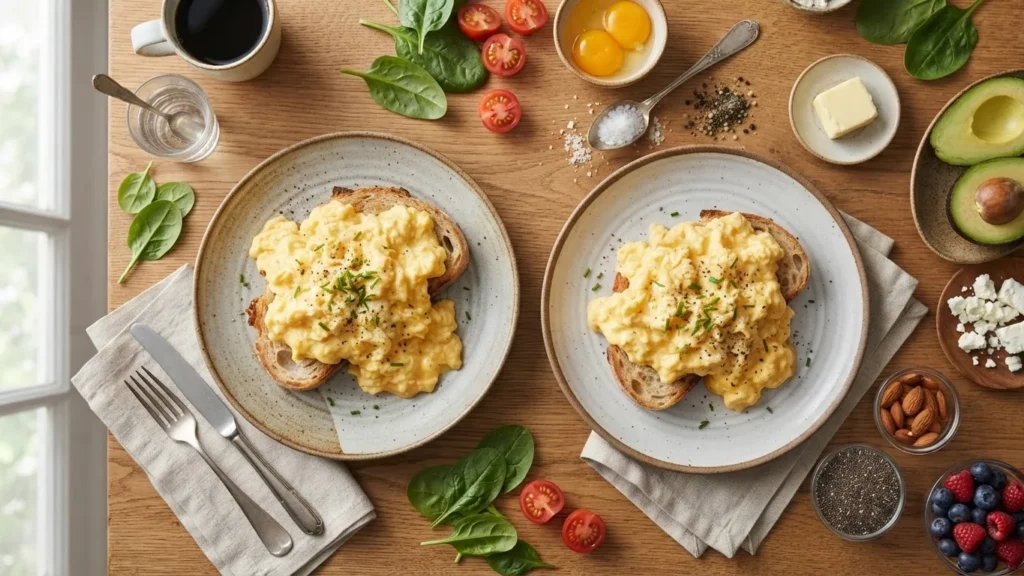
The 2 scrambled eggs nutritional information most people quote is off by a little in one direction and way off in another, so let me put the honest figures on the table first. Two large eggs, scrambled plain in a dry nonstick pan, land at roughly 143 calories, about 12.6 grams of protein, and near zero carbohydrate. That is the version I make on a normal Tuesday, and it is the baseline every other number here measures against. The moment you add butter, milk, cheese, or a heavy hand with the salt shaker, the panel shifts, and I will show you exactly how much.
By Wren Halloway, tastybend. Last reviewed July 7, 2026.
The short answer: two plain scrambled large eggs give you about 143 calories, 12.6 grams of complete protein, 9.5 grams of total fat, 3.1 grams of saturated fat, 372 milligrams of cholesterol, and roughly 140 milligrams of sodium before you salt them. Carbs sit under 1 gram. Add a teaspoon of butter and a splash of whole milk and you are closer to 195 calories. Those figures trace back to USDA FoodData Central egg entries, which I cross-check every time a recipe or a serving size changes.
Nutrition facts for 2 scrambled eggs (plain)
Here is the panel I keep taped inside my recipe binder. It reflects two large eggs, scrambled with nothing added but heat, using USDA FoodData Central values scaled from a single large egg. Percent Daily Values use the FDA reference amounts printed on the Nutrition Facts label.
| Nutrient | Per 2 large eggs (plain scramble) | %DV (FDA) |
|---|---|---|
| Calories | 143 kcal | – |
| Total fat | 9.5 g | 12% |
| Saturated fat | 3.1 g | 16% |
| Cholesterol | 372 mg | 124% |
| Sodium | 140 mg | 6% |
| Total carbohydrate | 0.8 g | 0% |
| Sugar | 0.4 g | – |
| Protein | 12.6 g | 25% |
One large raw egg on its own runs about 72 calories, 6.3 grams of protein, 4.8 grams of fat, 1.6 grams of saturated fat, 186 milligrams of cholesterol, and 71 milligrams of sodium. Double that and you have your plain scramble, because whisking and cooking do not add or remove calories on their own. What changes the number is everything you cook the eggs in, which is the part most calculators quietly skip.
The protein number people underestimate
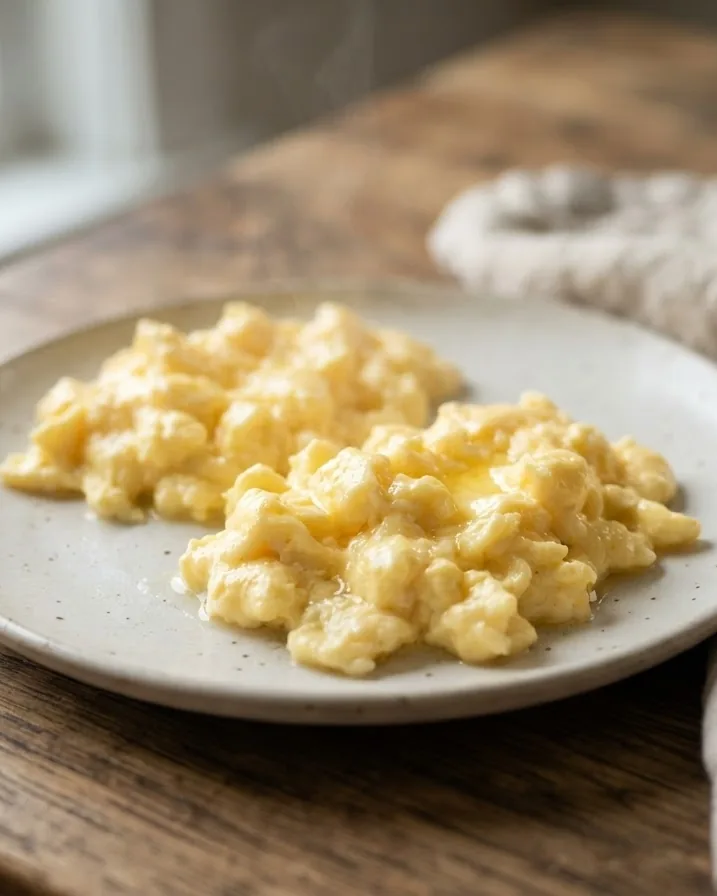
In the years I have spent reading nutrition panels, the figure that surprises people most is the protein. Two scrambled eggs deliver about 12.6 grams, and that is complete protein, meaning it carries all nine essential amino acids your body cannot make on its own. That covers roughly 25 percent of the FDA Daily Value of 50 grams from a breakfast that takes four minutes. When I tested a plain two-egg scramble against a single string cheese stick for a quick protein snack, the eggs won on total grams and on the amino-acid spread, which is why I lean on them before a long morning.
Protein is also why eggs keep me full. Fat and protein together slow digestion, so a two-egg scramble holds me until lunch far better than a bowl of cereal with the same calorie count. If you are chasing a protein target, remember that the yolk carries close to half of the protein, not just the fat. Tossing the yolks cuts the total protein down, which I get into below when I compare whole eggs to whites.
Fat, saturated fat, and where it lives
Two plain scrambled eggs carry about 9.5 grams of total fat and 3.1 grams of saturated fat. That saturated number is roughly 16 percent of the FDA Daily Value of 20 grams. Almost all of that fat sits in the yolk. The white is essentially fat free, which is the whole reason egg-white scrambles exist as a lower-fat option.
The fat in eggs is not the enemy people once treated it as. It carries the fat-soluble vitamins A, D, E, and K, plus choline, a nutrient most Americans fall short on. When I want a richer scramble I still reach for a small pat of butter, but I measure it, because that is where the calorie creep hides. A teaspoon of butter adds about 34 calories and around 2.4 grams of saturated fat, which alone can push your saturated fat past 25 percent of the daily reference. USDA FoodData Central lists butter and eggs separately, so I add them up rather than trusting a single blended entry.
Cholesterol in context
The cholesterol line is the one that makes people flinch. Two eggs carry about 372 milligrams, which reads as 124 percent of the old FDA Daily Value of 300 milligrams. For years that single number scared people off eggs entirely. The guidance has shifted. The 2015 to 2020 Dietary Guidelines dropped the strict 300 milligram daily cap, and the consumer portal at nutrition.gov now frames dietary cholesterol as something to keep reasonable rather than a hard ceiling. The FDA still prints the 300 milligram Daily Value on labels, so you will see the 124 percent figure on any tracker that uses it.
Here is the nuance I always share when a reader emails me worried about the yolk. For most people, saturated fat raises blood cholesterol more than dietary cholesterol does. That does not mean cholesterol is irrelevant, and anyone managing heart disease or diabetes should follow their own clinician’s advice. It does mean two scrambled eggs in an otherwise balanced day are not the villain the 372 milligram figure suggests on its own. If cholesterol is a live concern for you, mixing one whole egg with one or two whites is the swap I reach for, and I break down those numbers in the comparison table.
Sodium and the salt you add later
Plain scrambled eggs are naturally low in sodium, around 140 milligrams for two, or about 6 percent of the FDA Daily Value of 2,300 milligrams. That is genuinely modest. The catch is what happens at the stove. A single pinch of table salt can carry 200 to 300 milligrams of sodium, which can more than double the eggs’ own contribution in one shake.
When I tested my own habit with a measuring spoon, I was salting closer to a quarter teaspoon across two eggs, which is around 575 milligrams of sodium. That turned a low-sodium food into a moderate one. If you watch sodium, the eggs are not the problem, the shaker is. I now salt at the plate instead of the pan, because a little on the surface tastes like more than a lot mixed through.
What butter and milk actually do to the numbers
This is the part the phrase 2 scrambled eggs nutritional information usually glosses over, because the answer depends entirely on your pan. Milk is the cheap add-in, calorie wise. Two tablespoons of whole milk fold in only about 18 calories, a gram of protein, and a couple grams of natural sugar, while making the curds softer. If you want the full breakdown on that pour, I keep a detailed panel in my whole milk nutrition facts guide, and the short version is that a splash barely moves the needle.
Butter is the swing factor. Every teaspoon adds roughly 34 calories and about 2.4 grams of saturated fat. Cook two eggs in a tablespoon of butter, which is common in a restaurant kitchen, and you have added around 100 calories and a serious jump in saturated fat before the eggs even hit the plate. USDA’s own cooked scrambled egg entry, which assumes both milk and fat, comes out to about 149 calories per 100 grams, so two eggs prepared that way land near 182 calories rather than 143. My everyday number sits in the middle: two eggs, one teaspoon of butter, a splash of milk, about 195 calories.
Plain vs butter and milk vs egg whites
I built this comparison after one too many readers told me their tracking app and their bathroom scale disagreed. The gap almost always came down to which of these three columns they were actually eating. All values are for two large eggs or their white equivalent.
| Nutrient (per 2 eggs) | Plain scramble | Butter + milk | Egg whites only |
|---|---|---|---|
| Calories | 143 kcal | 195 kcal | 34 kcal |
| Protein | 12.6 g | 13.6 g | 7.2 g |
| Total fat | 9.5 g | 14 g | 0 g |
| Saturated fat | 3.1 g | 5.5 g | 0 g |
| Cholesterol | 372 mg | 378 mg | 0 mg |
| Sodium | 140 mg | 170 mg | 110 mg |
| Carbs | 0.8 g | 2.5 g | 0.7 g |
The takeaways I draw from this table are simple. Egg whites strip calories, fat, and cholesterol down to almost nothing, but they also cut the protein roughly in half per egg and lose the vitamins and choline that live in the yolk. The butter-and-milk column is not a disaster, it just quietly adds 50 calories and doubles the saturated fat. Plain scrambled eggs are, for my money, the best balance of protein, satiety, and calories on the board. When I want more protein without more fat, I scramble one whole egg with two whites, which lands around 106 calories and 13 grams of protein.
How 2 scrambled eggs fit keto and low-calorie plans
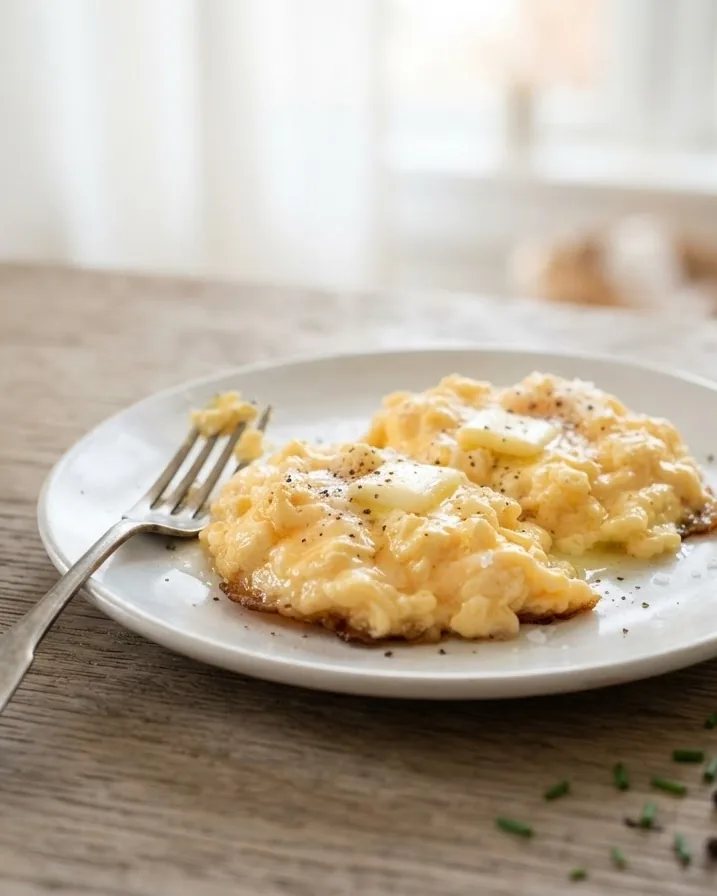
Eggs are naturally close to carb free, which is why two scrambled eggs slot into keto, low-carb, and diabetic-friendly plans without any math gymnastics. At under 1 gram of carbohydrate for two plain eggs, they will not move your blood sugar or knock you out of ketosis. On keto I actually want the fat, so the butter that inflates the calorie count elsewhere becomes a feature, not a bug.
For a low-calorie or high-volume plan, the move is the opposite. Scramble the eggs dry, or blend one whole egg with extra whites, and bulk the plate with vegetables like spinach, mushrooms, or tomatoes that add fiber and volume for very few calories. That is how I turn a 143 calorie base into a filling breakfast that still fits a cut. Either way, the protein floor stays high, which is the trait that makes eggs so flexible across diets.
How to read the egg carton label
The Nutrition Facts panel on an egg carton trips people up because the serving size is one egg, not the two or three you probably eat. Here is the order I read it in every time I buy a new brand.
- Check the serving size first. It is almost always “1 large egg,” so double every number for a two-egg scramble.
- Read calories against that serving. About 70 to 80 calories per large egg is normal; anything far higher means added ingredients.
- Scan the fat lines. Look for roughly 5 grams total fat and 1.5 grams saturated fat per egg, all from the yolk.
- Find cholesterol. Around 185 to 190 milligrams per egg is standard, and it is the number to watch if a clinician has flagged it.
- Confirm sodium is low, near 70 milligrams per egg, and remember any salt you add is on top of that.
- Ignore the marketing claims on the front and trust the panel and the USDA data behind it.
Healthier scramble swaps I actually use
None of these turn eggs into a different food, they just tilt the panel toward whatever goal you have that week. I rotate through all of them depending on what I am chasing.
- Swap butter for a teaspoon of olive oil to trade some saturated fat for unsaturated fat at a similar calorie cost.
- Use one whole egg plus two whites to hold protein high while cutting fat and cholesterol.
- Cook in a good nonstick pan with no fat at all to keep the plain 143 calorie number honest.
- Fold in a handful of spinach or diced tomato for volume, fiber, and a plate that eats bigger.
- Salt at the table instead of the pan so the flavor hits your tongue with far less sodium.
- Skip the shredded cheese, or measure it, since it stacks another 100 calories fast. A single portioned string cheese on the side is easier to track than a loose handful melted in.
A quick word on cooking eggs safely
Nutrition is only half the panel. FSIS, the USDA food-safety arm, advises cooking eggs until both the white and the yolk are firm, which happens around 160 degrees Fahrenheit internal. Soft, runny scrambles look great in videos, but for anyone pregnant, very young, older, or immune compromised, fully set curds are the safer call. I keep my heat at medium and pull the pan while the eggs still look barely wet, since carryover heat finishes them without turning them rubbery. It is a small habit that protects the food without hurting the texture. None of this changes the calorie or protein numbers, since safe cooking is about temperature, not added ingredients, but it is the piece I never skip when a reader asks whether soft scrambled eggs are worth the small risk. For a plain scramble the answer is easy, because firm curds cost you nothing on the panel.
Frequently asked questions
How many calories are in 2 scrambled eggs?
Two plain scrambled large eggs are about 143 calories using USDA FoodData Central values. Add a teaspoon of butter and a splash of milk and you are closer to 195 calories. Cooked in a full tablespoon of butter, they can reach 240 or more.
How much protein is in 2 scrambled eggs?
About 12.6 grams of complete protein, which is roughly 25 percent of the FDA Daily Value of 50 grams. The protein splits between the white and the yolk, so tossing the yolks drops the total, not just the fat.
Is the cholesterol in 2 scrambled eggs too high?
Two eggs carry about 372 milligrams of cholesterol, above the old 300 milligram FDA Daily Value. Current guidance from nutrition.gov treats dietary cholesterol as something to keep reasonable rather than a hard cap, since saturated fat affects blood cholesterol more for most people. Anyone managing heart disease should follow their clinician.
Are scrambled eggs good for a low-carb or keto diet?
Yes. Two scrambled eggs have under 1 gram of carbohydrate, so they fit keto, low-carb, and diabetic-friendly plans easily. On keto the added butter is a bonus rather than a drawback.
Do egg whites really cut the numbers that much?
They do. Two large egg whites scrambled are about 34 calories, 7.2 grams of protein, zero fat, and zero cholesterol. You trade away the yolk’s vitamins, choline, and roughly half the protein per egg, so a one-whole-egg-plus-two-whites mix is often the better middle ground.
Does milk add a lot of calories to scrambled eggs?
No. Two tablespoons of whole milk add only about 18 calories while making the curds softer. Butter is the real calorie driver at around 34 calories per teaspoon, so watch the fat you cook in, not the splash of milk.
Two scrambled eggs remain one of the most honest breakfasts I know: high protein, almost no carbs, and a calorie count that stays exactly where you decide to put it. Nail the plain baseline of 143 calories and 12.6 grams of protein, then add or subtract with your eyes open. The numbers here come straight from USDA FoodData Central and the FDA label references, and they will not move unless your pan does.