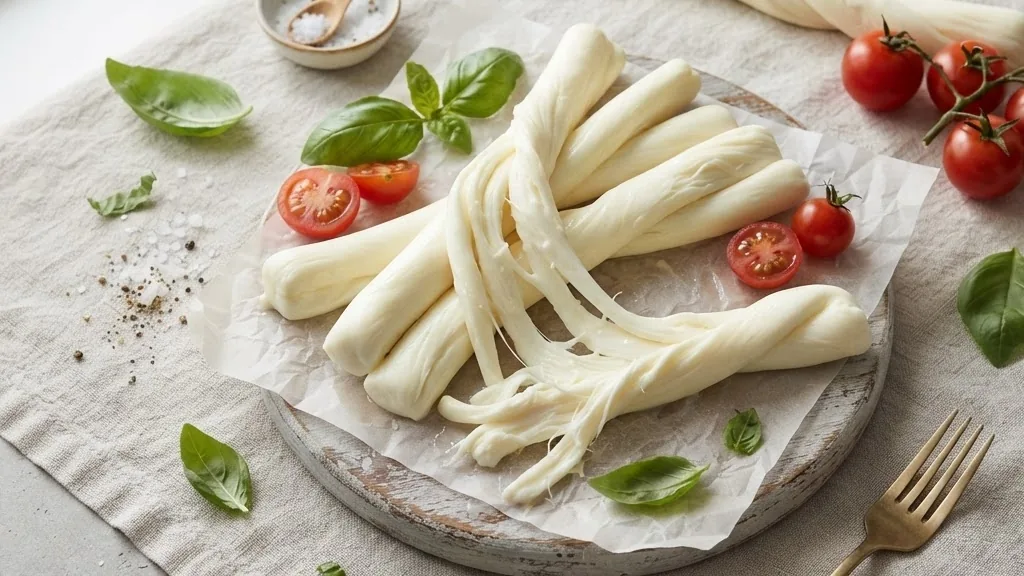
String cheese nutrition facts are easy to underrate, because the stick is small and it lives in the door of the fridge behind everything else. One standard stick of low-moisture part-skim mozzarella weighs 28 g, or 1 oz, and lands right around 80 calories with 6 g to 7 g of protein and almost no sugar. That protein-to-calorie ratio is the reason a bag is worth keeping on hand.
Below is the full breakdown for a single stick, brand by brand, plus the parts of the label most people skip: the sodium line, the saturated fat line, and the calcium number that makes this snack quietly useful. If you track macros, feed a lunchbox, or watch salt, the numbers here are the ones that matter. For a wider dairy comparison later, it helps to line this up against whole milk nutrition facts, since string cheese starts life as partly skimmed milk.
Here is the short version. One stick gives about 80 calories, 6 g to 7 g of protein, 6 g of total fat, 3 g of saturated fat, roughly 180 mg to 220 mg of sodium, 0 g to 1 g of carbohydrate, 0 g of sugar, and near 200 mg of calcium. That is a clean, portion-controlled hit of protein and calcium for a snack that survives a warm backpack for an hour and needs no prep at all.
String cheese nutrition facts per stick
The serving size on nearly every bag is one stick, listed as 28 g or 1 oz. That consistency is handy, because it means the numbers below travel from brand to brand with only small shifts. The U.S. Department of Agriculture, or USDA, keeps a generic entry for part-skim mozzarella string cheese in its FoodData Central database, and it reads close to the branded panels you see at the store. Calories sit near 80, protein sits near 7 g, and total carbohydrate rounds to 0 g. The differences between brands come down to a few milligrams of sodium and one gram of protein or fat, not wild swings.
The Food and Drug Administration, or FDA, sets the format of that Nutrition Facts panel and the percent Daily Value, or %DV, column beside it. When a label says 200 mg of sodium is 9% DV, that is the FDA reference daily value of 2,300 mg doing the math for you. Keep that in mind as you read the table, because a single stick looks tiny until you eat three.
| Nutrient (per 28 g / 1 oz stick) | Typical amount | About %DV |
|---|---|---|
| Calories | 80 calories | – |
| Protein | 6 g to 7 g | 12% to 14% |
| Total fat | 6 g | 8% |
| Saturated fat | 3 g | 16% |
| Trans fat | 0 g | – |
| Cholesterol | 20 mg | 7% |
| Sodium | 180 mg to 220 mg | 8% to 9% |
| Total carbohydrate | 0 g to 1 g | 0% |
| Sugars | 0 g | – |
| Calcium | about 200 mg | 15% |
Read the table as a range, not a fixed value. Across a dozen bags, the calorie count barely moves, but sodium can swing by 50 mg between brands. If you eat one stick a day, that gap is noise. If sticks are your default fridge snack and you go through two or three, the sodium math starts to count.
The protein and calcium payoff
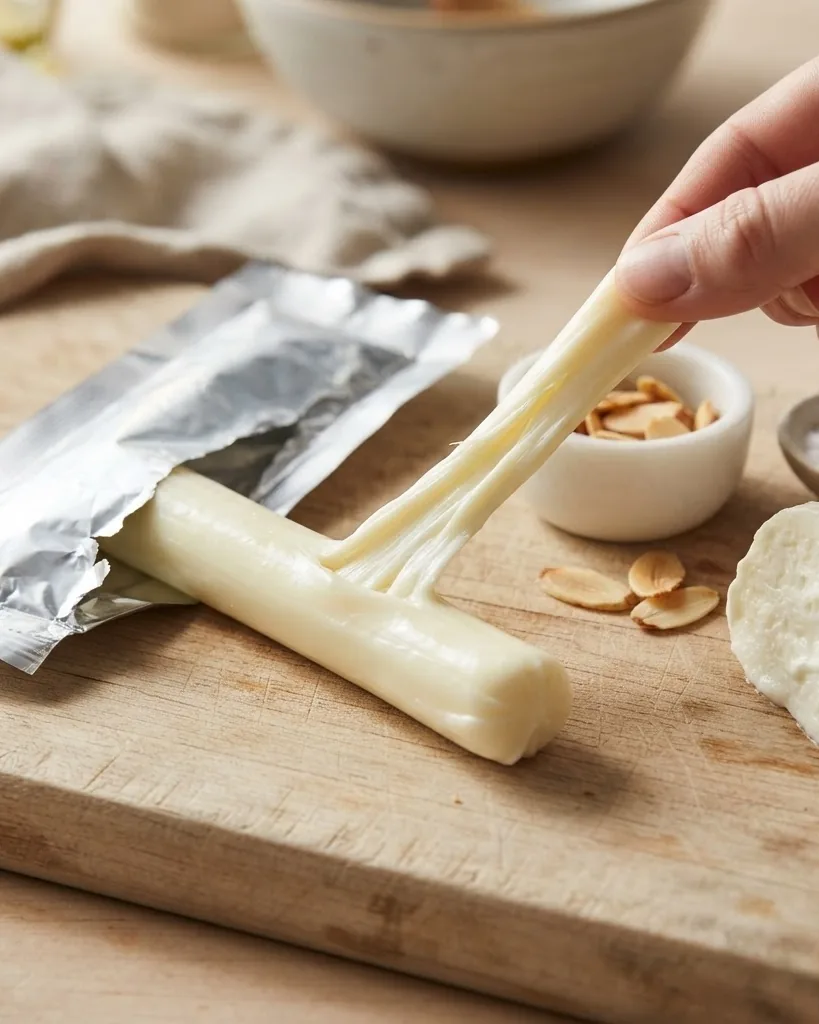
The reason nutritionists keep name-checking string cheese is the protein density. Six to seven grams of protein for 80 calories is a strong ratio for a shelf-snack you eat with one hand. Protein slows digestion, blunts the mid-afternoon crash, and helps you feel full longer than a cracker of the same calorie count. Two sticks give you 12 g to 14 g of protein for about 160 calories, which is a legitimate snack for anyone lifting, walking a lot, or just trying to skip the vending machine.
Calcium is the second quiet win. One stick carries roughly 200 mg of calcium, about 15% of the daily target the FDA prints on the label. The National Institutes of Health, or NIH, through its Office of Dietary Supplements, puts the adult calcium goal near 1,000 mg per day, rising to about 1,200 mg for women over 51. Two sticks cover close to a third of that, alongside real dietary protein and a little vitamin A. For people who do not drink milk, cheese is one of the more reliable calcium sources that does not require a supplement.
A few things worth naming here. String cheese is a whole-food source of calcium, meaning the mineral comes packaged with protein and fat that help your body use it. It is also portion-locked. You are not going to accidentally eat 600 mg of calcium worth of cheese from a single wrapper, which makes it easier to track than a block you slice by eye.
Sodium and saturated fat: the two lines to check
Every convenience food has a catch, and for string cheese it is salt and saturated fat. Sodium runs from about 170 mg to 220 mg per stick depending on the brand. On its own that is modest, around 8% to 9% of the FDA Daily Value of 2,300 mg. The Centers for Disease Control and Prevention, or CDC, notes that the average American already eats about 3,400 mg of sodium a day, well past that 2,300 mg ceiling. So the question is never whether one stick is salty. It is whether the rest of your day is.
Saturated fat is the other line. A stick carries about 3 g of saturated fat, which the FDA lists as roughly 16% DV against a 20 g daily reference. Eat two sticks and you are near a third of the day’s saturated fat before lunch. That is not a reason to avoid it. It is a reason to count it, especially if cheese, butter, and red meat all show up in the same day. If you cook with a lot of dairy fat already, it is worth glancing at heavy cream nutrition too, since those saturated fat grams add up across a recipe.
Here is what works at the shelf. Check two lines and move on:
- Sodium per stick. Under 200 mg is a sensible default; 170 mg to 180 mg brands exist if salt is a concern.
- Saturated fat per stick. Three grams is normal; a light stick can drop it to 2 g while keeping the protein.
- Serving size. Always confirm the panel is for one stick, not two, because a few multi-serve bags list a 2-stick serving and double every number.
Low-moisture part-skim vs whole-milk mozzarella
String cheese is almost always made from low-moisture part-skim mozzarella, and that phrase is doing real work. Part-skim means some of the fat is skimmed off the milk before the cheese is cultured. Low-moisture means extra water is pressed out, which concentrates the protein and gives the cheese that peelable, stringy pull. The result is a stick that keeps protein high while trimming fat compared with a fresh whole-milk mozzarella ball.
Whole-milk mozzarella runs a bit richer. Per ounce it tends to carry more total fat and more saturated fat, with calories often in the high 80s to low 90s. Part-skim string cheese sits near 80 calories and 6 g of fat, so you save a little fat and a few calories per serving without losing the protein. For a melt on pizza, whole-milk wins on texture and stretch. For a cold snack you eat straight from the wrapper, part-skim is the smarter macro trade.
None of this makes whole-milk mozzarella bad. It is a different tool. The point is that the words on the front of a string cheese bag are not marketing filler. Low-moisture part-skim is a genuine formulation choice that shows up in the fat line, and it is why string cheese scores better on a calorie-per-gram-of-protein basis than most snack cheeses.
String cheese on keto, low-carb, and high-protein snacking
This is where string cheese earns its keeper status for a lot of eating plans. Each stick has 0 g to 1 g of carbohydrate and 0 g of sugar. That near-zero carb count means it slots into keto and low-carb days without touching your carb budget. The fat and protein do the work, and there is no sugar spike to manage. Two sticks give you about 160 calories, 12 g to 14 g of protein, and under 2 g of carbs total, which is close to an ideal low-carb snack profile.
For high-protein snacking that is not tied to keto, the same math applies. You are getting roughly 6 g to 7 g of protein per 80 calories, a ratio that beats most granola bars and rivals a small serving of Greek yogurt. Because the stick is dense and needs chewing, it also tends to satisfy longer than a handful of crackers with the same calories. If your day skews low on protein, two sticks is an easy fix that fits in a coat pocket.
One honest caveat for keto eaters. Cheese is easy to overeat because it asks nothing of you. Three or four sticks in an afternoon is 240 to 320 calories and 9 g to 12 g of saturated fat, which can crowd out other foods. The portion wrapper helps, but only if you stop when the first one is gone. Balance the fat with fiber from vegetables or, on higher-carb days, from foods high in fiber, since cheese brings none of its own.

The lunchbox angle for kids
String cheese is a lunchbox staple for good reasons that go past the fun of peeling it. One stick delivers 6 g to 7 g of protein and around 200 mg of calcium in a portion a child cannot easily overdo. There is no added sugar, and the wrapper is self-contained, so it survives a few hours out of the fridge better than most dairy. The USDA even credits one stick as a meat or meat-alternate serving in the school meal programs it runs, which tells you the protein contribution is taken seriously at a policy level.
The thing to watch on a kid’s tray is total sodium across the whole lunch. A stick at 180 mg to 220 mg is fine on its own. Pair it with deli meat, salted crackers, and a pouch, and the salt adds up fast. String cheese is a good building block, not the whole meal. Add fruit and a whole grain and the stick becomes the protein anchor rather than another salty item competing for the same budget.
For picky eaters, the practical win is consistency. Every stick tastes the same, portions the same, and carries the same numbers, so you always know what you packed. That predictability is worth a lot when you are building five lunches on a Sunday night.
Brand comparison: Frigo, Sargento, Polly-O, and Kraft
Brands differ less than the shelf makes you think, but the small gaps matter if you buy the same bag every week. Below is how the common national brands stack up per single stick, based on their current published labels. Treat these as close reference points; recipes get tweaked, so the panel on your bag is the final word.
| Brand (per stick) | Calories | Protein | Sodium | Notes |
|---|---|---|---|---|
| Frigo Cheese Heads Original | 80 calories | 6 g | 200 mg | 3 g saturated fat |
| Sargento | 80 calories | 7 g | 220 mg | about 200 mg calcium, 15% DV |
| Polly-O part-skim | 80 calories | 7 g | 180 mg | lower-sodium option |
| Kraft | 80 calories | 6 g | 180 mg | 3 g saturated fat, 16% DV |
| Frigo Light | 50 calories | 6 g | 200 mg | 2.5 g fat, keeps protein |
My read on the table is simple. If sodium is your concern, Polly-O and Kraft at 180 mg edge out the others. If you want the most protein per stick, Sargento and Polly-O list 7 g. If you want to trim calories without losing protein, a light stick drops to around 50 calories and 2.5 g of fat while still giving 6 g of protein. There is no wrong pick here; there is only the line that matters most for your day.
How to read a string cheese label
Checking the label takes about ten seconds and saves a lot of guesswork. Start at the top with serving size and confirm it is one stick. Move to calories, then protein, because that ratio is the whole selling point. Then drop to the two lines that carry the catch: sodium and saturated fat. Sugar should read 0 g on a plain mozzarella stick; if it does not, you are holding a flavored or coated version.
The ingredient list is the last stop. A clean string cheese reads like low-moisture part-skim mozzarella cheese, made from pasteurized milk, cheese cultures, salt, and enzymes. That is it. If you see starches, added sugars, or a long list of stabilizers, you are likely looking at a cheese product rather than real mozzarella, and the numbers above may not hold. The FDA requires that ingredient panel, so it is the fastest tell for whether you have the real thing.
One more habit worth building. Compare the %DV column across two brands rather than the raw milligrams, because the FDA reference values make the comparison apples to apples. A 9% DV sodium stick and an 8% DV stick are closer than 220 mg versus 180 mg feels in your head. Reading the percentage keeps small differences in perspective.
Frequently asked questions
How many calories are in one stick of string cheese?
One standard 28 g stick of low-moisture part-skim mozzarella string cheese has about 80 calories, with a few brands and the USDA generic entry listing up to 90 calories. Light versions drop to roughly 45 to 50 calories while keeping most of the protein. Always confirm the serving size on the panel, since a small number of bags list a two-stick serving and double the count.
Is string cheese good for a high-protein or keto diet?
Yes. Each stick carries 6 g to 7 g of protein for 80 calories and only 0 g to 1 g of carbohydrate with 0 g of sugar, so it fits keto, low-carb, and high-protein snacking cleanly. The main thing to watch is saturated fat, about 3 g per stick or 16% of the FDA Daily Value, since cheese is easy to overeat when a snack asks nothing of you.
How much sodium and calcium does string cheese have?
A single stick has roughly 180 mg to 220 mg of sodium, about 8% to 9% of the FDA Daily Value of 2,300 mg. It also delivers around 200 mg of calcium, near 15% of the label target. The CDC reports average U.S. sodium intake near 3,400 mg per day, so string cheese fits best when the rest of your meals are not already salty.
Is part-skim string cheese healthier than whole-milk mozzarella?
For a cold snack, part-skim string cheese offers a better macro trade: near 80 calories and 6 g of fat per stick while keeping protein high. Whole-milk mozzarella runs a little richer in fat and calories per ounce, which suits melting and pizza more than snacking. Neither is bad. The low-moisture part-skim formulation simply trims fat without cutting the protein you are after.nnThe takeaway is that string cheese nutrition facts hold up under scrutiny. You get 80 calories, 6 g to 7 g of protein, near-zero carbs, and a useful dose of calcium in a wrapper that a kid can open and a busy adult can trust. Watch the sodium and saturated fat across the whole day, pick the brand whose numbers fit your priority, and this stays one of the simplest good snacks in the fridge. For the official numbers behind these ranges, the USDA keeps them at FoodData Central, the label rules and %DV come from the FDA, and sodium guidance sits with the CDC.