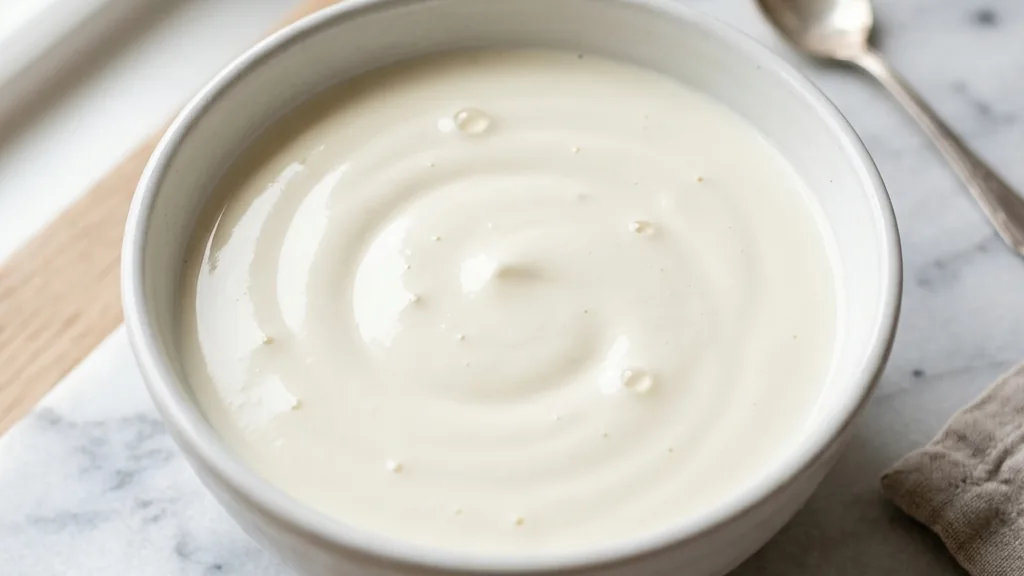
Heavy cream nutrition comes down to one word: fat. A single tablespoon delivers about 50 calories and 5.4 grams of fat, with almost no protein or carbohydrate, because heavy cream is the rich, high-fat layer skimmed from milk. By definition it contains at least 36 percent milkfat, which is what makes it whip into peaks and enrich a sauce so well. This guide breaks down the full nutrition label per tablespoon and per cup, the macros, the vitamins, how the saturated fat stacks up against your daily value, and how heavy cream fits different diets.
Heavy Cream Nutrition at a Glance
Most people use heavy cream a spoonful at a time, so the per-tablespoon numbers are the most useful starting point. Here is what one tablespoon (about 15 grams) contains.
| Nutrient | Per tablespoon |
|---|---|
| Calories | About 50 |
| Total fat | 5.4 g |
| Saturated fat | 3.5 g |
| Cholesterol | 20 mg |
| Sodium | 6 mg |
| Total carbohydrate | 0.4 g |
| Protein | 0.4 g |
The pattern is clear: heavy cream is calorie-dense and almost entirely fat. That is not a flaw, it is the point, since the high fat content is what gives cream its texture and cooking power. But it does mean the calories add up quickly when you pour rather than spoon.
Heavy Cream Nutrition Per Cup
When a recipe calls for cream by the cup, the numbers scale up dramatically. One cup (240 milliliters) of heavy cream contains roughly:
| Nutrient | Per cup |
|---|---|
| Calories | About 800 |
| Total fat | 88 g |
| Saturated fat | 55 g |
| Total carbohydrate | 6.6 g |
| Protein | 6.6 g |
That is why cream is used to enrich rather than to fill: a cup folded into a sauce for several servings adds richness without anyone eating a cup’s worth on their own. Knowing both the tablespoon and the cup figures helps you judge how a recipe spreads those calories across portions.
The Macronutrient Breakdown
Heavy cream has one of the most lopsided macro profiles in the kitchen. By calories, it is around 95 percent fat, with the small remainder split between carbohydrate and protein. The carbohydrate, about 0.4 grams per tablespoon, comes from lactose, the natural sugar in dairy, and the protein content is similarly tiny.
This makes heavy cream very different from milk, which carries far more of its calories as carbohydrate and protein. If you are tracking macros, treat cream essentially as a fat with a rounding error of carbs and protein attached.
Vitamins and Minerals
Because heavy cream is fat-rich, it carries the fat-soluble vitamins that come along with dairy fat. It is a source of vitamin A, provides some vitamin D when fortified, and contributes calcium, phosphorus, and choline. It also supplies small amounts of vitamin K2. These nutrients arrive in modest quantities at a typical serving, so cream is better thought of as a source of richness and a few fat-soluble vitamins than as a nutritional powerhouse. The bulk of what it offers your body is energy in the form of fat.
Saturated Fat and Your Daily Value
The number worth watching on the heavy cream label is saturated fat. The FDA Nutrition Facts label bases its percent Daily Value, or %DV, on a 2,000-calorie diet, and the Daily Value for saturated fat is 20 grams. One tablespoon of heavy cream provides about 3.5 grams of saturated fat, which works out to roughly 18 percent of the daily value.
That is a meaningful share from a single spoonful. Dietary guidance generally suggests keeping saturated fat to less than 10 percent of your daily calories, so heavy cream is a food to enjoy in moderation, especially if you are managing cholesterol or heart health. Used as a flavor enhancer rather than a base ingredient, a tablespoon or two fits most eating patterns comfortably.
Heavy Cream Compared to Other Dairy
Heavy cream sits at the rich end of the dairy spectrum, and seeing it next to its relatives makes the differences clear. These are approximate values per tablespoon.
| Dairy | Calories | Fat | Milkfat |
|---|---|---|---|
| Heavy cream | About 50 | 5.4 g | 36% or more |
| Light whipping cream | About 45 | 4.6 g | 30 to 36% |
| Half-and-half | About 20 | 1.7 g | 10.5 to 18% |
| Whole milk | About 9 | 0.5 g | About 3.25% |
The takeaway is that fat content drives everything. Heavy cream and heavy whipping cream are the same product, both at 36 percent fat or more, which is why only they whip into stable peaks. For lighter options, our breakdowns of whole milk nutrition and 2% milk nutrition show how much the numbers drop as the fat comes out.
Does Heavy Cream Fit Your Diet?
How well heavy cream fits depends entirely on the eating plan you follow.
- Keto and low-carb: A natural fit. With about 0.4 grams of carbohydrate per tablespoon and a high fat content, heavy cream is a keto staple for coffee, sauces, and desserts.
- Weight management: Use with awareness. At roughly 50 calories per tablespoon, cream is calorie-dense, so portions matter if you are counting calories.
- Lactose sensitivity: Often easier to tolerate in small amounts, because most lactose stays in the watery part of milk rather than the fat. It is not lactose-free, though.
- Heart-healthy eating: Use sparingly, since the saturated fat is high relative to recommended limits.
There is no single answer to whether heavy cream is healthy; it depends on how much you use and what the rest of your diet looks like. As a small enrichment, it works in most plans, while as a daily staple in large amounts it can crowd out room for saturated fat and calories.
Why the Fat Content Matters in Cooking
The same fat that drives the calorie count is what makes heavy cream so useful in the kitchen. At 36 percent fat or more, it whips into peaks that hold their shape, which lighter creams cannot do reliably. That high fat also keeps cream from curdling when simmered, so it enriches sauces and soups smoothly where milk might break. It is the backbone of ganache, ice cream, and countless rich desserts. Understanding that cream is essentially structured fat explains both why it is so calorie-dense and why no lower-fat substitute behaves exactly the same way.
Lighter Substitutes and How Their Nutrition Compares
When a recipe calls for richness but you want to trim calories or saturated fat, several swaps work, each with its own trade-off in taste and texture. None whips quite like the original, but many do fine in sauces and baking.
- Half-and-half: Around 20 calories and 1.7 grams of fat per tablespoon, less than half the calories. It enriches coffee and sauces but will not whip.
- Evaporated milk: A canned, concentrated milk with far less fat than the full-fat option, useful in sauces and custards.
- Milk plus butter: Whisking melted butter into whole milk mimics the fat ratio for cooking, though it will not whip.
- Coconut cream: A dairy-free, high-fat choice that whips and adds a coconut note; its fat is also largely saturated.
- Greek yogurt: Adds tang and protein with less fat, best stirred into finished sauces off the heat so it does not curdle.
The right swap depends on the job. For whipping you need high fat, so coconut cream is the closest dairy-free match, while for enriching a soup or pasta sauce, half-and-half or evaporated milk cuts the calories with little loss in the final dish.
How to Enjoy It Without Overdoing the Calories
Because the calories climb fast, a few habits let you keep the richness while controlling the total. Measure rather than pour, since a free-poured glug can easily be three or four tablespoons. Use it where it counts most, such as finishing a sauce or topping a dessert, rather than as a base you barely taste.
You can also stretch it by combining a smaller amount with a lighter dairy, getting much of the mouthfeel for fewer calories. And when a dish is mostly about flavor rather than texture, a lighter substitute often does the job without anyone noticing. None of this means avoiding it; it simply means spending those rich calories where they deliver the most pleasure.
Buying and Storing Heavy Cream
At the store, check the label for the fat percentage and the simplest ingredient list, ideally just cream and perhaps a stabilizer. Ultra-pasteurized versions last longer but can be slightly harder to whip than regular pasteurized ones. Once opened, keep the carton sealed and cold in the coldest part of the refrigerator, not the door, and use it within the window printed on the package, usually several days to a couple of weeks. You can also freeze it for cooking, though thawed cream separates and is better suited to sauces than to whipping. A quick smell and look tell you if it has turned, since spoiled dairy is sour and may show clumps.
How to Read the Nutrition Label Yourself
Reading the carton gives you the exact numbers for the brand in your hand, which can vary slightly from the averages here. Start with the serving size, usually one tablespoon, and note that the calories and other values all refer to that amount, so multiply if you use more. Check the saturated fat line and its %DV, the most important figure for this product. Scan the ingredient list for anything beyond cream, such as added stabilizers or sweeteners in flavored versions. The USDA FoodData Central database is a reliable place to confirm reference values if a label is unclear or missing, and it lists detailed nutrient profiles for dairy products of every fat level.
Frequently Asked Questions
How many calories are in heavy cream?
Heavy cream has about 50 calories per tablespoon and roughly 800 calories per cup. Almost all of those calories come from fat, around 5.4 grams per tablespoon, with only about 0.4 grams each of carbohydrate and protein. It is one of the most calorie-dense common dairy products.
Is heavy cream keto-friendly?
Yes. With about 0.4 grams of carbohydrate per tablespoon and a high fat content, heavy cream is a staple on keto and low-carb diets. It works well in coffee, sauces, and desserts without adding meaningful carbs, though its calories still count toward your daily total.
What is the difference between heavy cream and heavy whipping cream?
There is essentially no difference. Both heavy cream and heavy whipping cream contain at least 36 percent milkfat and have the same nutrition. The terms are used interchangeably. Light whipping cream is different, with a lower fat content of about 30 to 36 percent.
How much saturated fat is in heavy cream?
One tablespoon of heavy cream contains about 3.5 grams of saturated fat, roughly 18 percent of the 20-gram Daily Value used on the Nutrition Facts label. Because saturated fat adds up quickly, heavy cream is best enjoyed in moderation, particularly if you are watching your cholesterol or heart health.
Is heavy cream healthier than milk?
Neither is simply healthier; they serve different purposes. Heavy cream is far more calorie- and fat-dense than milk, while milk provides more protein and carbohydrate per serving along with calcium. Cream is best used in small amounts to enrich food, whereas milk works as a beverage or base ingredient.
How many calories does heavy cream add to coffee?
A typical splash of about one tablespoon adds roughly 50 calories and 5.4 grams of fat to your coffee, with almost no carbohydrate. Two tablespoons doubles that to around 100 calories. Because it is nearly carb-free, it is popular for keto coffee, but the calories still count, so measure your pour if you are tracking intake.
Can heavy cream help with weight gain or a high-calorie diet?
Yes. Its calorie density makes it a convenient way to add energy for people who need to gain weight or struggle to eat enough, since a small amount stirred into food adds calories without much volume. The same density that makes it useful for weight gain is why those watching calories should use it sparingly.
Does heavy cream have carbs or sugar?
Very little. Heavy cream contains only about 0.4 grams of carbohydrate per tablespoon, and that comes from lactose, the natural sugar in dairy. There is no added sugar in plain cream. This low carbohydrate count is exactly why it suits keto and low-carb diets, though flavored or sweetened cream products can contain added sugar, so check those labels.
Is heavy cream gluten-free?
Plain heavy cream is naturally gluten-free, since it is simply the high-fat portion of milk with no grains involved. As always, flavored or specialty versions can include additives, so anyone with celiac disease should confirm the label, but standard cream with a single ingredient poses no gluten concern.
Is the Saturated Fat in Heavy Cream Bad for You?
Saturated fat is the most debated part of this product’s profile, and the honest answer is that context matters. Long-standing dietary guidance recommends keeping saturated fat below 10 percent of daily calories to support heart health, and at about 3.5 grams per tablespoon, this dairy fat contributes meaningfully toward that limit.
At the same time, a tablespoon or two folded into a dish you would otherwise eat anyway is a small amount in the context of a whole day. The practical approach most dietitians favor is moderation rather than avoidance: enjoy the richness where it matters, balance it with plenty of vegetables, whole grains, and leaner proteins, and keep an eye on your overall saturated fat rather than fixating on one ingredient. If you have high cholesterol or heart concerns, your doctor or a registered dietitian can help you set the right limit for your situation.
Putting Heavy Cream Nutrition in Perspective
It helps to remember what role this ingredient actually plays in a meal. You rarely eat it on its own; it shows up as a spoonful in coffee, a swirl in a sauce, or a topping on dessert. Viewed that way, the headline numbers, about 50 calories and 5.4 grams of fat per tablespoon, are easy to manage with simple portion awareness. The richness it adds can even help a small, satisfying portion of food feel more complete, which has its own value. The goal is not to fear a calorie-dense ingredient but to use it intentionally, getting the flavor and texture you want from an amount that fits your day.
The Bottom Line
Heavy cream nutrition is simple to summarize: it is a concentrated source of dairy fat, with about 50 calories, 5.4 grams of fat, and 3.5 grams of saturated fat per tablespoon, and very little protein or carbohydrate. Its 36 percent milkfat is what lets it whip and enrich, and it is a natural fit for keto and low-carb cooking thanks to its tiny carb count. The main thing to watch is the saturated fat and the calorie density, both of which reward measuring your portions and using it where the richness counts most. Treated as a flavorful enhancement rather than a base, heavy cream fits comfortably into most kitchens and most diets.