
One 250 ml can of Red Bull carries 80 mg of caffeine and 27 grams of sugar, and those two numbers do most of the work when you decide whether the can fits your day. The rest of the Red Bull nutrition facts fill in around them: no protein, a stack of B-vitamins, and a calorie count that lands somewhere near 110 depending on which panel you read. This piece walks the label line by line, flags where the published numbers disagree, and tells you which figure to trust for your own situation.
The original blue-silver can and the sugar-free version share the same caffeine load but split hard on sugar and calories, so the two get treated separately below.
The 250 ml can at a glance: 110 calories, 27 g sugar, 80 mg caffeine
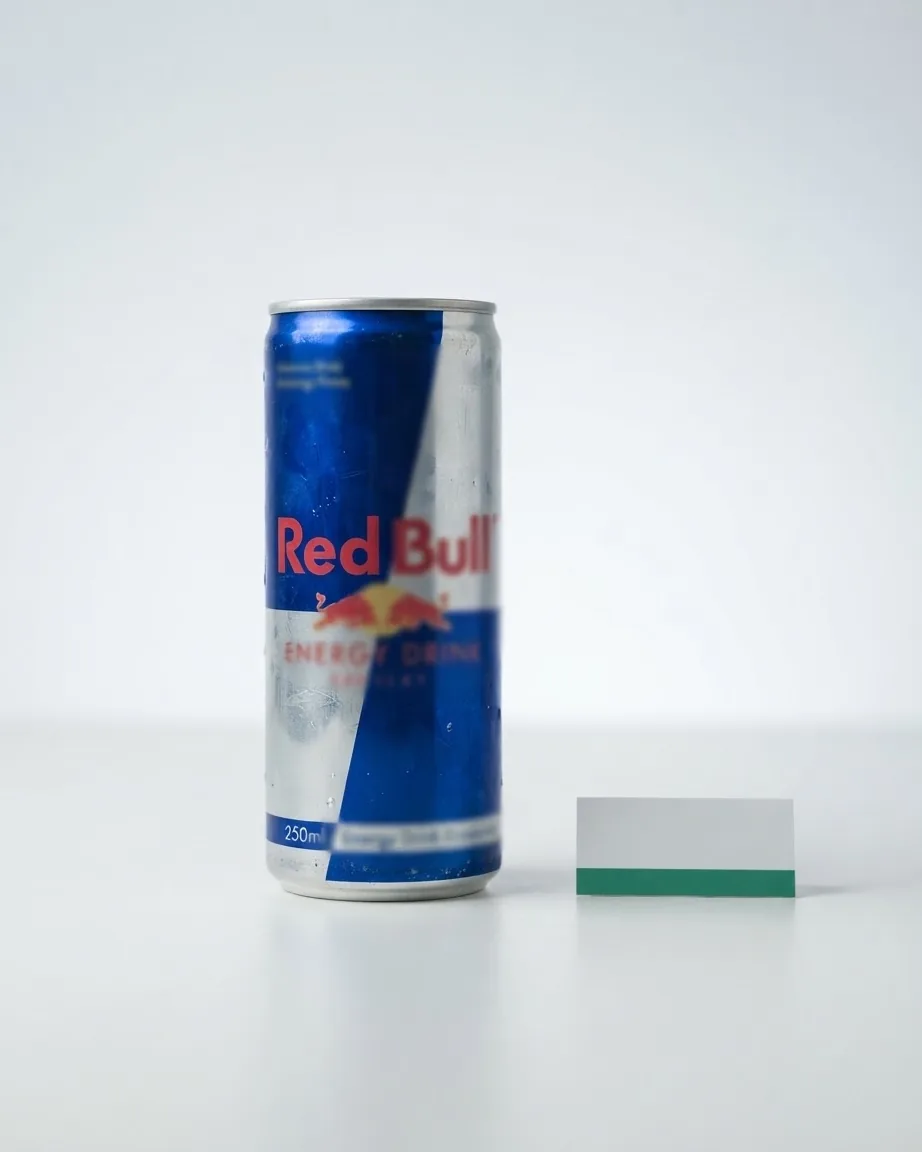
A single 250 ml can (marketed in the US as 8.4 fl oz) of regular Red Bull logs roughly 110 calories, 27 grams of sugar, 80 mg of caffeine, and 0 grams of protein. All of the calories come from carbohydrate, since there is no fat and no protein on the panel. The can also delivers 100 percent of the daily recommended intake for several B-vitamins, including B6 and B12. That 27-gram sugar figure is the whole can, not a partial serving – Red Bull sells the 250 ml size as one serving, so what you drink and what the label totals are the same thing.
Here is the regular 250 ml can, laid out clean:
- Serving size: 1 can, 250 ml (8.4 fl oz)
- Calories: ~110 per can
- Protein: 0 g (disputed – see below)
- Total fat: 0 g
- Total carbohydrate: 27 g
- Sugars: 27 g
- Caffeine: 80 mg
Notice what is not on that list: fiber and sodium don’t show up in the published figures for the can, so treat those as unreported rather than confirmed zeros. If a precise sodium number matters to you, the can’s own printed panel in your country is the place to check it. That habit of trusting the physical panel over a database export is worth building early, because as the next section shows, the aggregator pages don’t always agree with each other or even with themselves.
Why the calorie count reads 110, 111, 112, or 113
You will see four different calorie totals for the same drink, and none of them is a typo. SnapCalorie lists 112 calories per 8.4 fl oz can in one place and 110 calories in another; a separate reading gives 111; and the brand’s own European labelling states 113 kcal per 250 ml. The spread is small – three calories across the whole range – and it comes from rounding conventions and from the difference between a kcal figure printed for one market and a Calorie figure printed for another.
For a US shopper, the practical answer is to read the can in front of you and use that number. If you are logging the drink and want a single working figure, 110 calories is a defensible round number that matches the brand’s own product data closely enough for a food diary. Don’t lose sleep over the last calorie or two; the 27 grams of sugar underneath the calorie line is the figure that actually shapes your day.
One caution when you copy nutrition data off aggregator pages: SnapCalorie’s own entry contains an internal contradiction in the way it describes the can’s volume, so the size label there does not line up with the standard 250 ml serving even though the per-can nutrients are in range. When a source disagrees with itself on volume, lean on the brand panel for the serving size and use the aggregator only for the nutrient breakdown. The lesson generalizes: any time a database and a physical can conflict, the can wins, because it is the version regulators actually check.
The protein line: is it 0 g or 1 g?

This is the one spot on the Red Bull nutrition facts where sources openly clash. SnapCalorie reports 0 grams of protein. Healthline lists 1 gram. A third reference, MyFoodData, rounds its protein reading up to just 2 percent of a daily value. So which is right?
For any practical purpose – meal logging, macro counting, deciding whether Red Bull “has” protein – treat it as effectively zero. Even the highest of the published readings is a rounding-error amount in a 250 ml drink and contributes nothing meaningful to a day’s protein target. The disagreement exists because trace nitrogen from ingredients like taurine and the B-vitamin carriers can nudge a lab-calculated protein value just above or below the half-gram rounding threshold, which is why one panel prints 0 and another prints 1. Nobody is drinking Red Bull for the protein, and no version of the number changes that.
Caffeine content and the 400 mg daily ceiling
The 80 mg of caffeine in one 250 ml can is close to what a standard cup of brewed coffee gives you. A cup of coffee and the can land in broadly the same caffeine territory, close enough that the two are routinely compared – so the coffee can edge the can by a small margin rather than the other way around.
The number that governs how many cans is safe in a day is 400 mg of caffeine for healthy adults. At 80 mg per can, that is five cans before you hit the ceiling – but that ceiling assumes Red Bull is your only caffeine source, which for most people it isn’t. Stack two cans on top of a morning coffee and an afternoon soda and the total climbs fast. For an authoritative breakdown of caffeine and how much is too much, the Mayo Clinic’s caffeine guide lays out where common drinks land against that 400 mg figure.
The takeaway for your own math: count every caffeine source in the day, not just the cans, and remember that pregnancy, certain medications, and caffeine sensitivity all pull the safe number down well below 400 mg. Those personal factors matter more than any single published limit, because the 400 mg figure is an average-adult guideline, not a promise that five cans are fine for everyone.
The B-vitamins: niacin, pantothenic acid, B6 and B12
Red Bull is built around a set of water-soluble B-group vitamins: niacin (B3), pantothenic acid (B5), vitamin B6, and vitamin B12. One 250 ml can supplies 100 percent of the daily recommended intake for several of these, B6 and B12 among them. That is where a lot of the drink’s “energy” marketing comes from – B-vitamins help the body convert food into usable energy, though topping up past what you need doesn’t bank extra energy, since the water-soluble ones you don’t use are simply excreted.
If you want to see what those vitamins actually do and how much a body needs, the National Institutes of Health keeps plain-language dossiers; their vitamin B12 fact sheet is a good place to check the daily value the can’s “100 percent” is measured against. Worth knowing: hitting 100 percent of a B-vitamin from a can is not the same nutritional event as getting it from food, where the vitamins arrive alongside protein, fiber, and minerals. The can gives you the vitamin and the sugar, and little else.
Does Red Bull fit keto, low-carb, vegetarian, or pescatarian eating?
Two clean yes-or-no answers and one hard no here.
The hard no is keto and low-carb. With 27 grams of sugar in a single 250 ml can – all of it counting as carbohydrate – regular Red Bull is unsuitable for keto or low-carb diets. Keto and low-carb plans keep total daily carbohydrate deliberately low, and a single can’s worth of sugar makes a serious dent in that allowance before any actual food is counted. If you are keeping carbs down, the regular can is out; the sugar-free version is the only route in.
The two yeses: regular Red Bull is suitable for vegetarian and pescatarian diets. There is a persistent rumor that the taurine in energy drinks comes from animals – for Red Bull it does not; the taurine used is synthetic. That is what lets the drink sit inside a vegetarian or pescatarian pattern without an asterisk. If you’re the kind of label-reader who likes to know exactly what each line means, you may also like our breakdown of the Nutrition Facts on Coke Zero, which walks a zero-sugar can through the same lens.
Sugar-free Red Bull: same caffeine, different sweeteners
The sugar-free can keeps the 80 mg of caffeine – Healthline’s 75 – 80 mg range covers both versions – but drops the 27 grams of sugar and nearly all of the calories that came with it. In place of sugar it uses two artificial sweeteners: aspartame and acesulfame K. That single swap is what turns Red Bull from a keto non-starter into something that fits a low-carb day.
What the available data does not cleanly give you is a full side-by-side of every nutrient in sugar-free versus original beyond the sweeteners and the shared caffeine. If you need the sugar-free can’s exact calorie and micronutrient panel, read the specific can, because the number printed on it is the one that governs. For people managing sugar rather than avoiding it, the sugar-free can is the meaningful choice; for anyone steering around artificial sweeteners, it’s the reason to reach for something else. Our look at Diet Dr Pepper Nutrition Facts covers a similar aspartame-and-ace-K pairing if you want to compare how another diet soda handles it.
Taurine: how much is in a can, and how much is in you
Taurine is the ingredient people ask about most and the one the label tells you least about in absolute terms. The published figure is a comparison, not a milligram count: the human body of a 70 kg adult naturally contains about 70 times more taurine than one 250 ml can of Red Bull holds. Read that plainly – the can adds a small fraction of what your own body already carries and makes on its own.
The exact milligram dose per can isn’t part of the figures the brand foregrounds; it leads with the ratio instead. If a precise amount matters for a health reason, the can’s ingredient panel or a call to the manufacturer is the honest source, not a round number pulled off a chart. Taurine occurs naturally in meat and fish, but the taurine in Red Bull is synthesized rather than extracted from animals, which is the point that keeps the drink vegetarian-friendly. It is also why a vegetarian can drink it without checking where the taurine was sourced, since the synthetic route sidesteps animal origin entirely.
How the can stacks up against a cup of coffee
Put the two side by side and the trade becomes obvious. A 240 ml cup of brewed black coffee runs to very few calories and no sugar, while carrying a caffeine load in the same ballpark as the can. A 250 ml can of Red Bull runs about 110 calories, 27 grams of sugar, and 80 mg of caffeine.
So for a comparable caffeine hit, black coffee costs you almost nothing in calories and no sugar, while the Red Bull costs 110 calories and a full 27 grams of sugar. What the can adds that coffee doesn’t is the engineered dose of B-vitamins and taurine and the sweet, carbonated format. If the goal is simply alertness, coffee is the leaner delivery. If you want the specific flavor and the vitamin load, that’s the 27 grams of sugar you’re paying for.
- Red Bull, 250 ml: ~110 cal · 27 g sugar · 80 mg caffeine · 0 g protein
- Brewed black coffee, 240 ml: very low calories · 0 g sugar · caffeine in the same range · trace minerals
For more panels read off the label the same way, our wider drinks coverage lines up sodas, energy drinks, and diet versions can by can.
The math on one can: how many before the ceiling, and how much room it leaves
Every figure below is worked straight from the label numbers already on this page, so you can check the arithmetic against your own day rather than trusting a round claim. Two numbers do the heavy lifting: the 80 mg of caffeine and the 27 g of sugar in a single 250 ml can.
- Caffeine, cans to the ceiling: the 400 mg adult limit divided by 80 mg per can works out to 5 cans, and drinking just one leaves a wide margin of caffeine still available for the rest of the day – room that a morning coffee and an afternoon soda quietly eat into.
- Keto and low-carb, the carb bite: one can’s 27 g of sugar all counts as carbohydrate, so against the deliberately tight carb allowances that keto and low-carb plans run, a single can takes a heavy bite out of the day’s budget before any food is eaten. That is the arithmetic behind the “hard no” for keto.
- Sugar concentration: 27 g across 250 ml works out to 10.8 g of sugar per 100 ml, a useful figure for comparing the can against any other drink labelled per 100 ml.
- Taurine, the reality check: the brand notes that a 70 kg body already holds about 70 times the taurine in one can, which reframes the can’s taurine as a top-up rather than a megadose.
Note the caffeine ceiling assumes Red Bull is your only source; pregnancy, some medications, and caffeine sensitivity all push the safe can count below five.
Frequently asked questions
How much sugar is in one can of Red Bull?
A standard 250 ml can holds 27 grams of sugar, and because Red Bull sells that 250 ml size as a single serving, the can total and the serving figure are identical. All 27 grams count as carbohydrate, which is why the regular can doesn’t fit keto or low-carb eating.
Is Red Bull stronger than coffee for caffeine?
No. One 250 ml can carries 80 mg of caffeine, while a standard cup of brewed coffee lands in a broadly similar range. The can is close to a cup of coffee but tends to sit slightly under it. Both stay well within the 400 mg daily caffeine ceiling for healthy adults on their own.
Does Red Bull actually contain any protein?
Practically none. Published figures range from zero up to only a fraction of a gram, a spread caused by rounding trace nitrogen from ingredients like taurine. Even the highest reading contributes nothing meaningful to a day’s protein, so treat the can as a zero-protein drink for logging purposes.
What sweeteners are in sugar-free Red Bull?
The sugar-free version uses two artificial sweeteners, aspartame and acesulfame K, in place of the 27 grams of sugar in the regular can. It keeps the same caffeine load, roughly 75 to 80 mg, which is what makes it the low-carb-friendly option while the original stays off-limits.
How many cans of Red Bull are safe in a day?
At 80 mg per can, five cans reach the 400 mg daily caffeine limit for healthy adults – but only if Red Bull is your sole caffeine source. Count coffee, tea, and soda too, and lower the number for pregnancy, medications, or caffeine sensitivity, where the safe amount drops well below 400 mg.