
>
Nutrition facts on Coke Zero start with a line that stops most people cold: a 12-fl-oz serving of Coca-Cola Zero Sugar carries 0 calories, 0 grams of total sugars, and 0 grams of added sugars, according to the label The Coca-Cola Company publishes for the current U.S. product. That trio of zeros is real, and it is verifiable on the manufacturer’s own page. But a Nutrition Facts panel is not just its calorie line. The same 12-fl-oz serving lists 40 mg of sodium and 60 mg of potassium, and it carries 34 mg of caffeine that the calorie count never hints at. The zeros describe what the drink lacks. The rest of the panel, plus the ingredient list underneath it, describes what you actually swallow.
This guide takes the exact figures from the Coca-Cola Zero Sugar 12-fl-oz serving and walks each one back into plain English: what the sweeteners are, why the drink tastes sweet with no sugar, what the caffeine number means against federal guidance, and why a sugar-free soda still matters for your teeth.
Quick answer: what a 12 fl oz Coke Zero contains
A 12-fl-oz serving of Coke Zero contains 0 calories, 0 g total fat, 0 g total carbohydrate, 0 g total sugars, 0 g added sugars, and 0 g protein, per the Coca-Cola Zero Sugar U.S. label. It is not a nutritional blank, though. The same serving lists 40 mg of sodium at 2 percent Daily Value and 60 mg of potassium at 2 percent Daily Value, and it delivers 34 mg of caffeine. Sweetness comes from aspartame, acesulfame potassium, and stevia extract rather than sugar. Those are the nutrition facts on Coke Zero worth carrying in your head.
Reading the zeros: why “0 calories” is a labeling rule, not a magic trick
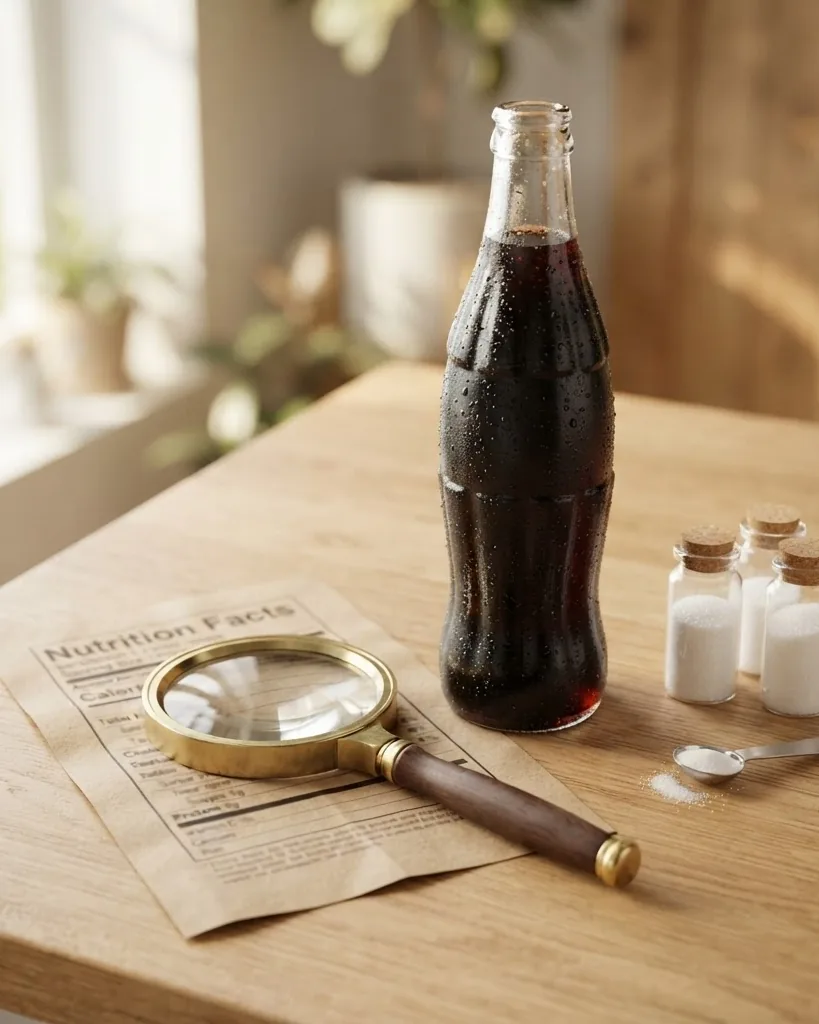
The zeros on a Coke Zero panel are a labeling outcome, not a claim that the can contains literally nothing. The U.S. Food and Drug Administration sets how each nutrient gets rounded and how the whole panel ties to a single serving size, and it states plainly that every nutrient amount on the label refers to the stated serving. For Coca-Cola Zero Sugar that reference serving is 12 fl oz, and against it the calories, total carbohydrate, total sugars, and added sugars all read 0 g or 0. A drink can taste distinctly of cola while its carbohydrate line sits at zero because the sweetening compounds are not sugars and are used in tiny amounts.
Two ideas are easy to blur here, so keep them apart:
- Nutrients are the calories, fat, sodium, carbohydrate, and protein counted on the panel.
- Ingredients are the substances listed below it, including things like caffeine and sweeteners that shape flavor without adding countable macronutrients.
The FDA’s own explainer on reading added sugars on the Nutrition Facts label puts the number in scale: the Daily Value for added sugars is 50 g per day based on a 2,000-calorie diet. Coke Zero’s 0 g added sugars sits at the very bottom of that scale, which is the whole point of the product.
Sodium at 40 mg and potassium at 60 mg: the numbers the zeros hide
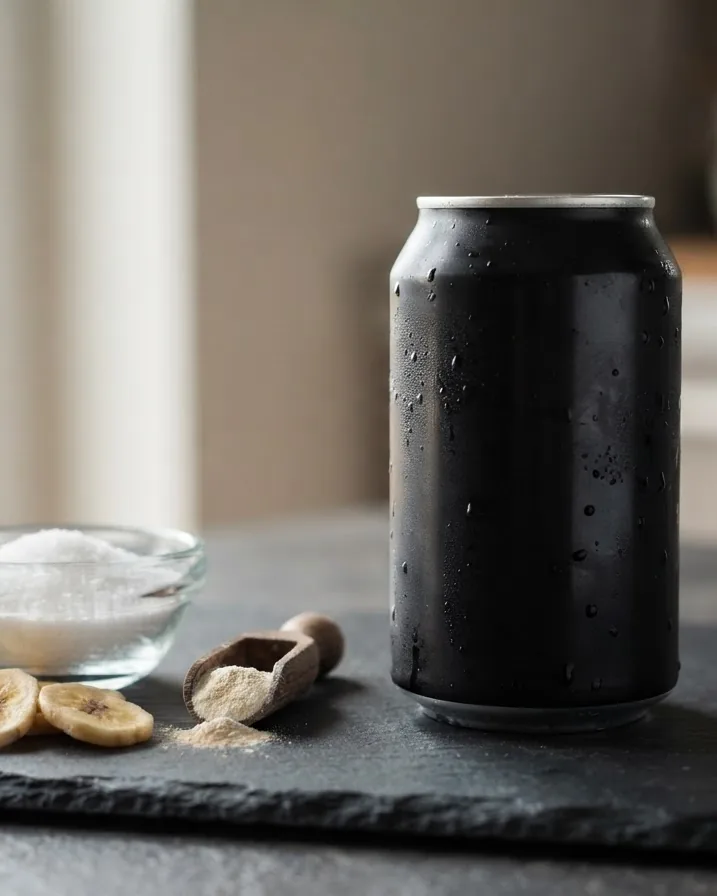
Coke Zero is not free of everything, and the two figures people miss are its minerals. A 12-fl-oz serving carries 40 mg of sodium, listed at 2 percent Daily Value, and 60 mg of potassium, also listed at 2 percent Daily Value, on the Coca-Cola Zero Sugar label. Those percentages are small on a single can, which is exactly why they matter for anyone tracking intake across a day: 2 percent is trivial once, and less trivial across three or four cans. The potassium and sodium arrive largely through the potassium citrate, potassium benzoate, and other listed compounds rather than from any nutritional dairy or produce source.
Put beside a food built around minerals and macronutrients, the contrast is stark. A hard aged cheese, for instance, packs meaningful sodium and protein into a small weight, which is why the numbers in our breakdown of what a tablespoon and an ounce of Parmesan actually deliver look nothing like a soda panel. Coke Zero’s minerals are incidental. They are there, they are measurable, and they belong on the label, but they do not make the drink a source of anything you would seek it out for.
If you are watching sodium for blood pressure reasons, the honest read is this: one can adds 40 mg, and that is small next to most meals. The figure earns attention only through repetition.
Aspartame, acesulfame potassium, and stevia: how it tastes sweet with zero sugar

Coke Zero gets its sweetness from three declared sweeteners working together rather than from sugar. The current U.S. ingredient list for Coca-Cola Zero Sugar includes aspartame, acesulfame potassium (often written as Ace-K), and stevia extract, alongside carbonated water, caramel color, phosphoric acid, natural flavors, potassium benzoate, potassium citrate, and caffeine. These sweeteners register as intensely sweet on the tongue at quantities far too small to contribute countable carbohydrate, which is how the total sugars line stays at 0 g while the drink still reads as cola.
Safety limits for these compounds are set by named bodies, and they use a metric called the acceptable daily intake, or ADI. The U.S. Food and Drug Administration lists an ADI for aspartame in its overview of aspartame and other sweeteners in food. Internationally, the Joint FAO/WHO Expert Committee on Food Additives, the scientific panel that advises the World Health Organization, sets a lower figure: an aspartame ADI of 0 to 40 mg per kilogram of body weight per day in its JECFA aspartame evaluation.
Why two numbers for one sweetener? Because two independent expert bodies ran their own reviews and landed on different safety margins. Neither figure describes the amount in a can. Both describe a ceiling, per kilogram of your body weight, that a regulator considers safe every day for a lifetime.
The PKU warning that has to be on the can
There is one group for whom aspartame is not a neutral ingredient. The FDA states that people with phenylketonuria, known as PKU, should avoid or restrict aspartame because it contains phenylalanine, an amino acid that people with this inherited condition cannot process normally. That is why cans and bottles sweetened with aspartame carry a phenylalanine statement. For everyone without PKU the warning is not directed at you. For the small population who has it, that line on the label is doing real medical work.
34 mg of caffeine in a 12 fl oz Coke Zero
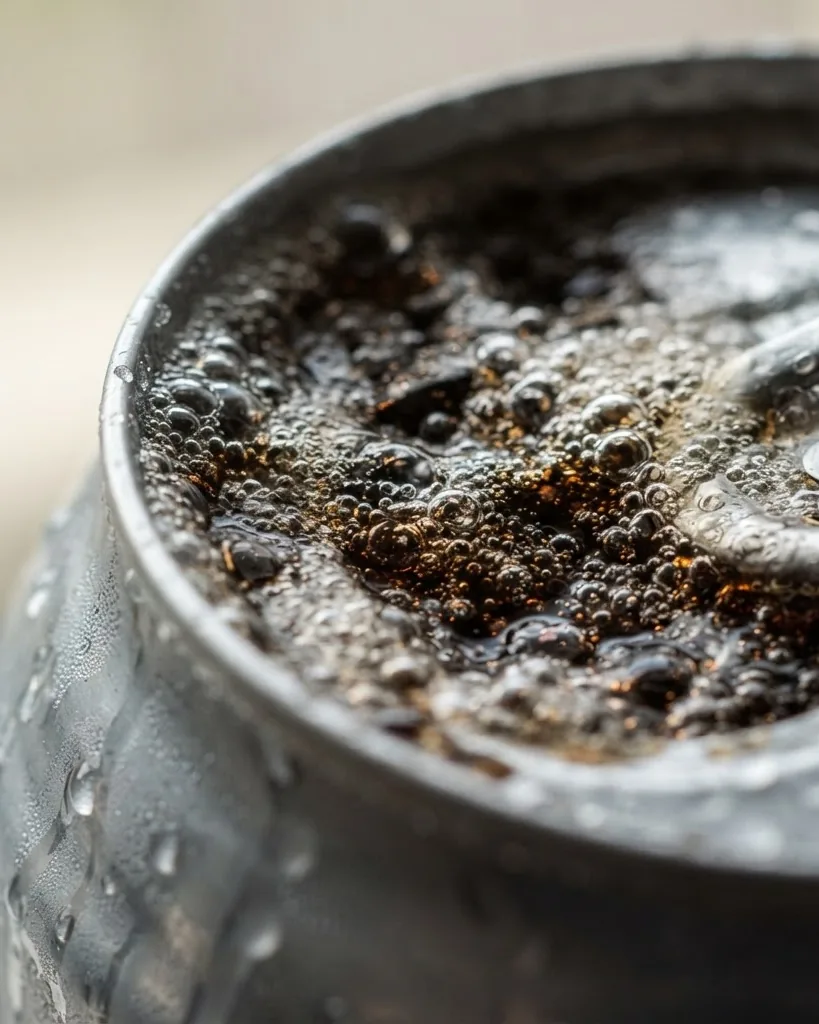
Coke Zero contains 34 mg of caffeine per 12-fl-oz serving, a figure the calorie count gives no clue about. That amount is modest against federal guidance. The U.S. Food and Drug Administration addresses daily caffeine intake in its consumer piece Spilling the Beans: How Much Caffeine is Too Much?. Even so, caffeine sensitivity is individual, and the zero-calorie profile does nothing to soften a stimulant if you are prone to jitters or you drink several cans late in the day.
For anyone who wants the cola flavor without the stimulant, a caffeine-free version of Coca-Cola Zero Sugar exists. That matters because caffeine is one nutrition line the calorie count can never warn you about, the way a black coffee’s stimulant load hides behind a low calorie number in our look at the 130-calorie truth behind common Starbucks drinks.
Sugar-free but still acidic: what Coke Zero does to teeth
Removing sugar removes one dental risk and leaves another intact. Sugar feeds the bacteria behind cavities, so a 0 g sugars drink sidesteps that specific pathway. But Coke Zero is still a carbonated soda built on phosphoric acid, and acid attacks enamel directly through a separate process called dental erosion. The American Dental Association draws exactly this line: in its guidance on dental erosion, the ADA identifies frequent consumption of soft drinks, particularly carbonated sodas, as a primary risk factor for erosive tooth wear. That risk does not depend on sugar being present.
The distinction is worth holding onto:
- Dental caries are cavities driven largely by sugar and the bacteria that ferment it. Coke Zero, at 0 g sugars, is low on this axis.
- Dental erosion is enamel loss from acid contact, and a sugar-free acidic soda still carries it.
You can read the ADA’s own framing in its topic on dental erosion and erosive tooth wear. Practical habits that reduce acid contact include not holding or swishing an acidic drink around your mouth, and rinsing with plain water afterward so the acid is not left sitting against your teeth. None of that turns a soda into a tooth-friendly drink; it just lowers how long the acid lingers.
Serving-size math: what a 20 oz bottle really adds up to
The panel describes 12 fl oz, and packages larger than that multiply every line. This is the trap in reading any Nutrition Facts label: the FDA is explicit that the nutrient amounts refer to the stated serving size, not to whatever container you happen to be holding. A 12-oz can of Coke Zero and a 20-oz bottle both read “0 calories” in the sense that matters, because zero times any number is still zero. The numbers that actually scale are the ones that are not zero: caffeine, sodium, and potassium.
Because Coke Zero’s calorie, sugar, and carbohydrate lines are all 0, the only figures that move when you drink more are the minerals and the caffeine. Here is how the non-zero lines track if you scale the stated 12-fl-oz serving. A 20-fl-oz volume is about 1.67 times a 12-fl-oz serving (20 divided by 12).
| Volume | Calories | Sodium | Caffeine |
|---|---|---|---|
| 12 fl oz (label serving) | 0 | 40 mg | 34 mg |
| Two 12 fl oz cans | 0 | 80 mg | 68 mg |
| Three 12 fl oz cans | 0 | 120 mg | 102 mg |
The two-can and three-can figures are simple multiples of the label serving: 40 mg sodium becomes 80 and 120 mg, and 34 mg caffeine becomes 68 and 102 mg. At three cans, the sodium and caffeine are now amounts worth noticing rather than rounding away. Portion honesty is the same discipline that changes the picture for any snack, which is why the numbers shift so much across sizes in our breakdown of the Slim Jim label across three sizes.
Coke Zero vs. Coca-Cola Original and Diet Coke
The clearest way to place Coke Zero is beside its two closest siblings. Against Coca-Cola Original Taste, the split is the whole product story: Coke Zero holds the cola flavor at 0 calories and 0 g sugars, while regular Coca-Cola carries meaningful calories and sugar from actual sugar. Against Diet Coke, the numbers converge because both are sugar-free and calorie-free; what differs is the flavor target. Coca-Cola positions Zero Sugar to taste closer to Coca-Cola Original Taste, while Diet Coke carries its own distinct, lighter profile.
What separates Coke Zero from Diet Coke is therefore the ingredient list and the flavor it produces, not the calorie or sugar lines. Both land at zero on those. The takeaway for a label reader:
- Coke Zero vs. Coca-Cola Original: the difference is calories, sugar, and carbohydrate. Coke Zero zeros all three; the original does not.
- Coke Zero vs. Diet Coke: both are 0 calories and 0 g sugar. The difference is intended taste and the specific sweetener blend, not the macros.
- Caffeine: Coke Zero lists 34 mg per 12 fl oz; a caffeine-free Coca-Cola Zero Sugar exists for anyone who wants the flavor without it.
Because product names hint at differences that only the label confirms, the safe move is to read the ingredient declaration on the exact can in your hand rather than assume two “diet” colas are identical inside.
One caveat before you trust any of these numbers
Formulations change, and a label is only current until the company revises it. Everything here describes the U.S. Coca-Cola Zero Sugar 12-fl-oz serving as The Coca-Cola Company presents it. If the can in your hand differs, the can wins. Check the panel on the package you actually bought, especially the sodium, potassium, and caffeine lines and the ingredient declaration, since those are the parts most likely to move between reformulations or between markets.
The Multi-Can Math: What 3 or 4 Coke Zeros Actually Add Up To
The label’s 2 percent Daily Value tags for sodium and potassium look negligible on a single 12-fl-oz can, but the article itself notes that the figure matters more ‘across three or four cans.’ Running that exact multiplication against the numbers already on the panel turns the vague warning into concrete totals.
- Per can, Coke Zero carries 40 mg of sodium and 60 mg of potassium, a ratio of roughly 2:3 between the two minerals.
- Three cans in a day bring that to 120 mg of sodium (6% DV) and 180 mg of potassium (6% DV) — each mineral triples right alongside the can count.
- Four cans push the totals to 160 mg of sodium (8% DV) and 240 mg of potassium (8% DV), four times the single-serving figures.
- Caffeine scales the same way even though it carries no Daily Value on the label: three cans deliver 102 mg of caffeine, and four cans deliver 136 mg, both calculated directly from the stated 34 mg per 12 fl oz.
None of these numbers appear on any single can’s panel, but they are exactly what a reader drinking more than one Coke Zero a day is actually consuming, built entirely from the figures the label already discloses.
Frequently asked questions
Does Coke Zero really have zero calories?
Yes. A 12-fl-oz serving of Coca-Cola Zero Sugar lists 0 calories, 0 g total carbohydrate, 0 g total sugars, and 0 g added sugars on the current U.S. label. The sweet taste comes from aspartame, acesulfame potassium, and stevia extract, which register as sweet at amounts far too small to add countable calories or carbohydrate to the serving.
How much caffeine is in a can of Coke Zero?
A 12-fl-oz serving of Coke Zero contains 34 mg of caffeine, per the Coca-Cola Zero Sugar label. A caffeine-free version of Coca-Cola Zero Sugar is also available for people who prefer to skip the stimulant.
Is Coke Zero bad for your teeth if it has no sugar?
Removing sugar lowers cavity risk but not erosion risk. Coke Zero is still an acidic carbonated soda made with phosphoric acid. The American Dental Association identifies frequent soft-drink consumption, particularly carbonated sodas, as a primary risk factor for erosive tooth wear. Rinsing with water afterward and not swishing the drink around your mouth reduces how long acid contacts enamel.
Why does Coke Zero have a phenylalanine warning?
Because it is sweetened with aspartame, which contains phenylalanine. The FDA states that people with phenylketonuria, or PKU, should avoid or restrict aspartame for that reason. PKU is an inherited condition in which the body cannot process phenylalanine normally, so the warning is a required safety notice aimed specifically at that group, not at the general population.
How much sodium and potassium are in Coke Zero?
A 12-fl-oz serving lists 40 mg of sodium at 2 percent Daily Value and 60 mg of potassium at 2 percent Daily Value on the Coca-Cola Zero Sugar label. Both are small on a single can. They become worth tracking mainly if you drink several cans a day, since each additional 12-fl-oz serving adds another 40 mg of sodium.
What is the difference between Coke Zero and Diet Coke nutritionally?
Very little on the panel itself. Both are sugar-free and calorie-free, so their calories, sugars, and carbohydrate all read zero. The real differences are the flavor target and the specific ingredient blend. Coca-Cola positions Zero Sugar to taste closer to Coca-Cola Original Taste, while Diet Coke has its own distinct, lighter taste. Always confirm on the current label.
This piece is a nutrition reference, not medical advice. If you have a condition such as PKU, diabetes, or a caffeine sensitivity, use the exact label figures alongside guidance from a clinician who knows your situation.