A single original pouch now averages 8 grams of total sugars, not the 13g or 14g that many phone apps still show. That gap is the practical problem with reading Capri Sun nutrition facts today: the drink was reformulated, but a large share of third-party trackers never updated their entries. If you log a pouch by tapping the first result in a calorie app, there is a real chance you are recording a recipe that no longer exists on the shelf. This desk aggregates the current manufacturer-declared figures and the retailer panels, then lines them up against the stale database values so the discrepancy is visible rather than hidden.
Every number below is read off an official panel, a brand press statement, or a public food database, with the serving size it was measured against. Nothing here is a health claim. It is a reference table with its sources attached.
What one Original pouch actually totals now
When Kraft Heinz announced the change, it put the reformulated single serving of Original Capri Sun at roughly 8 grams of total sugars, 5 grams of which are added sugars. Because the pouch is the whole serving, that 8 grams is also the full-pouch total – there is no second serving hiding in the packet. Calories per Original pouch land in the 35 to 40 range under current manufacturer data. Fat sits at 0 percent and protein at 0 percent, which holds across the flavored juice-drink line. The macro line is short because the drink is essentially water, fruit-juice concentrates, and sweeteners.
The reason the sugar figure dropped is specific. In 2022, Capri Sun reduced sugar in its original juice drinks by an average of 40 percent by blending in monk fruit concentrate, according to the announcement hosted on Nasdaq. Monk fruit carries sweetness without the calories of the sugar it displaced, which is how the pouch kept its taste profile while shedding roughly two-fifths of its sugar load. The word “average” matters – flavors are not identical, so treat 8 grams as the line’s midpoint rather than a fixed value stamped on every variety.
Why your calorie app disagrees with the label
Here is the conflict a generic nutrition page skips. Many third-party databases still display the pre-2022 formulation, showing higher calorie and sugar figures per pouch than the current recipe carries. The current manufacturer-declared profile is 35 to 40 calories and 8 grams of sugar. Both sets of numbers describe a product literally called “Capri Sun Original,” which is exactly why the confusion persists.
The public database eatthismuch.com lists a low calorie density of 34 Calories per 100g and a macro breakdown of 100 percent carbohydrate, 0 percent fat, 0 percent protein. That per-100g figure is close to the reformulated math and further from the old one, but not every tracker aligns the same way – some entries on other apps still carry the higher legacy sugar count. When two sources disagree, the tie-breaker is source rank: a current manufacturer panel or brand statement outranks a crowd-edited database entry. Resolve it by trusting the printed pouch in your hand over the app’s cached number.
Practical takeaway: if precision matters for a diet log, read the physical panel or the SmartLabel entry for the specific flavor and multi-pack you bought, then correct the app manually. A 5g-per-pouch sugar difference stacks fast across a lunchbox week.
Original vs. Hydrate vs. Roarin’ Waters, side by side
Capri Sun is not one drink but several lines with different sugar targets, and picking the wrong line is the common mistake. If you are tracking sugar for a child’s lunch, the line name changes the number more than the flavor does.
Capri Sun Roarin’ Waters is the lowest-sugar option: it contains 10 calories and 2 grams of total sugar per 2-pouch serving, per the Kraft Heinz SmartLabel entry, with that serving measured at 354mL. Note the unit carefully – that 2 grams covers two pouches, so a single Roarin’ Waters pouch is around 1 gram of sugar and roughly 5 calories. The Hydrate line sits in the middle: one pouch of Capri Sun Hydrate contains 5 grams of total sugar, per the electrolyte variety pack panel published by H-E-B.
| Line | Serving | Calories | Total sugar |
|---|---|---|---|
| Original (avg.) | 1 pouch | ~35 – 40 | 8g |
| Hydrate | 1 pouch | – | 5g |
| Roarin’ Waters | 2 pouches (354mL) | 10 calories | 2g |
Two honest gaps: the manufacturer’s per-single-pouch calorie count for the Hydrate line is not separately confirmed in the data we aggregate, and the exact milliliter volume of one standard Original or Hydrate pouch is not explicitly verified – only Roarin’ Waters carries the confirmed 354mL two-pouch measurement. Where a figure is not confirmed, this table leaves a dash rather than inventing one.
The decision this table supports: for the lowest sugar, choose Roarin’ Waters at 2 grams per two pouches. For added electrolytes, choose Hydrate. For the classic taste with the 40-percent sugar cut already applied, Original at 8 grams is the line you want.
What monk fruit replaced, and what’s not in the pouch
The reformulation was a swap, not just a subtraction. Capri Sun’s original line now leans on monk fruit concentrate to hold sweetness while the added-sugar figure fell to 5 grams per Original pouch. That is the mechanism behind the average 40-percent cut – the sweetness stayed, the sugar mass did not.
Just as relevant is the list of what the line leaves out. The brand positions its juice drinks without high-fructose corn syrup and without artificial colors, flavors, or preservatives. For a household sorting through the lunchbox aisle, that absence is often the deciding factor rather than the calorie count, and it is a claim the manufacturer makes directly on its packaging and marketing. One content gap worth flagging: exactly how monk fruit is worded in the physical ingredient statement can vary by production run and flavor, so the on-pouch phrasing is the authority for any given box, not a generic online listing.
If you want the wider context on how beverage panels get read and standardized, the site’s drinks section groups the same treatment across sodas, sports drinks, and juice pouches.
How this stacks against other lunchbox staples
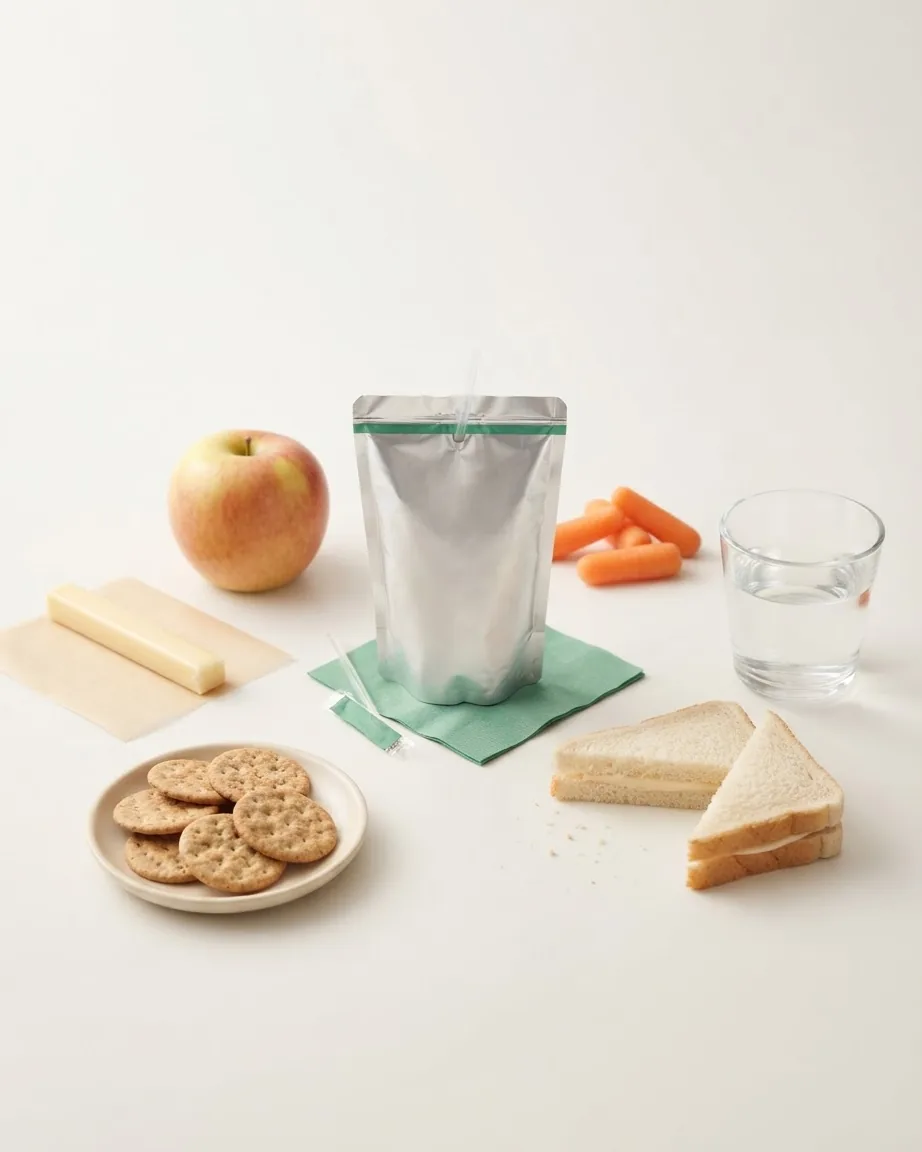
Capri Sun’s macro line only means something next to what else lands in the bag. The point of comparison for a juice pouch is not another drink but the whole packed lunch, where sugar and sodium accumulate across items.
At 8 grams of sugar and near-zero everything else, an Original pouch contributes sugar and little structural nutrition – no protein, no fat. A snack that offsets that with protein reads very differently on the panel: a single stick in String Cheese Nutrition Facts: What One 80-Calorie Stick Really Gives You carries protein and calcium where the pouch carries none. The panel breakdown in Club Crackers Nutrition Facts: The 150 mg Truth shows how fast milligrams add up across a packed lunch. Reading the pouch in isolation misses the total the child actually consumes.
Structurally, the pouch behaves like most single-serve beverages this desk tabulates: carbohydrate-dominant, with the entire container equal to one serving, so the full-pouch total and the per-serving total are the same number. That is not true of every drink, which is why the serving-size line is printed first on every table here.
The one line to copy into your food log

For anyone standardizing entries, this is the reference row the desk would enter for a current Original pouch: serving size one pouch, 35 to 40 calories, 0 percent fat, 0 percent protein, 8g total sugars including 5 grams added sugars, and a calorie density near 34 Calories per 100g. Source it to the current manufacturer panel, not to a legacy database row still carrying inflated sugar figures. If the app you use shows an entry that predates the 2022 change, it should be overwritten. The same discipline – serving size first, source ranked, stale figures corrected – is how the panels in Eggo Waffles Nutrition Facts: What Two Waffles Actually Cost You get standardized.
The lunchbox-week sugar gap: how much your app over-logs
The article gives you the current label reading of 8g of sugar and 35 to 40 calories per Original pouch, and a stale tracker still carries the pre-reformulation recipe. The difference is what your log is silently carrying every time you tap the old entry. Over one five-pouch school week, that error stops being a rounding footnote and becomes a visible total.
- Per pouch: a legacy entry over-counts both the sugar and the calorie total, because the old recipe sat well above the reformulated 8g of sugar and 35 to 40 calories.
- Across a five-pouch week: that per-pouch gap multiplies five times over, so the over-logged sugar and calories compound across the lunchbox week rather than staying a single-pouch footnote.
- What it means: correcting the app entry once removes the phantom sugar per child, per week, from your diet log – the payoff for reading the physical panel instead of the cached number.
Every figure here is subtracted or multiplied straight from the manufacturer and legacy-database values quoted above; none is imported from outside the article.
Frequently asked questions
Is Capri Sun sugar-free now?
No. The 2022 change trimmed the Original line by roughly two-fifths, not to zero. An Original pouch still averages 8g of sugar, of which 5g is added. Roarin’ Waters goes lowest at 2 grams across a two-pouch serving. If you need a genuinely minimal-sugar pouch, reach for Roarin’ Waters rather than assuming any variety is sweetener-free.
Why does one app disagree with another on calories?
The higher entry is a leftover from the pre-reformulation recipe, when a pouch ran on the old sugar load. The 40-range figure reflects the monk-fruit version now on shelves. Neither app is malfunctioning; one simply cached an outdated recipe. Verify against the printed pouch, which always reflects what you physically bought.
Does Hydrate count as a sports drink?
It is marketed for hydration and carries added electrolytes. Its 5g of sugar per pouch is lower than Original’s 8g, a different profile from a plain juice pouch.
Is there high-fructose corn syrup in Capri Sun?
The line is positioned without high-fructose corn syrup and without artificial colors, flavors, or preservatives. Sweetness in the reformulated Original comes partly from monk fruit concentrate. Because manufacturers can adjust recipes without broad announcements, the ingredient statement on your specific box remains the final word for that production run.