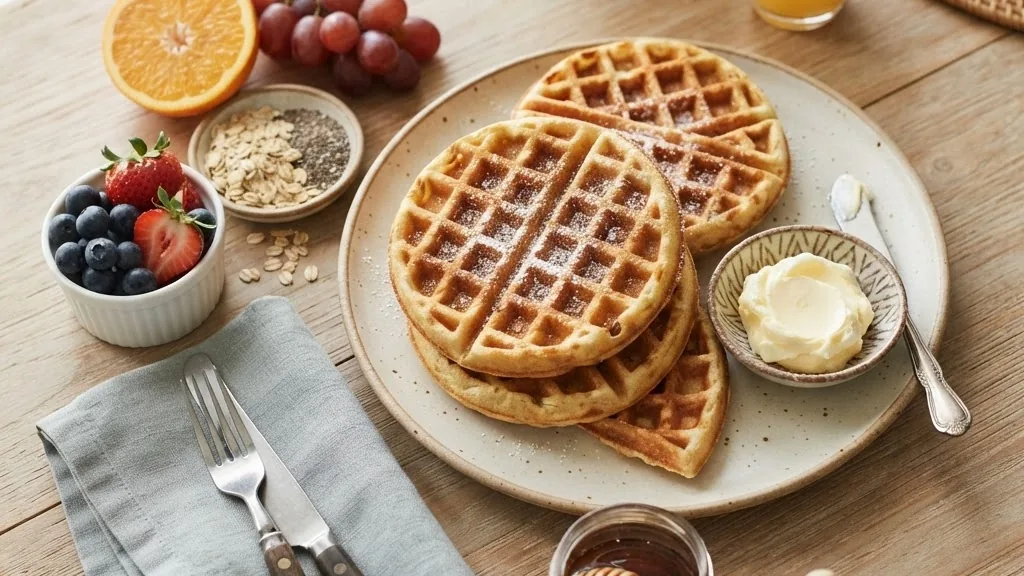
The Eggo waffles nutrition facts live on the side of the yellow box, and for Homestyle the headline is two waffles for 180 calories. That is the number a shopper reads, and it is more trustworthy than any calculator, because it comes straight off the Kellogg’s carton panel. Frozen waffles get a bad reputation they only half deserve. Some of it is fair. Some of it is what you pour on top. This breakdown walks the whole panel, one line at a time, and puts every number next to the daily value the FDA prints for context.
By Tastybend Nutrition Desk. Last reviewed July 7, 2026.
The quick answer: A serving of Eggo Homestyle waffles is 2 waffles (70 g) and delivers 180 calories, 4.5 g total fat, 1 g saturated fat, 5 mg cholesterol, 230 mg sodium, 31 g carbohydrate, 1 g fiber, 5 g total sugars, and 4 g protein. Iron is fortified to about 25 percent of the daily value. On its own that is a moderate breakfast starch. The math changes the moment syrup shows up.
Eggo Homestyle nutrition facts table
Here is the full brand label for one serving, with the percent daily value (%DV) shown the way the FDA lays it out on the Nutrition Facts panel. This table is built from the Kellogg’s SmartLabel entry for Homestyle, with the macros cross-checked against USDA FoodData Central.
| Nutrient | Per 2 waffles (70 g) | %DV |
|---|---|---|
| Calories | 180 | – |
| Total fat | 4.5 g | 6% |
| Saturated fat | 1 g | 5% |
| Trans fat | 0 g | – |
| Cholesterol | 5 mg | 2% |
| Sodium | 230 mg | 10% |
| Total carbohydrate | 31 g | 11% |
| Dietary fiber | 1 g | 4% |
| Total sugars | 5 g | – |
| Added sugars | about 4 g | 8% |
| Protein | 4 g | – |
| Iron | about 4.5 mg | 25% |
One waffle is exactly half of that: roughly 90 calories, 15.5 g carbs, and 115 mg sodium. It is worth mentioning because plenty of people toast only one, and halving the panel in your head is the fastest label skill you can build. If you like seeing a sweet breakfast broken down the same way, the walk-through of Cinnamon Toast Crunch nutrition facts uses the identical method, and the sugar contrast between the two is worth a look.

The box, line by line
Carbohydrate is the engine here. At 31 g per serving, roughly 69 percent of the calories in Eggo Homestyle come from carbs, which makes sense for something built on enriched wheat flour. Fat sits at 4.5 g, mostly from vegetable oil, with only 1 g saturated and no trans fat on the current panel. Protein lands at 4 g, which is modest but real, and it climbs fast when you pair the waffles with the right topping rather than syrup.
The line that tends to surprise people is iron. Because Eggo uses enriched flour, two waffles carry about 25 percent of the daily value for iron, plus a chunk of the B vitamins that go into enrichment: riboflavin, niacin, thiamin, and folic acid. That is fortification, not whole-food nutrition, and it should never be sold as a health halo. But if you have ever wondered why a plain frozen waffle shows meaningful iron on the panel, that is the reason. USDA FoodData Central lists the same enrichment pattern across the Eggo line.
Fiber is the weak spot, and it is worth naming plainly. One gram per serving is very little, and it is the direct result of building the waffle on refined enriched flour rather than whole grain. Compared on paper, the two Eggo lines differ most on fiber, which is why the versus table further down matters more than the calorie count. If you are tracking macros, log two waffles as roughly 30 g of net carbs, since fiber barely moves the number.
A quick word on how to read the fat line. At 4.5 g total with only 1 g saturated, the fat profile here is unremarkable in a good way. There is no trans fat on the current panel, and cholesterol is a token 5 mg because there is only a small amount of real egg in the recipe despite the brand name. If you are watching saturated fat specifically, the waffle is not your problem; butter and whipped cream on top are where that number climbs.
Serving size reality
The panel is honest about the serving: 2 waffles, 70 g. The trouble is that almost nobody stops at two. A standard box holds ten waffles, and a hungry teenager plows through four without blinking. A “normal” plate of three waffles comes to 270 calories and 46.5 g of carbohydrate before a single drop of anything sweet.
So the first correction when someone asks about Eggo waffles nutrition facts is to multiply by their real serving, not the printed one. Two is the reference. Count what you actually toast. The habit that keeps the numbers honest is toasting a fixed count and plating it before sitting down, rather than grazing straight from the toaster. It sounds small. It is the difference between a 180-calorie breakfast and a 360-calorie one you never decided to eat.
- 1 waffle: about 90 calories, 15.5 g carbs, 115 mg sodium
- 2 waffles (label serving): 180 calories, 31 g carbs, 230 mg sodium
- 3 waffles: about 270 calories, 46.5 g carbs, 345 mg sodium
- 4 waffles: about 360 calories, 62 g carbs, 460 mg sodium
Sodium and sugar in context
Sodium is the quiet number on this label. At 230 mg per serving, two waffles use 10 percent of the FDA daily value of 2,300 mg. That is not alarming, but frozen breakfast foods add up quietly across a week, and the FDA flags sodium as one of the nutrients most Americans overshoot. Eat four waffles and you are at 460 mg, roughly a fifth of the day, from breakfast starch alone.
Sugar is more reassuring than the internet assumes. Homestyle carries 5 g total sugars, of which about 4 g is added. For reference, the FDA sets the added-sugar daily value at 50 g, so the waffles themselves spend about 8 percent of it. The sugar problem with waffles almost never comes from the waffle. It comes from the bottle next to it, which is the next section. nutrition.gov makes the same point about breakfast foods: the base item is usually reasonable, and the toppings are where a meal tips over.
The syrup problem, audited
This is the part that matters most, because it is where the real calories hide. The numbers are hard to forget. A quarter cup of pure maple syrup, which is the pour many people actually use, runs about 210 calories and 52 g of sugar according to USDA data. That single pour carries more calories and more than ten times the sugar of the two waffles under it.
Even a restrained 2 tablespoons of syrup adds roughly 105 calories and 26 g of sugar. Pancake syrup made with corn syrup lands in the same range. So the honest version of the story is this: two Eggo waffles are a 180-calorie, 5-g-sugar food, and a generous syrup pour can turn the plate into a 390-calorie, 57-g-sugar dessert. When waffles get blamed for wrecked morning macros, the waffles are rarely the culprit.
Butter is the second hidden line. One tablespoon adds about 100 calories and 7 g of saturated fat, which is more saturated fat than the two waffles carry on their own. Nobody has to eat dry waffles. The point is that the toppings are where the meal gets decided, and it helps to know the rough cost of each pour before you reach for it. Once you have those numbers in your head, you can spend them where you want to.
- Measure syrup with a spoon, not the bottle. Two tablespoons is a real serving.
- Swap half the syrup for fresh fruit to cut added sugar without losing sweetness.
- If you want the flavor with fewer grams, a light dusting of cinnamon does a surprising amount of work.
Homestyle versus Nutri-Grain whole wheat
Eggo sells a whole-grain option, and the comparison is the clearest way to see what “whole grain” buys you. The two brand panels sit side by side, both at the 2-waffle serving, so you can read the trade directly.
| Per 2 waffles (70 g) | Homestyle | Nutri-Grain whole wheat |
|---|---|---|
| Calories | 180 | 170 |
| Total fat | 4.5 g | 6 g |
| Total carbohydrate | 31 g | 27 g |
| Dietary fiber | 1 g | 3 g |
| Total sugars | 5 g | 3 g |
| Protein | 4 g | 4 g |
The story in that table is fiber. The whole-wheat version triples the fiber, from 1 g to 3 g, while trimming 2 g of sugar and 10 calories. Protein is a tie at 4 g. The fiber gap is the one that actually changes how full you feel an hour later, which matters more than the ten-calorie difference. If your only goal is fewer added sugars and steadier energy, the Nutri-Grain line is the better default, and it toasts nearly the same.
How Eggo fits keto, low-calorie, and high-protein goals
Here is the blunt version for the diets people ask about. For keto, Eggo Homestyle does not fit. At 31 g of carbohydrate and only 1 g of fiber, two waffles carry about 30 g of net carbs, which is a full day of carbs for many keto plans. No frozen wheat waffle survives that math.
For general calorie control, they work fine as a portion-defined starch. Two waffles at 180 calories is a predictable number, which is exactly what you want when you are counting. The risk is not the waffle; it is the uncounted syrup and butter. For a higher-protein breakfast, the waffle is a base, not the main event. Eggo works like toast: the interesting nutrition comes from what goes on it. Adding an egg and a glass of milk moves the whole plate toward 20 g of protein. If you want the exact numbers on that dairy pour, the breakdown of whole milk nutrition facts covers the protein and fat you would be adding.
Ingredients and allergens
The ingredient list is short by frozen-food standards: enriched wheat flour, water, vegetable oil, eggs, leavening, sugar, salt, and the added vitamins and minerals that create the enrichment numbers on the panel. There is nothing exotic in there, and there is no fiber additive propping up that 1 g figure, which is why it stays low.
On allergens, Eggo waffles contain wheat, soy, milk, and egg. That covers four of the major allergens the FDA requires to be declared, so anyone avoiding those should skip the product outright rather than trying to read around it. Treat the allergen line as a hard stop, not a suggestion, because cross-contact statements do not always tell the whole story. When in doubt, the FDA and nutrition.gov both host plain-language allergen guidance that is worth a bookmark.
How to read the Eggo label yourself
This gets easy once you know the order. The FDA standardizes the panel so every box reads the same way, and here is the sequence to run through in the store.
- Find the serving size first. On Eggo it is 2 waffles (70 g). Every number below it is tied to that amount.
- Check servings per container so you know how far the box stretches.
- Read calories, then scan the %DV column. The FDA rule of thumb is that 5 percent DV is low and 20 percent DV is high for a nutrient.
- Look at sodium and added sugars specifically, the two lines most Americans overspend on.
- Scan the ingredient list for enrichment and allergens. Eggo lists wheat, soy, milk, and egg.
Run that five-step pass and you can decode any waffle box in about fifteen seconds. It is a simple routine for anyone who wants to stop trusting front-of-box marketing and start trusting the panel.
Healthier ways to build the plate
A frozen waffle is no nutrition powerhouse. It is a convenient starch, and you can make the plate around it a lot stronger without much effort. These swaps work on busy mornings.
- Choose the whole-grain or Nutri-Grain version for 3 g of fiber instead of 1 g.
- Top with plain Greek yogurt and berries instead of syrup to add protein and cut added sugar.
- Add a scrambled egg on the side for about 6 g of protein and staying power.
- Use nut butter for fat and protein, but weigh it, since 2 tablespoons is roughly 190 calories.
- Keep syrup to a measured 1 to 2 tablespoons, or skip it and lean on cinnamon and fruit.
Sources and further reading
The nutrition figures and label rules above draw on the following authorities. Each link points to the organization’s current homepage so it stays valid over time.
- USDA FoodData Central, the reference database for food nutrient values.
- FDA, which sets the Nutrition Facts label format and %DV rules.
- nutrition.gov, USDA consumer guidance on reading labels and building meals.
Frequently asked questions
How many calories are in 2 Eggo waffles?
Two Eggo Homestyle waffles (70 g, the label serving) have 180 calories. That is before any topping. A single waffle is about 90 calories.
How much sugar is in Eggo Homestyle waffles?
Two waffles have 5 g of total sugars, of which about 4 g is added sugar, or roughly 8 percent of the FDA added-sugar daily value of 50 g. Most of the sugar on a waffle plate comes from syrup, not the waffle.
Are Eggo waffles keto friendly?
No. At 31 g of carbohydrate and only 1 g of fiber per serving, two waffles carry about 30 g of net carbs, which is too high for a standard keto day.
How much sodium is in Eggo waffles?
A serving of two waffles has 230 mg of sodium, which is 10 percent of the FDA daily value of 2,300 mg. Larger servings scale up quickly, so four waffles reach 460 mg.
Are Eggo Homestyle or whole wheat waffles healthier?
The Nutri-Grain whole-wheat version edges it out for most goals: 3 g of fiber versus 1 g, 3 g of sugar versus 5 g, and 10 fewer calories, with the same 4 g of protein.
Do Eggo waffles have any real nutrients?
Yes, from fortification. Because they use enriched flour, two waffles supply about 25 percent of the daily value for iron plus added B vitamins. That is added nutrition, not whole-food nutrition, but it does count on the panel.
The bottom line on the plate
Eggo Homestyle waffles are a 180-calorie, 31-carb, 4-gram-protein starch, and read that way they are a perfectly reasonable weekday breakfast. The number that decides whether the meal stays reasonable is not on the waffle box at all; it is on the syrup bottle. Toast two, measure what goes on top, pick the whole-grain version when you can, and build a little protein into the plate. Do that and the panel works for you instead of against you. If you want to verify any figure here yourself, the Kellogg’s label, USDA FoodData Central, the FDA Nutrition Facts guidance, and nutrition.gov all point the same direction.