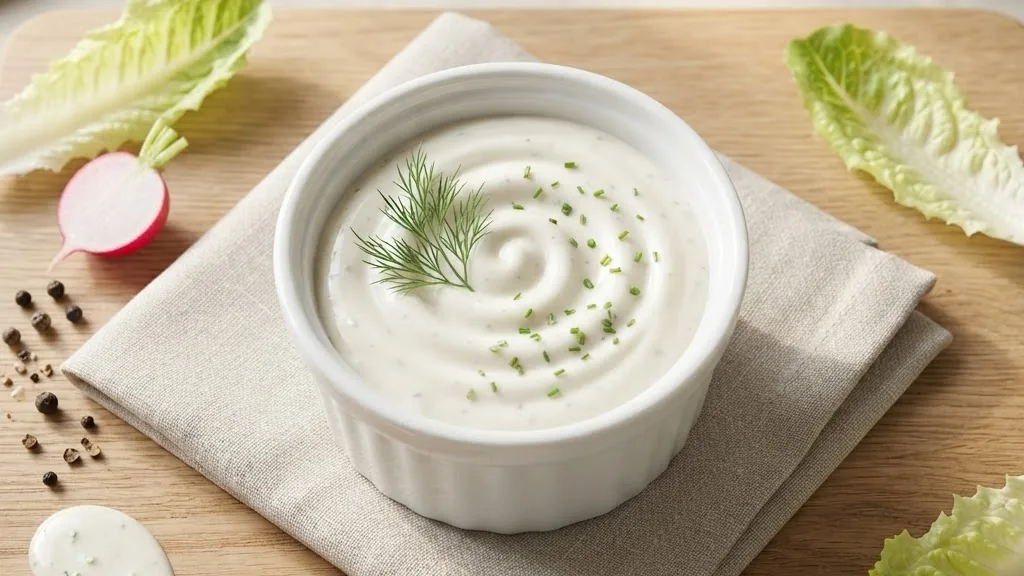
Ranch dressing nutrition facts start with a number most people underestimate: a standard two-tablespoon serving of commercial ranch, such as Hidden Valley, carries roughly 130 calories, 14 grams of total fat, and 260 milligrams of sodium. That is a lot of energy packed into two spoonfuls, and the reason is chemical rather than accidental. Ranch is an emulsion of oil and water held together by egg and dairy, and oil is the densest food energy there is. Understand that one fact and the whole label suddenly reads differently.
The confusing part is that ranch tastes light. It pours thin, it clings to lettuce, and the tang from buttermilk reads as fresh rather than fatty. But the mouthfeel is a decoy. Below we walk through the full panel, why the fat sits so high, how sodium behaves in the fat-free versions, and where the honest lighter options actually land.
Quick answer: Standard ranch dressing nutrition facts for a two-tablespoon (30 gram) serving come to about 130 calories, 14 grams of fat, and 260 milligrams of sodium, according to nutrition data compiled by Health Digest. Fat-free versions drop to roughly 25 calories and 0 grams of fat but can push sodium up to 300 milligrams. A homemade Greek yogurt version from USDA MyPlate lands at just 19.4 calories and 0.6 grams of fat. The macros are driven almost entirely by the oil and mayonnaise base.
Why 14 grams of fat hides in two tablespoons of ranch
The fat in ranch is not a flaw, it is the recipe. Classic ranch is built on a base of soybean oil and mayonnaise, and mayonnaise is itself an oil-and-egg emulsion. When a two-tablespoon serving delivers 14 grams of total fat inside 130 calories, that means fat supplies about 126 of those calories, since each gram of fat carries nine. The buttermilk you taste as tang is a minor player by weight. It brings the sour, cultured flavor and a little body, but it contributes almost nothing to the energy total. The oil does the heavy lifting.
This is why “light” ranch always changes the texture. Pull the oil out and the emulsion loses its cling. Manufacturers then rebuild body with gums, starches, and water, which is a different product wearing the same name.
- Soybean oil and mayonnaise: the calorie and fat engine, responsible for nearly all 130 calories.
- Buttermilk: the flavor, not the fat. It delivers tang and a thin creaminess.
- Herbs and alliums: dill, parsley, garlic, and onion for aroma, with negligible macros.
If you want the deeper macro breakdown of a specific bottle, our companion piece on the nutrition facts for ranch walks the panel line by line. For the fundamentals of how dietary fat is counted on any label, the USDA Agricultural Research Service maintains the Food and Nutrient Database for Dietary Studies, the same baseline that federal programs lean on.
The sodium trap: why fat-free ranch can be saltier
Here is the counterintuitive part of ranch dressing nutrition facts. When you remove fat, flavor collapses, and salt is the cheapest way to bring it back. Standard ranch runs about 260 milligrams of sodium per two-tablespoon serving, per Health Digest. Fat-free commercial versions, which drop to roughly 25 calories and 0 grams of fat, can climb as high as 300 milligrams of sodium in that same serving to compensate for the flavor the oil used to carry. So the “healthier” bottle can hand you more salt, not less.
That 40-milligram jump matters most if you eat ranch by the ladle. On chips, on wings, on pizza crust, the servings stack fast, and sodium is the number that quietly compounds.
The federal picture on sodium is shifting too. The USDA reduced documented sodium values by 10 percent for the ingredient codes covering ranch dressing, a move made to align school meal patterns with the updated 2020-2025 Dietary Guidelines for Americans. That change lives in the technical documentation, not on your bottle, but it signals where public health thinking is headed.
- Standard ranch: about 260 mg sodium per 2 tablespoons.
- Fat-free ranch: up to 300 mg sodium per 2 tablespoons.
- Homemade control: you set the salt yourself, which is the only true low-sodium lever.
Reading the % Daily Value line without getting fooled
The percent Daily Value column is the most useful number on a ranch label and the most ignored. Reading it well means paying close attention to where the sodium and saturated fat lines land, since those are the nutrients that climb fastest in a dressing built on oil. A dressing high in sodium in a single serving is worth watching closely, especially since most people use more than the listed serving.
The catch is serving size. Labels report per two tablespoons, but a restaurant pour or a generous home drizzle is often double or triple that. Multiply the DV by how much you actually use before you judge the number.
The full framework, including which nutrients you want to keep low versus high, lives on the FDA’s own guide to the lows and highs of percent Daily Value. It takes ten minutes to read and permanently changes how you shop the condiment aisle.
One more literacy tip: DV percentages are built on a 2,000-calorie reference day. If you eat well above or below that, treat the percentages as a rough guide rather than gospel.
Is ranch keto, and does gluten hide in the bottle?
Ranch is one of the few dressings that plays well with a low-carbohydrate plan, and the reason is structural. Because the calories come from fat rather than sugar or starch, standard ranch usually carries only a gram or two of carbohydrate per serving, which is why Hidden Valley markets certain lines as keto-friendly on its digital label. For anyone counting carbs, that makes ranch a rare condiment that fits the macros instead of blowing them. If you are building meals around this approach, our practical keto diet home cook’s guide shows how a fat-forward dressing slots into a day of eating.
Gluten is a different question. Ranch is naturally gluten-free in its classic form, since oil, egg, buttermilk, and herbs contain no wheat. The risk is additives. Some thickeners, flavor blends, or maltodextrin sourced from wheat can introduce trace gluten, so celiac shoppers should look for an explicit gluten-free certification rather than assume.
- Keto fit: usually yes, because carbs are minimal and fat is high.
- Gluten: naturally free, but verify the certification for hidden thickeners.
- Vegan: standard ranch is not vegan; the egg, buttermilk, and dairy solids rule it out. Plant-based versions rebuild the base from cashew, soy, or aquafaba.
Vegan ranch deserves its own note. To be truly plant-based, it has to replace three animal inputs at once, the egg in the mayonnaise, the buttermilk tang, and any milk solids, which is why texture varies so much between brands.
Full-fat vs reduced-fat vs fat-free: the honest comparison
The three shelf versions of ranch are not small tweaks of one recipe, they are three different foods. Full-fat ranch delivers about 130 calories and 14 grams of fat per two tablespoons. Fat-free ranch collapses to roughly 25 calories and 0 grams of fat, an enormous calorie cut, but it can carry up to 300 milligrams of sodium versus the 260 milligrams in the standard bottle. Reduced-fat sits between them, trading some oil for water and gums. The decision is not simply “fewer calories is better,” because the fat-free option asks you to accept more salt and a different mouthfeel.
Which one wins depends on what you are optimizing. Cutting calories hard favors fat-free. Watching sodium favors standard or, better, homemade.
| Version | Calories | Fat | Sodium |
|---|---|---|---|
| Full-fat commercial | ~130 | 14 g | 260 mg |
| Fat-free commercial | ~25 | 0 g | up to 300 mg |
| Greek yogurt homemade | 19.4 | 0.6 g | you control |
The homemade line is the quiet standout. It beats fat-free on both calories and fat while handing you the salt dial.
If you like putting condiment numbers side by side, the same lens works on other pantry regulars. Our breakdown of what a cheese slice really costs in calories uses the identical method: read the panel, then ask what the number is actually made of.
The Greek yogurt swap that cuts calories
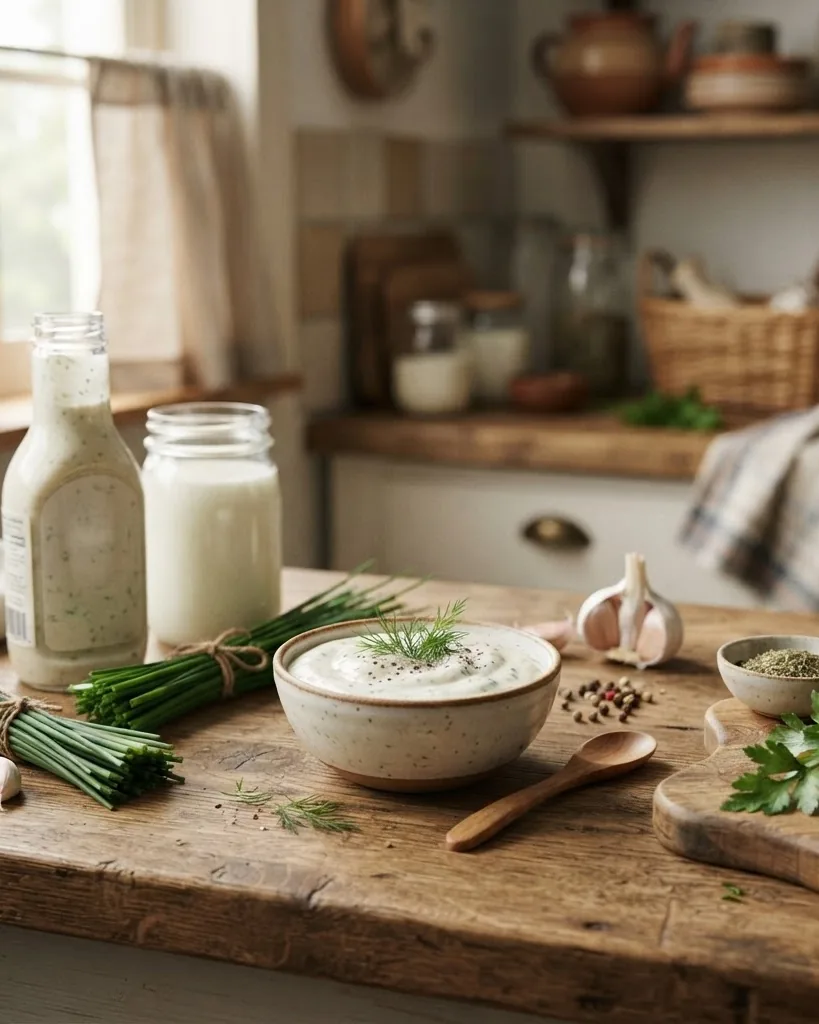
This is the most actionable move in the whole guide. Replacing the traditional mayonnaise and buttermilk with fat-free Greek yogurt and skim buttermilk in a homemade ranch recipe drops the payload to just 19.4 calories and 0.6 grams of fat per two-tablespoon serving, according to the recipe published by USDA MyPlate. Set that against the 130 calories in the commercial bottle and you are cutting roughly 110 calories per serving, a reduction of about 85 percent, while keeping the dill, garlic, and onion flavor profile fully intact. The tang even improves, because cultured yogurt is naturally sour.
The trade is texture. Yogurt ranch is thicker and less pourable, so thin it with a splash of skim buttermilk until it drapes the way you want.
- Base swap: fat-free Greek yogurt for the mayonnaise emulsion.
- Tang: skim buttermilk, which keeps the sour note without the oil.
- Flavor: fresh or dried dill, parsley, granulated garlic, and onion.
- Salt: add gradually and taste, so you never touch that 260 to 300 milligram commercial range.
You can lift this exact formula from the government’s own kitchen. The USDA MyPlate homemade ranch dressing recipe lists the ingredients and the verified per-serving math, which is why the 19.4-calorie figure is trustworthy rather than a marketing claim.
A word on the yogurt itself. Not all Greek yogurt is equal in protein and fat, so if you want to understand how a label can look lean while hiding a catch, the same skepticism we apply to snacks in our Quest Chips nutrition breakdown pays off here too.
Where ranch’s numbers stack against fast food you already track
Context turns a scary number into a usable one. A two-tablespoon serving of ranch at 260 milligrams of sodium is a fraction of what a full fast-food meal delivers, but it rarely arrives alone. It is the dip beside the tots, the drizzle on the burger, the pool next to the nuggets. Stacked on top of an already salty meal, that 260 to 300 milligrams is the addition people forget to log. A single serving of standard ranch is not a disaster on its own; the problem is that condiment servings almost never stop at one.
The fix is not to fear ranch, it is to count it. Treat the two-tablespoon panel as a real portion and measure it rather than free-pour.
If you like seeing where a condiment sits next to the mains it dresses, these tastybend breakdowns cover the usual suspects: the Big Mac nutrition facts, the 6-piece Chicken McNuggets nutrition, and tater tot calories, sodium, and carbs. Ranch touches all three plates, so knowing their numbers tells you what the dip is being added to.
For a genuinely different pairing that lowers the whole plate’s load, a grain bowl beats fries. Our guide on how to cook quinoa so it comes out fluffy gives you a base that a spoon of yogurt ranch can dress without the fast-food math.
Permits, labeling law, and what compliance costs a ranch maker
Every number on a ranch bottle is there because federal law puts it there. The Food and Drug Administration governs nutrition labeling for packaged foods in the United States, which means the calorie, fat, and sodium lines, the serving size, and the percent Daily Value column all follow FDA formatting rules rather than the manufacturer’s preference. That is why a Hidden Valley panel and a store-brand panel look structurally identical even when the recipes differ. The agency also sets the DV reference values that make the label’s low and high shorthand possible in the first place.
Behind the label sits a chain of agencies most shoppers never see.
- Food and Drug Administration (FDA): writes the nutrition labeling rules and the Daily Value framework for packaged dressings.
- USDA Agricultural Research Service (ARS): runs the Food and Nutrient Database for Dietary Studies (FNDDS), the national baseline that tracks what nutrients foods like ranch actually contain.
- Food Safety and Inspection Service (FSIS): oversees safety where dressings meet regulated meat and poultry, relevant to ready-to-eat products.
- Centers for Disease Control and Prevention (CDC): shapes the public-health guidance on sodium that steers reformulation.
The practical cost lands on the operator. When the USDA cut documented sodium values by 10 percent for the ranch dressing ingredient codes to match the 2020-2025 Dietary Guidelines for Americans, that was not just paperwork. It nudged reformulation for any maker selling into school meal programs, which forces recipe testing, new panel printing, and re-verification against the FNDDS baseline. FoodSafety.gov and nutrition.gov both point consumers to those same federal standards, so a small producer effectively answers to the whole alphabet before a single bottle ships.
The takeaway for a home cook is reassuring. The reason your bottle’s numbers are trustworthy at all is that a research service, a labeling authority, and a public-health body all sit behind them.
Frequently asked questions about ranch dressing nutrition facts
How many calories are in two tablespoons of ranch dressing?
A standard two-tablespoon serving of commercial ranch, such as Hidden Valley, contains about 130 calories, according to nutrition data compiled by Health Digest. Nearly all of that comes from 14 grams of total fat in the oil and mayonnaise base. Fat-free versions drop to roughly 25 calories per serving.
Is ranch dressing keto-friendly?
Standard ranch generally fits a keto plan because its calories come from fat rather than carbohydrate, leaving only a gram or two of carbs per serving. Hidden Valley labels certain lines as keto-friendly on its digital nutrition sheet. Always check the specific bottle, since added sugar or starch thickeners can raise the carb count unexpectedly.
Why does fat-free ranch sometimes have more sodium?
When manufacturers remove the oil, they lose the flavor and richness fat provides, so they add salt to compensate. That is why fat-free ranch can carry up to 300 milligrams of sodium per two-tablespoon serving versus about 260 milligrams in standard ranch, even though it saves you roughly 105 calories. Homemade lets you control the salt directly.
What do the Hidden Valley Ranch dressing nutrition facts show?
The Hidden Valley Ranch dressing nutrition facts on the brand’s digital label list roughly 130 calories, 14 grams of fat, and 260 milligrams of sodium per two-tablespoon serving, along with gluten-free and keto-friendly certifications. The panel follows FDA labeling rules, so the calorie, fat, sodium, and percent Daily Value lines appear in the standard federal format.
How can I make a lower-calorie ranch at home?
Swap the mayonnaise and buttermilk for fat-free Greek yogurt and skim buttermilk, then season with dill, garlic, and onion. The USDA MyPlate recipe using this method comes to just 19.4 calories and 0.6 grams of fat per two-tablespoon serving. That is roughly 110 fewer calories than the 130 in a standard commercial bottle.
Is ranch dressing gluten-free?
Classic ranch is naturally gluten-free because its core ingredients, oil, egg, buttermilk, and herbs, contain no wheat. The risk comes from additives like certain thickeners or flavor blends. If you have celiac disease, look for an explicit gluten-free certification on the label rather than assuming the recipe is safe on ingredients alone.
Nutrition figures on this page come from Health Digest, USDA MyPlate, the FDA, and the USDA Agricultural Research Service. Specific products vary by brand and batch, so treat the panel on your own bottle as the final word and measure your serving before you judge the number.
[req:7922779]