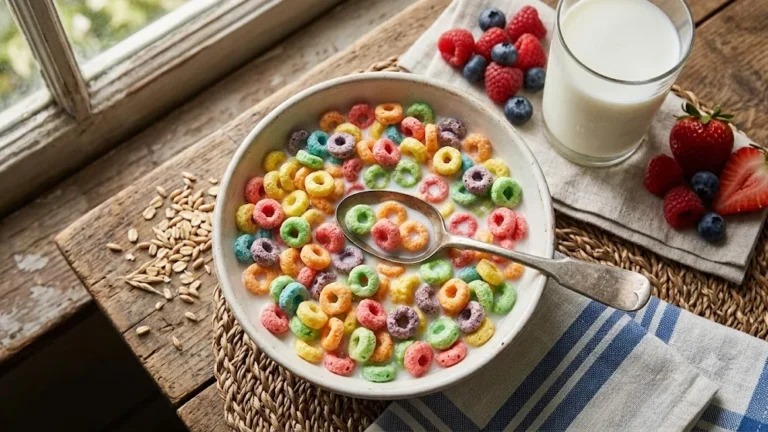
Every one of the 12 grams of sugar on a bowl of Fruity Pebbles is added sugar. Not a trace of it rides in naturally from the grain the way a little sugar does in milk or fruit. That single number tells you more about what this cereal is than the calorie count does, and it’s the first thing worth reading when you decode the Fruity Pebbles nutrition label. The rest of the panel fills in around it: 140 calories, almost no fat, one lonely gram of protein, and zero fiber. Below, we walk the panel line by line, sort out where the numbers come from, and flag the two spots where sources don’t agree.
Quick answer: One serving of Fruity Pebbles is 1 cup, or 36 grams. That cup carries 140 calories, 31 grams of total carbohydrate, 12 grams of total sugars (all added), 1.5 grams of total fat, 1 gram of protein, and 0 grams of dietary fiber. The ingredient list starts with rice, sugar, and canola and/or soybean oil, and includes the dyes Red 40, Yellow 5, Yellow 6, and Blue 1, plus BHT to preserve freshness. The cereal is labeled gluten-free. These figures come from the brand’s own product panel.
The serving size the Fruity Pebbles nutrition label reports against
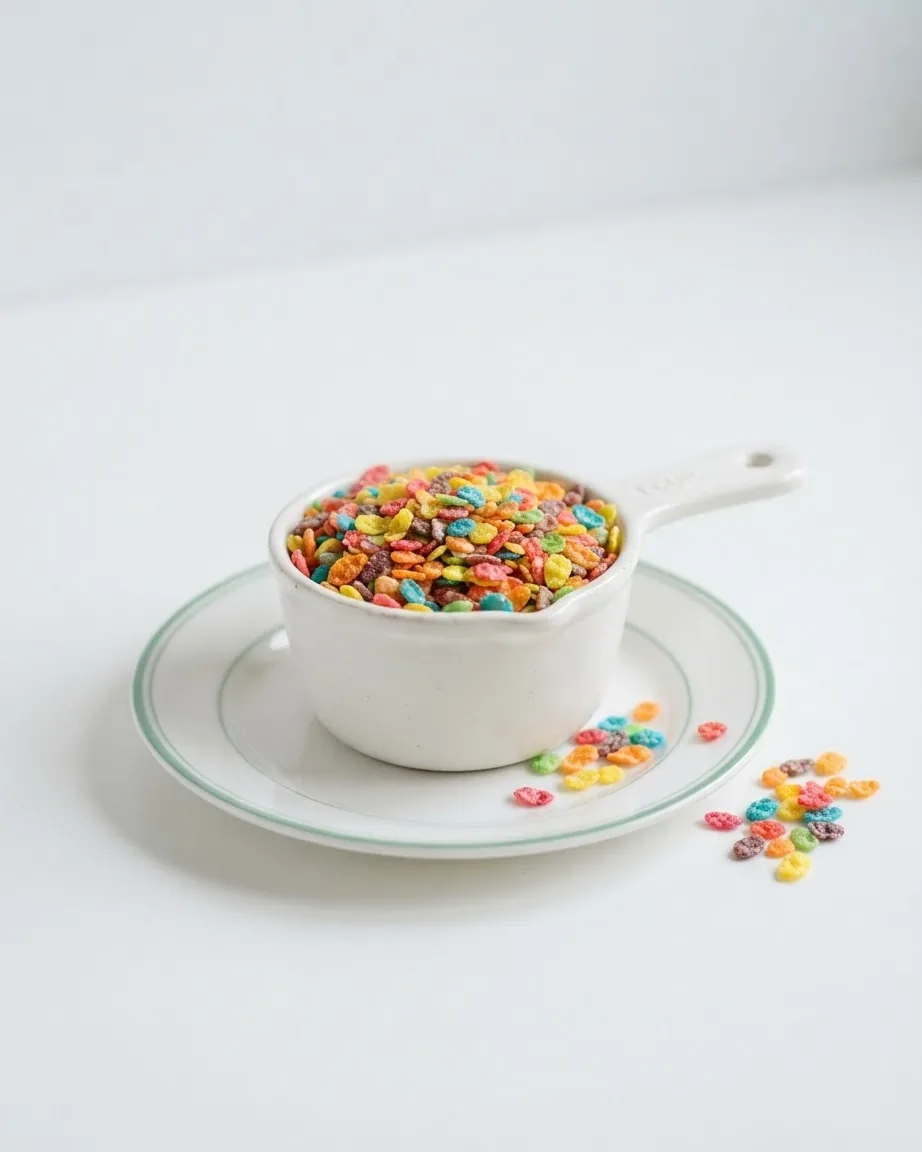
Read any number on this box and the first question is: a number of what? Post Consumer Brands, which publishes the panel on pebblescereal.com, measures against 1 cup, weighed as 36 grams. Every headline figure on the box – the 140 calories, the 12 grams of sugar – is pinned to that cup.
The catch most people miss: a cup of a light, puffed rice cereal is easy to overpour. Fruity Pebbles are small and dense-packing compared to a big flake, so a heaping bowl can quietly run to a cup and a half or two cups. Double the cup and you’ve doubled every line. This is the same trap we flag with airier cereals over on the Lucky Charms cereal nutrition label breakdown – the per-serving math only holds if your bowl matches the box’s cup.
Why the same cereal shows 140 calories in one place and 402 in another
Here’s where a quick search sends people in circles. The brand panel lists 140 calories per serving. A separate nutrition database, Nutrola (nutrola.app), lists 402 calories – for a 100-gram serving of the cereal. Both are correct. They’re just measuring different amounts.
The brand’s 36-gram cup is the real-world portion; the 100-gram figure is a standardized lab reference that lets you line up any food against any other on a level scale. At 100 grams you’re looking at nearly three servings’ worth. The 34.3 grams of sugar Nutrola reports at that 100-gram scale maps back to roughly the 12 grams per cup once you shrink the portion – it’s the same cereal, sliced thinner.
For your bowl, use the 36-gram numbers. Reach for the 100-gram figures only when you’re comparing Fruity Pebbles head-to-head against another food that’s also quoted per 100 grams. Mixing the two scales is how a harmless cereal ends up looking either twice as sweet or half as caloric as it is.
The sugar and carbohydrate line, and the fiber that isn’t there
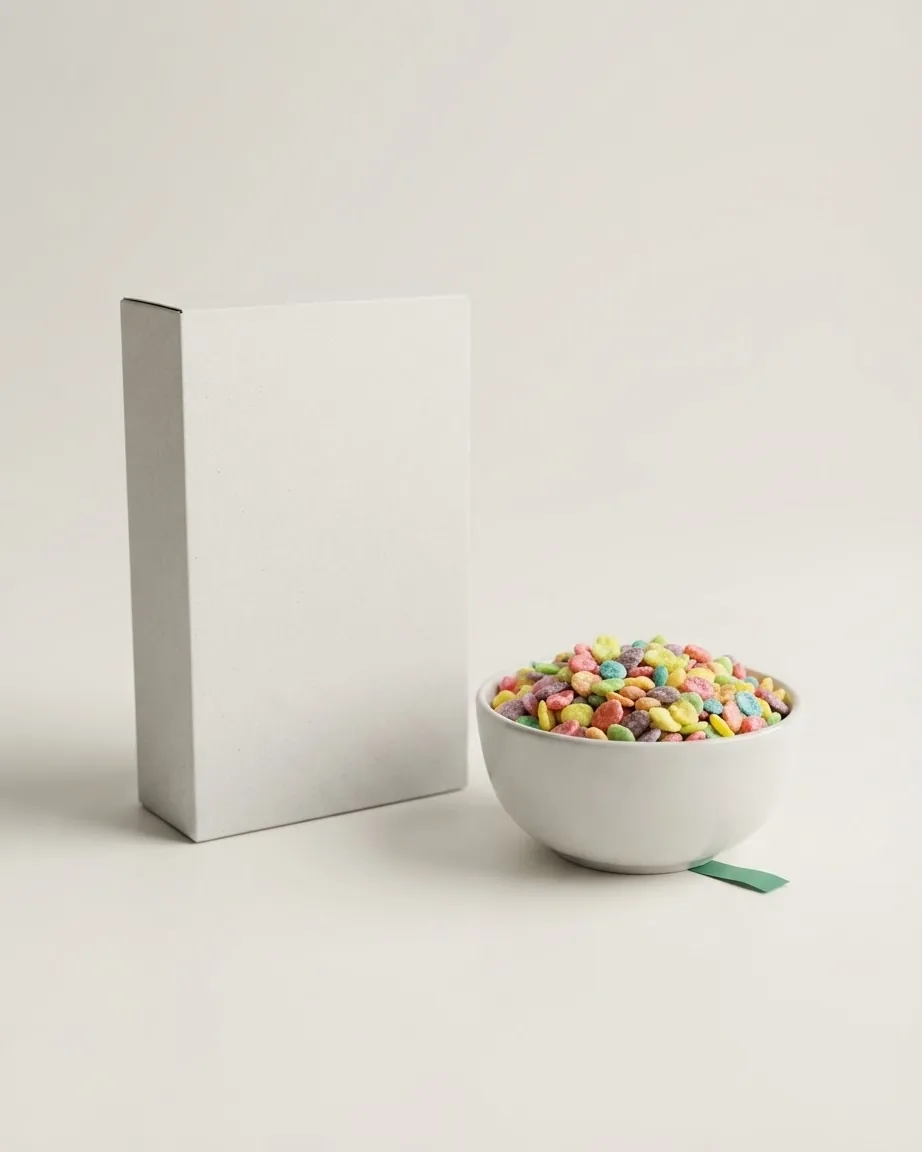
The carbohydrate block is where this cereal earns its reputation. One cup carries 31 grams of total carbohydrate. Of that, 12 grams are sugar – and the label marks every gram of it as added sugar, not sugar that occurs naturally in the grain.
That distinction matters because added sugar is a line health authorities single out for scrutiny, and a single dry cup of Fruity Pebbles spends a meaningful share of a day’s added-sugar allowance before you’ve poured milk or eaten anything else. The added-sugars line on the modern Nutrition Facts panel exists precisely so you can see this; the FDA’s guidance on added sugars explains why the number is broken out separately from total sugars.
Then there’s the empty slot: 0 grams of dietary fiber. Because the base grain is refined rice rather than a whole grain, nothing on the panel slows the sugar down. That’s the trade you’re making. A bowl of Fruity Pebbles is fast fuel with no fiber ballast, which is worth knowing if you were reaching for it as a “balanced” morning start.
Fat and protein: the two smallest numbers on the box
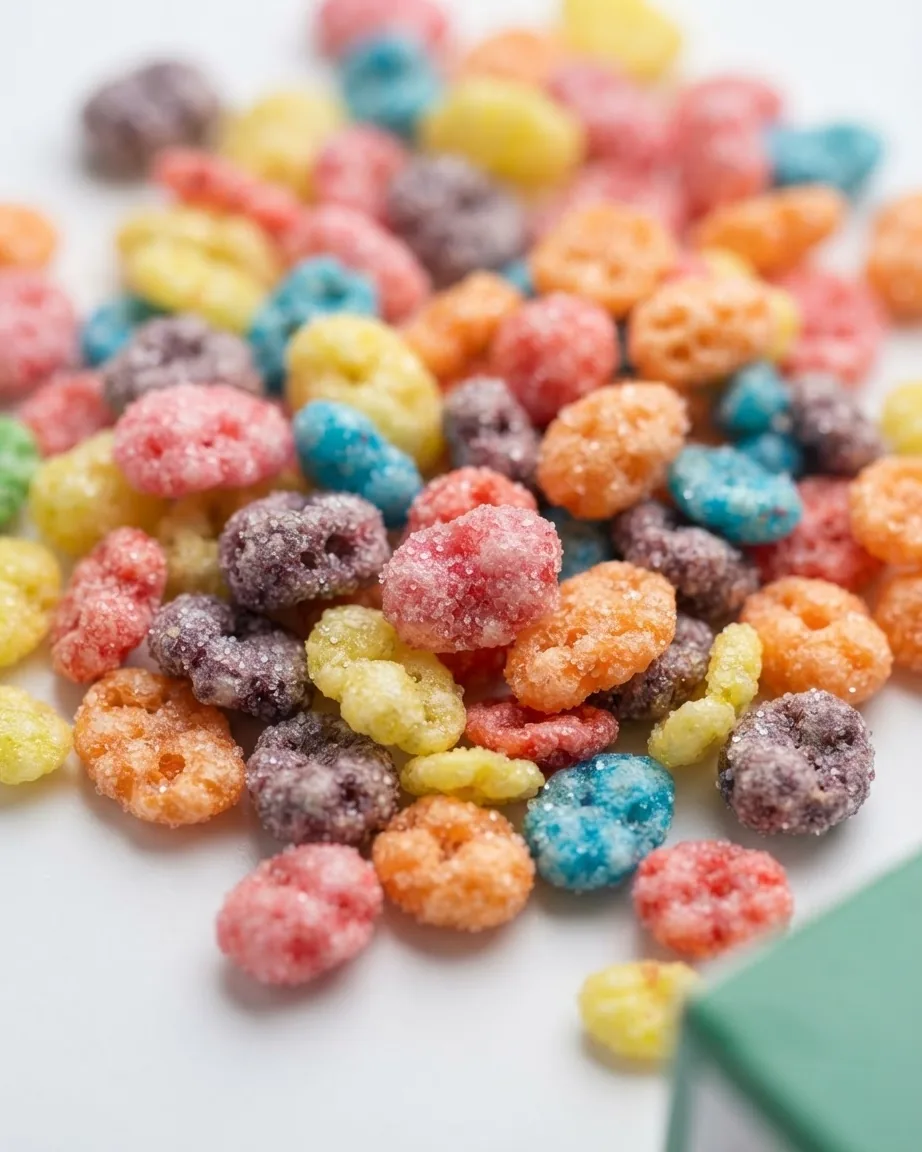
The fat and protein lines are almost afterthoughts, and one of them is disputed. The brand panel lists 1.5 grams of total fat per serving – a small amount that traces to the canola and/or soybean oil used to coat the puffs. Nutrola’s write-up instead reports 0 grams of fat for the cereal. Since the fat comes directly from an oil in the ingredient list, the brand’s 1.5 grams is the figure to trust; a hard zero would mean the panel itself rounded away an ingredient it names. Treat 1.5 grams as the working number.
Protein comes in at 1 gram per cup. That’s essentially nothing for a breakfast – not enough to blunt the sugar or carry you to lunch. If protein per serving is what you’re tracking, cereal like this leans on the milk to supply it, which is a different calculation entirely.
What’s actually in the box: rice, sugar, oil, and four dyes
Ingredient lists run in order of weight, so the first names tell you the most. Fruity Pebbles leads with rice, then sugar, then canola and/or soybean oil. The fruit flavors and bright colors you see in the bowl aren’t fruit at all – the color is built from four artificial dyes: Red 40, Yellow 5, Yellow 6, and Blue 1.
These four are among the certified color additives the FDA reviews and lists for use in food; the agency maintains the running color additive status list that spells out which dyes are approved and under what conditions. If artificial dyes are something you avoid – some households do, especially for kids sensitive to them – this is a cereal to read closely, because the color is central to the product rather than incidental.
Also on the list: BHT, added to preserve freshness. It’s an antioxidant preservative that keeps the oils from going rancid on the shelf, common across dry cereals and snack foods. Its presence is a normal shelf-life measure, not a flavor or nutrition ingredient.
The gluten-free label, and the vitamin lines the panel leaves blank
Allergen warning
Here’s a genuinely useful fact for anyone shopping around celiac disease or gluten sensitivity: Fruity Pebbles is a gluten-free cereal. Because the grain base is rice rather than wheat, oats, or barley, it clears the gluten bar that trips up most mainstream sweetened cereals. That makes it one of the easier grab-and-go picks in the cereal aisle for a gluten-free household – a distinction the marshmallow-and-oat competitors usually can’t match.
What the brand panel doesn’t spell out clearly is fortification. Most commercial cereals are enriched with vitamins and minerals – Vitamin D, iron, zinc, B vitamins – and those lines are standard on a full Nutrition Facts label, yet they’re not detailed in the summary figures the brand publishes. If a specific micronutrient matters to you, read the physical box in the store rather than trusting a summary, and cross-check against USDA’s FoodData Central for how fortified rice cereals typically stack up. Fortification levels also change without fanfare, so the box in your hand is the only truly current source.
The Fruity Pebbles panel next to two shelf neighbors
A number means little alone, so put the cup in company. Against a plain sweetened cereal and against a rice-based treat, Fruity Pebbles reads as high-sugar, low-everything-else.
Take a Rice Krispie treat, another refined-rice-and-sugar product: it lands in similar territory on sugar-per-serving, and we broke down each size over on the Rice Krispie treat nutrition facts page. The shared theme is refined rice plus added sugar with almost no fiber to show for it. Where Fruity Pebbles separates itself is the dye load and the gluten-free status – the treat carries neither the four colors nor, usually, a gluten-free claim.
Here’s the 36-gram cup, laid out clean:
- Serving size: 1 cup (36 g)
- Calories: 140
- Total fat: 1.5 g
- Total carbohydrate: 31 g
- Total sugars: 12 g (12 g added sugars)
- Dietary fiber: 0 g
- Protein: 1 g
Source: the Post Consumer Brands product panel on pebblescereal.com. For a 100-gram reference point, Nutrola lists 402 calories and 34.3 grams of sugar – the same cereal on the standardized scale.
A note on the marketing math: 50 years or 55?
One small thing worth calling out, because it turns up right on the brand’s own page and can throw a careful reader. The product copy in one spot celebrates “55 years of PEBBLES,” while another line describes it as “a family favorite for over 50 years.” Both come from the same page. There’s no contradiction in spirit – “over 50 years” and “55 years” agree – it’s just loose marketing rounding. Neither figure is a nutrition number, so it changes nothing on the panel; it’s only a reminder that the promotional text and the Nutrition Facts box are written by different hands and held to different standards. Trust the panel for figures, not the tagline.
Frequently asked questions
Is Fruity Pebbles gluten-free?
Yes. Fruity Pebbles is labeled gluten-free because its grain base is rice rather than wheat, barley, or oats. That makes it a workable option for households managing celiac disease or gluten sensitivity, which many sweetened cereals aren’t. As always, confirm the claim on the physical box, since manufacturers can change recipes and sourcing without broad announcement.
How much sugar is really in a bowl of Fruity Pebbles?
A single 1-cup (36 g) serving holds 12 grams of total sugar, and the label marks all 12 as added sugar. That is a meaningful share of a day’s added-sugar intake before you’ve even poured milk. Pour a heaping bowl closer to two cups and you’re doubling that figure, so portion size drives the whole number here.
Why does one site say 140 calories and another says 402?
They’re measuring different amounts. The brand panel reports 140 calories per 1-cup, 36-gram serving – the real portion. The 402-calorie figure from Nutrola is for a standardized 100-gram serving, which is nearly three cups’ worth. Use 140 for your bowl; use 100-gram figures only when comparing against other foods quoted on that same 100-gram scale.
Does Fruity Pebbles have artificial dyes?
Yes – four of them: Red 40, Yellow 5, Yellow 6, and Blue 1. The bright color is built entirely from these certified additives rather than from fruit. The cereal also contains BHT, an antioxidant preservative that keeps its oils from going rancid on the shelf. If your household avoids artificial dyes, this is a cereal to read closely before it hits the cart.