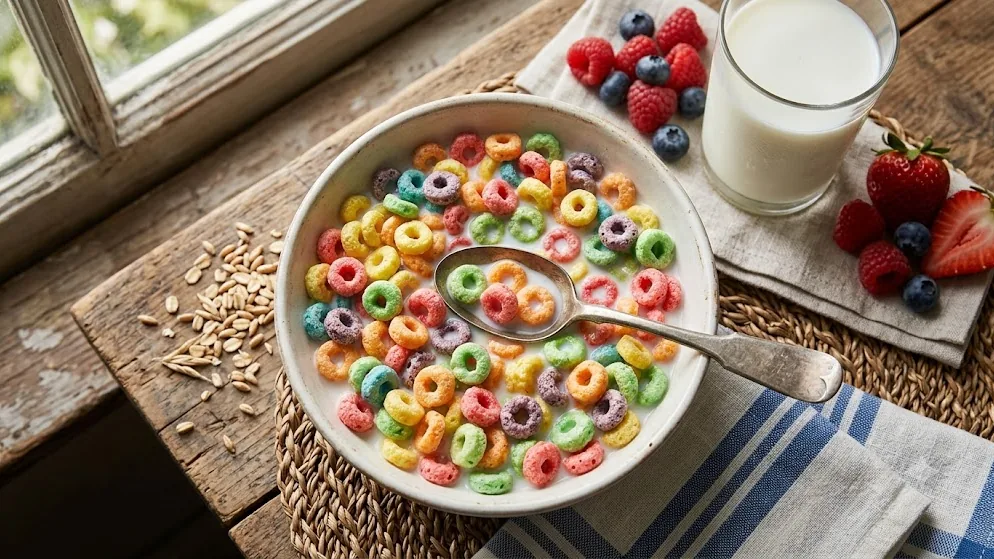
Fruit Loops nutrition facts changed under people’s feet, and almost nobody told the internet. The current WK Kellogg Co label puts one serving at 1 1/3 cup, or 39 grams, delivering 150 calories. Search results still spit back 110 calories for the same bowl, and both numbers are real. The gap is the whole story: an older United States label measured a 28 gram serving at 110 calories, and that figure never died. It hides in databases, forum posts, and half the calorie apps you own. Below is the reconciliation nobody bothered to publish, with every figure pulled straight from the manufacturer’s SmartLabel and the food agencies that write the rules.
Quick answer: Current Fruit Loops nutrition facts list calories, total carbohydrate, added sugars, fiber, protein, sodium, and iron per 39 gram serving (1 1/3 cup) on the current label. The 110 calorie number you may remember came from an older 28 gram serving size. Same cereal, smaller reference bowl.
Pour a normal breakfast helping and you are usually eating two of either serving, so double the numbers before you judge the box. That single habit, checking the gram weight before trusting the calorie headline, resolves most of the confusion you will read about below.
The current 39g label, line by line
One serving of Fruit Loops is 1 1/3 cup, weighing 39 grams, and it carries 150 calories. That is the number stamped on the box you buy today, confirmed on the WK Kellogg Co SmartLabel entry. The fat load is small in this cereal. Carbohydrate runs the show, of which a portion is added sugars and only a small share is fiber. Protein sits at 2 grams. Sodium is also listed on the panel. A 19.4 ounce box yields roughly 14 servings, which matters when you are pricing breakfast per bowl rather than per box.
- Calories: listed per 39 gram serving on the current label
- Total fat: and saturated fat are both listed as small amounts
- Sodium: listed in milligrams per serving
- Total carbohydrate: the main macronutrient, with a modest amount of fiber
- Added sugars: a meaningful share of the Daily Value
- Protein: 2 grams
- Iron: 4.5 milligrams (25 percent Daily Value)
- Vitamin D: 2 micrograms (10 percent Daily Value)
Do the arithmetic on a full box and the numbers get more useful for planning. That is a helpful way to think about the product at the household level rather than the single-bowl level, especially if more than one person is eating from the same box across a week.
You can read the full manufacturer sheet on the Kellogg’s SmartLabel product page, which is the primary document the aggregators copy from without crediting. Worth checking yourself, because WK Kellogg Co reformulations can shift a line at any time, and a printed box on your shelf could technically predate or postdate a label refresh you have not seen reflected online yet.
Why 28g and 39g both haunt your calorie app
The two serving sizes trip up more people than any other cereal number. An older United States Fruit Loops label used a 28 gram serving pegged at 110 calories. The current label uses 39 grams at 150 calories. Nobody scrubbed the old data from the ecosystem, so calorie trackers, recipe sites, and screenshots still quote 110 as if it were live. It is not wrong, exactly. It is stale. When a 28 gram figure and a 39 gram figure describe the same flakes, the smaller serving simply reports fewer calories, and readers assume the recipe changed. It did not.
Run the numbers side by side and the consistency becomes obvious. The old label works out to about 3.93 calories per gram (110 divided by 28). The current label works out to about 3.85 calories per gram (150 divided by 39). Those two ratios sit within a normal rounding tolerance for how nutrition labels round calorie counts to the nearest ten, which is strong evidence that this is a serving-size update rather than a formula change. If the cereal itself had gotten noticeably sweeter or denser, the calories-per-gram figure would have moved by more than a rounding error.
There is a third figure floating around too. The calculator site EatThisMuch lists 1 cup of ready-to-eat Fruit Loops at 109 calories, with roughly 87 percent of energy from carbohydrate. Once you know which serving a number describes, the contradictions collapse. The brand itself has history here: Fruit Loops launched in 1963 and moved to WK Kellogg Co in the corporate spin-off at the end of 2023, which is part of why label revisions and database lags overlap.
Added sugars, artificial colors, and the wheat allergen nobody flags
The health context is where the top-ranking pages go quiet, and it is exactly what parents, diabetics, and allergy households actually search for. One 39 gram serving carries added sugars, which the label rates at a meaningful share of the Daily Value. Under the current reference, the added sugars Daily Value is 50 grams, per the United States Food and Drug Administration. So a single small serving spends a real chunk of a full day’s added-sugar allowance, and most people pour two servings. The ingredient list also names Red 40, Yellow 5, and Blue 1, the color additives that drive the food-dye debate. And the box contains wheat, a labeled allergen.
The Food and Drug Administration explains how these percentages are meant to be read on its Daily Value reference guide, distinguishing low amounts of a nutrient per serving from high amounts. By that rule, 24 percent added sugars is squarely in the “high” band. The agency’s own advice is to choose foods lower in added sugars and higher in fiber, and Fruit Loops delivers only 2 grams of fiber per serving.
Do the math against the 50 gram daily reference and the pattern is easier to see: 12 grams divided by 50 grams equals 24 percent, exactly what the box prints. Pour a second serving, as most people do, and you are at 24 grams of added sugars, or roughly 48 percent of the full day’s Daily Value, before lunch. That framing is useful precisely because none of the generic nutrition databases connect the gram figure to the FDA’s own high-versus-low threshold.
- Added sugars: 12 grams, 24 percent Daily Value, which the FDA classes as high
- Color additives: Red 40, Yellow 5, Blue 1
- Allergen: contains wheat
- Grain base: corn flour blend, sugar, wheat flour, whole grain oat flour
Worth noting for edge cases: the “contains wheat” declaration covers the dry cereal itself and is the relevant flag for anyone managing a wheat allergy or gluten sensitivity. It says nothing about dairy, because the cereal is dry. The moment you add the manufacturer’s suggested milk, you introduce a dairy allergen that is not on the cereal’s own ingredient panel, which matters if you are checking the box for a milk-allergic household member rather than checking the finished bowl.
If you track sugar across breakfast staples, it is worth comparing this against a benchmark waffle. The breakdown in our Eggo Waffles Nutrition Facts: What Two Waffles Actually Cost You guide shows how a two-piece serving stacks up on the same added-sugar scale, and the contrast is sharper than most people expect.
The fortification math: iron, vitamin D, and B vitamins
Fruit Loops earns most of its nutrition label from fortification, not from its base grains. One 39 gram serving supplies 4.5 milligrams of iron, which is 25 percent of the Daily Value, and 2 micrograms of vitamin D, which is 10 percent of the Daily Value. Those are added nutrients, not native ones, which is standard for sweetened breakfast cereals. Foodstruct’s USDA-based profile also flags density in B vitamins, specifically vitamin B12 and niacin (vitamin B3). The takeaway is blunt: the micronutrient column looks respectable because the cereal is enriched, while the base ingredients contribute little on their own.
The fortification blend typical of sweetened cereals in this category usually extends beyond the two headline nutrients printed with a percentage. Manufacturers commonly add vitamin B6 and zinc alongside iron, vitamin D, B12, and niacin, and those additional micronutrients are frequently listed by name in the ingredient panel even when the Nutrition Facts box only prints a percentage for a subset of them. If a specific vitamin matters to your diet, check the ingredient list itself rather than assuming the short Nutrition Facts table is the complete inventory.
The vitamin D detail carries a hidden consequence for anyone eating plant-based. Vitamin D3 used in fortification is frequently animal-derived, which is why a cereal that looks vegetarian-friendly on paper is not reliably vegan. That single ingredient is the reason the honest answer to “is Fruit Loops vegan” is a qualified no rather than a clean yes. It is the kind of line-item nuance that gets lost when a database just prints the vitamin percentage without saying where the vitamin came from.
Per 100g and the “with milk” version for real comparisons
To compare Fruit Loops against any other cereal, you need a per-100-gram baseline, because serving sizes differ box to box. On that basis, Foodstruct’s USDA-derived profile lists 375 kilocalories per 100 grams, with 78.7 grams of net carbohydrate, 5.3 grams of protein, and a glycemic index of 69. Those numbers lean on older USDA Standard Reference data, so they diverge slightly from the current SmartLabel per-serving figures, and that divergence is expected rather than an error.
You can scale the current label up to compare it against the 375 kilocalories the older USDA-based figure reports, and the two land close enough to be a small, normal amount of drift between a current retail label and a legacy government database, not a sign that one source is unreliable. Use the 100 gram column for cereal-versus-cereal math, and use the 39 gram column for what is actually in your bowl this morning.
| Basis | Energy | Carbohydrate | Protein |
|---|---|---|---|
| Per 100g (USDA) | 375 kcal | 78.7g net carbs | 5.3g |
| Per 39g serving | 150 cal | 34g total | 2g |
The manufacturer also publishes a “with milk” column, which the top-ranking aggregators skip entirely. The SmartLabel version adds milk to the 39 gram serving and reports the combined calorie line. That second column matters because almost nobody eats dry cereal, so the “with milk” figure is closer to lived reality than the dry number the calculators quote.
If you want to see how a dry-versus-prepared gap plays out in another product, our Rice Cream Nutrition: The Cooked-vs-Dry Numbers Nobody Reconciles breakdown walks through the same trap, and it is a useful habit to build for any packaged food that lists both a dry weight and a prepared weight on the same panel.
Keto, diabetes, and the glycemic index reality
Fruit Loops does not fit a ketogenic diet, and the number that settles it is 34 grams of total carbohydrate per 39 gram serving. A standard keto day targets a strict daily carbohydrate budget, so a single serving can consume most or all of it before you have eaten anything else. The added-sugar share makes it worse for glucose management: 12 grams of added sugars sit inside those 34 carbohydrate grams. For anyone counting, one bowl is not a rounding error, it is the whole allowance.
Run the same math on a two-serving bowl, which is closer to how most people actually eat, and a keto diet takes an even harder hit: 68 grams of total carbohydrate, easily exceeding a typical daily carbohydrate target in a single meal. There is effectively no version of “a small bowl of Fruit Loops” that fits comfortably inside a strict ketogenic macro budget, regardless of how the rest of the day is planned.
The glycemic index reinforces the point. Foodstruct places Fruit Loops at a glycemic index of 69, which lands in the high range and signals a fast blood-sugar rise. For people managing diabetes, that combination of high glycemic index and a meaningful load of added sugars per small serving is the reason dietitians steer toward lower-sugar, higher-fiber cereals. The 2 grams of fiber here does little to blunt the spike. None of this makes the cereal forbidden, but the numbers do not support treating it as a diabetes-friendly or keto-friendly breakfast.
What you actually pour versus what the label counts
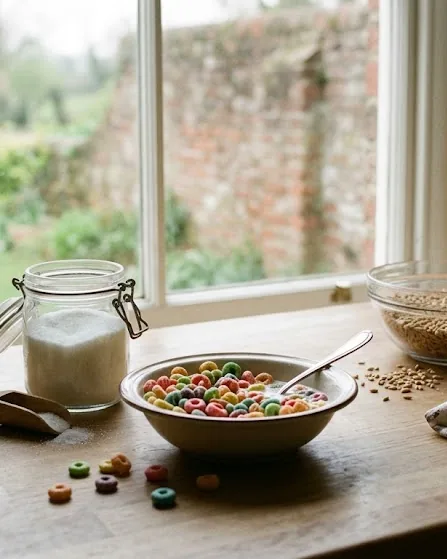
The single biggest reason people misjudge Fruit Loops nutrition facts is the gap between the reference serving and the real pour. The label measures 1 1/3 cup at 39 grams and 150 calories, but poured breakfast bowls routinely hit two to three times that. Fill a normal cereal bowl and you are plausibly looking at meaningfully more calories from cereal alone, before milk, using nothing but the label’s own calorie multiple. Add the SmartLabel milk column and the real morning total climbs further, because the “with milk” line already reads higher calories at just one serving.
Two servings roughly double the weight, calories, and added sugars compared with one serving, and three servings roughly triple them, which is closer to what a generously filled bowl actually looks like. This is not a criticism of the cereal so much as a warning about the arithmetic. Every figure on the box assumes restraint that most bowls do not show. When you screenshot a calorie count, note the grams, then eyeball whether your bowl matches. It almost never does. The same discipline applies across packaged breakfast foods, and it is the fastest way to stop being surprised by a nutrition label.

Fruit Loops variants: less sugar, marshmallow, and snack packs
The base cereal is not the only version on shelves, and the variants change the math in different directions. A “1/3 Less Sugar” line exists specifically for households trying to cut the added-sugar load without dropping the cereal entirely, and it is built around the same fortification approach, just with a reduced sweetener target. A marshmallow-added version pushes in the opposite direction, layering extra sweetened pieces on top of the base loops. Mini or snack-pack formats repackage the same recipe into smaller, pre-portioned bags, which is one of the few reliable ways to actually land on the labeled serving size instead of guessing at a poured bowl.
None of these variants change the core reconciliation this article is built around. Whichever version is in your pantry, check the printed gram weight on that specific box before comparing it to any of the figures above, since a snack pack, a less-sugar reformulation, and the standard box will each carry their own Nutrition Facts panel even though they share a brand name and a base recipe.
How does Fruit Loops compare to Raisin Bran on sugar?
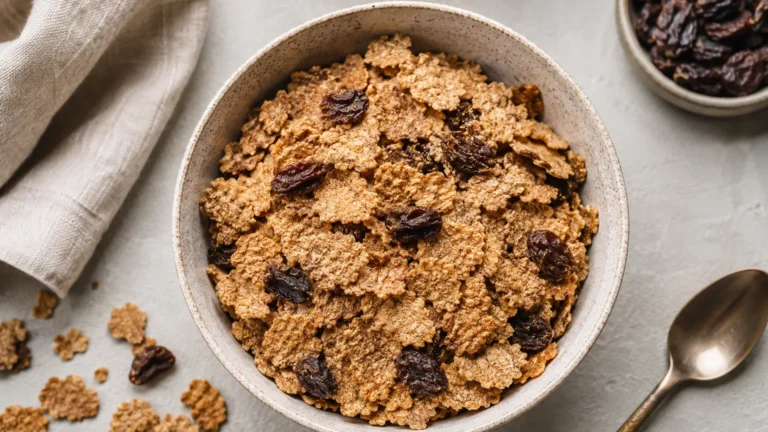
They target different eaters. Fruit Loops carries a meaningful load of added sugars and only 2 grams of fiber per 39 gram serving. Raisin Bran leans on fiber from bran and raisins, which changes the glucose picture. For the exact figures, see our full Raisin Bran Nutrition Facts breakdown before you decide which bowl fits your morning.
Why do I see 110 calories in some apps?
Because they still carry the older United States label, which used a 28 gram serving at 110 calories. The current WK Kellogg Co label uses a 39 gram serving at 150 calories. Both describe the same cereal at different reference weights, and the calories-per-gram ratio for each (about 3.93 versus about 3.85) confirms it is a serving-size update, not a recipe change. Trust the grams, not the headline number, and match the serving size to your actual bowl.
Is Fruit Loops vegan or vegetarian?
It is generally treated as vegetarian, but not reliably vegan. The sticking point is fortification: the vitamin D3 added to enriched cereals is frequently animal-derived. Because manufacturers can change sourcing, a strict vegan should verify the current ingredient list on the SmartLabel page rather than assume the cereal qualifies from its plant-based grain base alone.
How much iron is in one serving?
One 39 gram serving provides 4.5 milligrams of iron, which the label lists as 25 percent of the Daily Value. That iron is added through fortification rather than native to the grains. It is one of the stronger micronutrient lines on the box, alongside 2 micrograms of vitamin D at 10 percent Daily Value.
Does adding milk really change the numbers that much?
Yes. The manufacturer’s own “with milk” column adds milk to the 39 gram serving and reports a combined calorie total, up from the dry cereal figure. Since almost nobody eats dry cereal, that combined figure is closer to what you actually consume at breakfast than the dry-cereal number aggregators tend to quote.
Can I trust the per-100g figures for comparison?
Use them for cereal-versus-cereal math with a caveat. The per-100-gram profile of 375 kilocalories, 78.7 grams net carbohydrate, and glycemic index 69 comes from older USDA Standard Reference data, so it diverges slightly from the current SmartLabel per-serving figures. Scaling the current label to 100 grams lands close to that older figure, a small and normal gap. For your actual bowl, use the 39 gram serving numbers instead.
How many calories and how much sugar are in a whole box?
A 19.4 ounce box holds roughly 14 servings. That framing is useful for planning how far a single box actually stretches across a household or a week.
The bottom line on the numbers
Fruit Loops is a fortified, high-added-sugar cereal whose two circulating calorie figures both trace to a single change in serving size: 28 grams at 110 calories on the old label, 39 grams at 150 calories on the current one, with nearly identical calories-per-gram ratios confirming the recipe itself did not change. Anchor on the current 39 gram, 150 calorie label, note that 12 grams of added sugars equals 24 percent of the Daily Value, and remember the wheat allergen and the Red 40, Yellow 5, and Blue 1 color additives if that matters to your household.
Keep the per-100-gram figures for cross-cereal comparisons, keep the “with milk” column for a realistic breakfast estimate, and keep in mind that a real poured bowl is usually two to three labeled servings rather than one. For a very different sugar and protein profile at breakfast, our Oikos Triple Zero Nutrition Label: What Every Line Actually Means guide is a useful counterpoint. Read the box, count the grams, and double the numbers for the bowl you actually pour.