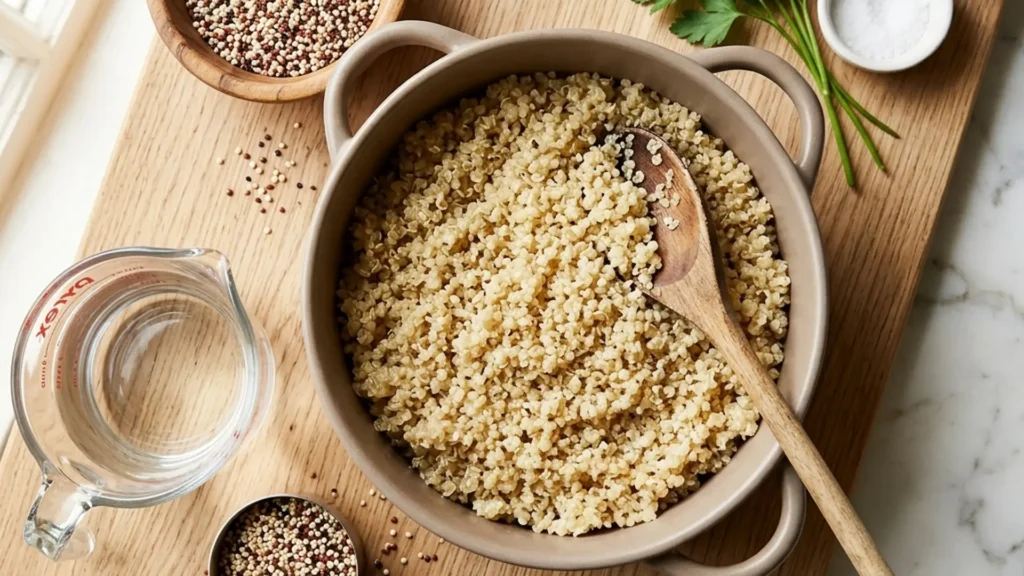
How to cook quinoa well comes down to three things most recipes rush past: rinsing it, using less water than you think, and letting it steam off the heat before you touch it. Get those right and you get separate, fluffy grains with a faint pop. Get them wrong and you get a wet, clumped pile that tastes faintly of soap. I have made quinoa hundreds of times in my own kitchen, ruined it plenty, and the difference between the two outcomes is smaller than you would guess. This guide walks through the exact ratios, the methods that actually work in a normal home kitchen, and a troubleshooting section for when it goes sideways, because that part is where almost every other guide leaves you stranded.
Quinoa is a seed, not a grain, even though we treat it like one. That matters for cooking because seeds hold less water than rice, and the standard “2 parts water to 1 part quinoa” you see everywhere is the single biggest reason home cooks end up with mush. I will explain what I use instead, and why.
The Water Ratio That Actually Gives You Fluffy Quinoa
Here is the thing nobody tells you: 2:1 water to quinoa is too much water. It works, in the sense that the quinoa cooks through, but you are left with grains that have swelled and softened past the point of springiness. They go gummy. I use between 1 1/4 and 1 1/2 cups of water for every 1 cup of dry quinoa. One and a quarter cups gives you grains with real bite, the kind you want in a salad. One and a half gives you a softer, more tender result that works as a warm side dish or a base for a bowl.
Why the lower number works: rice keeps absorbing water until it is fully gelatinized, so it needs that 2:1 cushion. Quinoa hits its tender point and then keeps drinking, going soft and pasty if there is extra water sitting in the pot. Starve it slightly and it stops at the sweet spot. The first time I dropped to 1 1/2 cups I thought I would scorch it. I did not. The grains were the best I had made.
One cup of dry quinoa yields right around 3 cups cooked, which feeds three to four people as a side. The absorption method here is the same idea you use for any grain: a measured amount of liquid, a covered pot, and a rest at the end. Once that logic clicks, you can scale it up or down without a recipe in front of you, which is most of what cooking confidence really is.
Rinse First, and Toast If You Have Two Extra Minutes
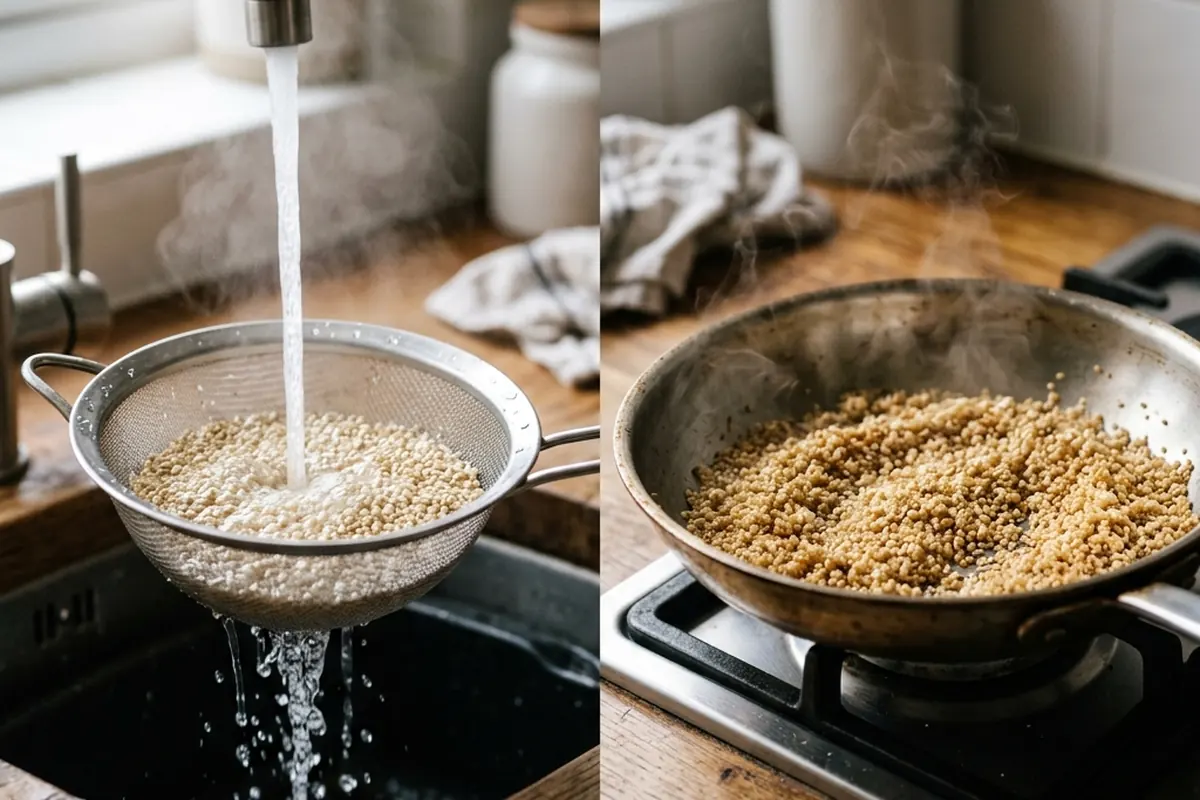
Quinoa seeds are coated in saponins, a natural compound the plant produces to keep bugs and birds off. Saponins taste bitter and soapy. Most boxed quinoa is pre-rinsed, but “pre-rinsed” is not the same as “fully rinsed,” and a quick rinse at home is cheap insurance. Put the dry quinoa in a fine-mesh sieve, run cold water over it, and rub the seeds against the mesh with your fingers for about 30 seconds until the water runs clear instead of cloudy. If you have ever had quinoa that tasted vaguely like dish soap, you skipped this or rushed it.
The step almost every guide leaves out is toasting. After rinsing, shake the sieve hard to drain, then dump the damp quinoa into a dry saucepan over medium heat. Stir it for two to four minutes until it smells nutty and you hear faint crackling. This drives off surface water and deepens the flavor in a way you cannot get back later. It is the same logic as toasting nuts. Skip it when you are in a hurry, but on a slow Sunday it is worth the two minutes.
Stovetop Method, Step by Step
The stovetop is still my default. It gives you the most control and you can hear and see what is happening.
Rinse 1 cup quinoa and drain well. Toast it dry in a medium saucepan for two to four minutes if you like. Add 1 1/4 to 1 1/2 cups water (or broth) and 1/4 teaspoon salt. Bring it to a boil over high heat. The moment it boils, drop the heat to low, cover, and set a timer for 15 minutes. Do not lift the lid. Lifting it lets steam escape and throws off the timing.
At 15 minutes, the water should be gone and you should see little curled white “tails” (the germ) springing off most of the grains. That tail is your doneness signal. Pull the pot off the heat, keep the lid on, and let it sit undisturbed for 10 minutes. This is the rest that finishes the steaming and firms the texture. Then take the lid off and fluff with a fork, lifting and separating rather than stirring, which mashes the grains. Salt to taste and you are done.
If You Are Using Broth Instead of Water
Swapping water for chicken, vegetable, or bone broth is the easiest upgrade there is. Use the same volume. Cut the added salt in half, because broth is already salted, then adjust at the end. A bay leaf or a smashed garlic clove dropped in with the liquid carries through nicely and costs nothing.
Every Method Compared, With Real Ratios and Times
I have cooked quinoa five different ways. Here is what each one actually needs, in one place, so you are not hunting across three recipes.
| Method | Water per 1 cup quinoa | Time | Notes |
|---|---|---|---|
| Stovetop | 1 1/4 to 1 1/2 cups | 15 min cook + 10 min rest | Most control, best texture |
| Instant Pot | 1 cup | 1 min high pressure + 10 min natural release | Hands-off, very forgiving |
| Rice cooker | 1 1/2 cups | One white-rice cycle + 10 min rest | Set and forget |
| Microwave | 2 cups | 6 min high + 5 to 10 min rest | Use a large bowl, it foams over |
| Oven (baked) | 1 1/2 cups (boiling) | 375 F covered for 18 to 20 min | Best for big batches |
Notice the Instant Pot uses the least water, just 1:1, and the microwave the most. Pressure traps every bit of steam, so you lose almost nothing to evaporation. The microwave loses a lot, which is why it needs the cushion. The oven method is the one I reach for when I am cooking 3 cups of dry quinoa for the week, because the heat is even and I do not have to babysit a pot.
White, Red, Black, and Tricolor: Do They Cook Differently?
They do, slightly, and it is worth knowing if you mix them. White (sometimes called golden) quinoa is the softest and quickest, tender at the 15-minute mark. Red quinoa holds its shape better and stays chewier, which makes it the better pick for cold salads where you do not want mush. Black quinoa is the firmest and earthiest, and it can take two to three extra minutes. Tricolor blends are pretty but uneven by nature, since the black grains finish later than the white ones. If you want consistency, cook a single color. If you want the look, accept that some grains will be a touch firmer than others, which honestly does not bother me in a grain bowl.
Flavor tracks texture here. White quinoa is the mildest, almost neutral, which is why it disappears so easily into bowls and lets a dressing or sauce lead. Red has a slightly nuttier, more assertive taste. Black is the deepest and most earthy. If you are serving quinoa to someone who claims they do not like it, start them on white cooked in broth, because the soapy-bitter memory most skeptics carry comes from unrinsed quinoa, not from the seed itself. Win them back with a properly rinsed, broth-cooked batch and they usually come around.
Batch Cook It: Storing, Freezing, and Reheating
Quinoa is one of the best things to batch cook, and almost no guide tells you how to store it properly. Cooked quinoa keeps in the fridge for about 5 days in an airtight container. Let it cool to room temperature first, uncovered, so condensation does not turn it slimy, then seal it.
It also freezes well, which surprises people. Spread cooked, cooled quinoa on a sheet pan in a thin layer and freeze it flat for an hour so the grains do not clump, then transfer to a freezer bag. It keeps three months. To reheat, microwave straight from frozen with a splash of water over the top, covered, for about 90 seconds per cup, or steam it in a covered pan with a tablespoon of water. The splash of water is the trick. Reheated dry, quinoa turns gravelly. With steam, it comes back nearly as good as fresh. I keep frozen quinoa portions on hand for weeknight bowls the same way I keep cooked rice, and it has saved dinner more than once.
Troubleshooting: Why Your Quinoa Went Wrong
This is the section the big sites skip, and it is the one you actually need at 7 p.m. on a Tuesday. Here is what goes wrong and how to fix it next time, or rescue it now.
| Problem | Cause | Fix |
|---|---|---|
| Mushy, gummy | Too much water, or stirred while cooking | Drop to 1 1/4 cups water; never stir mid-cook |
| Crunchy, undercooked | Too little water or lid lifted early | Add 2 tbsp water, cover, cook 3 more min off lid-peeking |
| Tastes soapy or bitter | Saponins not rinsed off | Rinse until water runs clear, 30+ seconds |
| Clumped together | No rest, or fluffed too soon and too hard | Rest 10 min covered, then fork-fluff gently |
| Scorched on the bottom | Heat too high during simmer | Keep it on genuine low; use a heavy pot |
| Watery at the end | Lid not sealing or weak simmer | Drain off excess, return uncovered 2 min to dry |
The watery fix is the one I lean on most. If your 15 minutes are up and there is still liquid pooling, just drain it, put the pot back on low without the lid for a minute or two, and the surface moisture cooks off. Quinoa is more forgiving than rice that way.
One more troubleshooting note that took me a while to figure out: the pot matters. A thin saucepan develops hot spots and scorches the bottom layer while the top stays wet. A heavier pot with a thick base spreads the heat and is the single easiest equipment fix for both scorching and uneven cooking. If you only own thin pans, keep the heat lower than you think you need and accept a slightly longer cook. The same goes for the lid: a glass lid that seals well keeps the steam where it belongs, and a warped or loose lid is a common hidden reason quinoa comes out underdone even when you followed the timing exactly.
A Few Notes on Hard Water and Altitude
If your tap water is very hard, the minerals can leave quinoa tasting flat or slightly metallic. Cooking in broth masks this completely, which is one more reason I default to broth. At high altitude, water boils at a lower temperature, so grains take longer. Above roughly 3,000 feet, add a couple of extra minutes to the cook and an extra splash of water, and lean toward the covered methods like the Instant Pot, where pressure compensates for the thinner air. These are small adjustments, but they explain why the same recipe behaves differently in Denver than in Miami.
What to Do With Your Cooked Quinoa
Cooked quinoa is a blank base, which is its whole appeal. Fold it into a grain bowl with roasted vegetables and a fried egg. Stir a cup into soup for body. Use it cold in a lemony salad with cucumber, herbs, and feta. Toss it warm with butter and parmesan as a side. It also bakes into things, holding moisture in muffins and quick breads.
Because quinoa carries real protein and fiber, it pairs naturally with other protein- and fiber-forward foods when you are building a meal that keeps you full. A scoop of quinoa under a saucy serving of refried beans turns two plant proteins into a genuinely filling plate, and the fiber from the beans plus the complete protein from the quinoa is a combination worth understanding by the numbers. For a higher-protein cold bowl, top chilled quinoa with fruit and a thick yogurt like a triple-zero Greek yogurt, which adds protein without much added sugar. Reading the actual labels on the things you pair with quinoa is how you build meals on purpose instead of by accident.
Quinoa is high in protein and one of the few plant foods with a complete amino acid profile, which is part of why it earns its place on the plate. For the full nutritional rundown, Harvard’s nutrition source lays it out clearly, and the tested pilaf approach from a trusted kitchen is a good next step once you have the basics down.
Frequently Asked Questions
Do I really have to rinse quinoa?
Yes, unless the box clearly says fully pre-rinsed and you have had good luck with that brand. Even then, a 20-second rinse costs you almost nothing and removes any leftover saponin coating that makes quinoa taste soapy. It is the cheapest way to avoid the most common complaint about quinoa.
Why is my quinoa always mushy?
Almost always too much water. The standard 2:1 ratio overshoots for quinoa because the seeds keep absorbing past their tender point. Drop to 1 1/4 or 1 1/2 cups of water per cup of dry quinoa, and resist stirring it while it simmers, which breaks the grains and releases starch.
What is the white ring that appears around cooked quinoa?
That curled white thread is the germ of the seed separating as it cooks. It is your doneness signal. When most grains show that little tail, the quinoa is cooked through. No tail means it needs a few more minutes.
Can I cook quinoa ahead and reheat it?
Yes, and it reheats better than rice. Keep cooked quinoa up to 5 days in the fridge or 3 months frozen. Reheat with a splash of water under cover, in the microwave or a covered pan, so steam brings the texture back instead of drying it out.
Is quinoa gluten free?
Quinoa is naturally gluten free, since it is a seed rather than a true cereal grain. If you have celiac disease, check for a certified gluten-free label, because quinoa can pick up cross-contamination from shared equipment during processing.
How much dry quinoa do I need per person?
Plan on about 1/4 cup of dry quinoa per person as a side, which cooks up to roughly 3/4 cup. So 1 cup dry, yielding about 3 cups cooked, serves three to four as a side or two as a main base in a bowl.
Bottom Line
Quinoa is forgiving once you stop drowning it. Rinse it so it does not taste like soap, use less water than the box says, leave the lid alone for the full simmer and the full rest, then fluff with a fork. From there you can take it any direction, fridge it for the week, or freeze it for the nights you have nothing planned. The grains that come out separate, springy, and faintly nutty are within reach of any home cook willing to skip the 2:1 habit and trust a slightly drier pot.