Beef jerky nutrition looks simple on the front of the bag and gets complicated the moment you flip it over. One ounce delivers protein, which is why gym bags and glove boxes are full of the stuff. The catch hides two lines down, next to sodium. Before you commit to jerky as a daily habit, it helps to see the same food the way a dietitian does: per ounce, per 100 grams, and per real packet, with the mineral wins and the salt problem side by side. If you already track macros on cuts like filet mignon calories and protein, the jerky math will feel familiar, only more concentrated because the water is gone.
Dried meat concentrates everything. Take the moisture out of beef and you shrink the volume while leaving the protein, the minerals, and unfortunately the salt exactly where they were. That is the whole story in one sentence, and the rest of this guide puts numbers on it using data from USDA FoodData Central, the U.S. Food and Drug Administration, and the World Health Organization.
One more thing worth stating up front: jerky is not one food, it is a category. A plain, unsweetened strip and a honey-teriyaki strip can differ by 6 grams of sugar and hundreds of milligrams of sodium in the same size bag. Every number in this guide comes with a source so you can decide which version of jerky you are actually buying, rather than assuming all jerky behaves the same on a nutrition label.
Quick answer: Beef jerky nutrition is protein-dense and mineral-rich but very salty. Per 100 grams, USDA data shows 410 calories, 33.2 grams of protein, 25.6 grams of fat, and 1,780 mg of sodium, which is about 77 percent of the 2,300 mg Daily Value. A single ounce runs high in sodium, delivering a significant portion of the day’s sodium in one small handful. Jerky also carries the World Health Organization processed-meat label, so portion size matters more than the marketing suggests.
Beef Jerky Nutrition by the Numbers
Beef jerky nutrition per 100 grams, according to USDA FoodData Central, lands at concentrated amounts of calories, protein, total fat, and carbohydrate with fiber. That protein figure is the headline. Very few portable snacks put a third of their weight into complete animal protein. Fat sits around a quarter of the weight, with close to 11 grams of that being saturated fat.
The number that reframes everything is sodium: 1,780 mg per 100 grams, though some USDA reference bases list the same food as high as 2,081 mg. Both readings tell you the same thing. This is a salted food first and a protein food second, and no amount of clean-label marketing changes what the drying process requires.
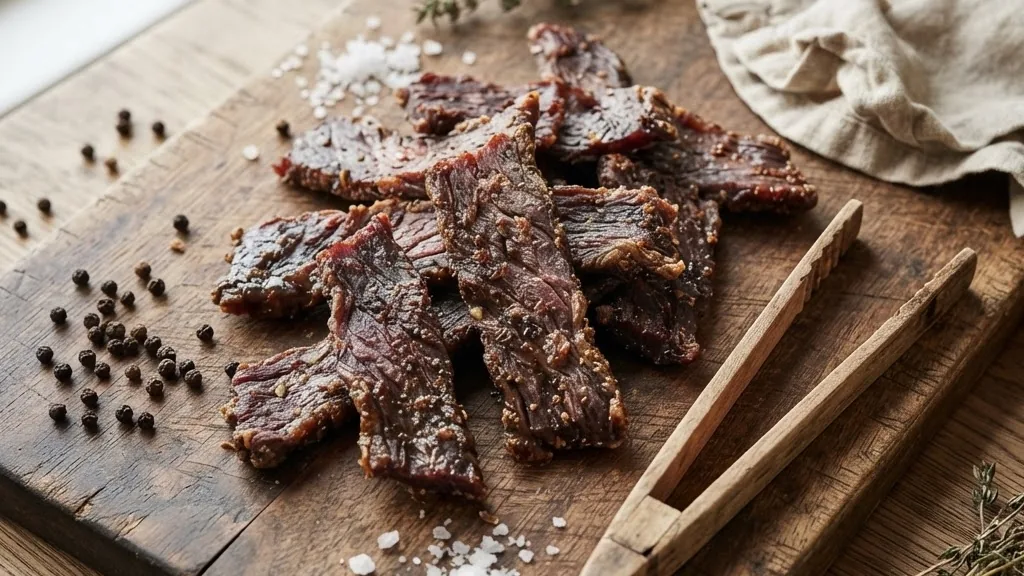
Most people never eat 100 grams in a sitting, so the ounce column matters more day to day. A one-ounce serving, about 28 grams, carries roughly 116 calories, 9.4 grams of protein, 7.3 grams of fat, and 3.1 grams of carbohydrate. That single ounce is usually four or five thin strips depending on the cut and the brand’s slicing thickness, which is a useful visual reference when you do not have a scale handy.
| Portion | Calories | Protein | Sodium |
|---|
A standard packet uses Great Value Original as a real-world example, and it behaves differently from the USDA average because recipes differ by brand. Read the calorie-to-protein ratio and you see the appeal. For a snack that survives a week in a backpack, getting protein for calories is genuinely hard to beat.
Density is the trap, though. Because water is gone, calories per gram climb fast, and it is easy to eat three ounces without noticing. Three ounces is nearly the full day of sodium if you are aiming for the American Heart Association’s stricter target. Weigh a portion once and the illusion breaks.
A simple habit fixes this: portion jerky into ounce-sized bags at home the same day you buy or make it. Once you have seen what one real ounce looks like next to a kitchen scale, you stop needing the scale, because your eyes calibrate to the actual serving instead of the “whole bag is one serving” assumption that drives most overeating.
Protein Quality: Why the Grams Punch Above Their Weight
Protein quality is where jerky earns its reputation beyond the raw gram count. Beef supplies complete protein, meaning it carries all nine essential amino acids in the ratios the human body needs to build and repair tissue. That high biological value is the reason protein from an ounce of jerky does more structural work than protein from most plant snacks, which usually run low on one amino acid or another.
Drying does not damage this. The amino acid profile of the muscle stays intact even after the moisture leaves, so a dry strip and a fresh steak deliver essentially the same building blocks per gram of protein. What changes is water content, not protein structure, which is exactly why jerky can pack 17 grams of protein into a 35-gram packet while a fresh steak needs three or four times that weight to deliver the same amount.
This is why jerky slots so naturally into higher-protein eating patterns. If you build meals around lean cuts and want ideas that scale, this roundup of high-protein recipes pairs well with jerky as the grab-and-go piece between cooked meals.
One honest caveat: protein satiety works better with cooked, tender meat you actually chew slowly. Jerky is calorie-dense and easy to overeat, so the same protein that fills you at dinner can slip past your hunger signals as a snack. Chewing jerky takes longer than eating a soft protein bar, which does slow you down somewhat, but it does not fully replace the fullness signal that a plated, sit-down meal provides.
Sodium: The Real Catch in Every Bag
Sodium is the number that decides whether jerky belongs in your routine. The FDA sets the Daily Value for sodium at 2,300 mg, and a single ounce of jerky delivers a significant percentage of that limit in one small serving. Eat 100 grams and you reach close to a full day’s ceiling from a single snack.
The American Heart Association goes further, naming 2,300 mg as the upper limit and 1,500 mg as the ideal daily target for most adults. That gap between the FDA ceiling and the AHA ideal is worth knowing, because most nutrition labels only reference the higher, more permissive number.
Salt is not incidental in jerky. It is the preservative. Sodium pulls water out of the meat and blocks the bacteria that would otherwise spoil it, so a low-salt jerky is a harder thing to make shelf-stable than the marketing admits. This is also why “low sodium” jerky is rare on shelves compared to low-sodium chips or crackers, where salt is purely a flavor choice rather than a safety requirement.
What to do with that:
- Treat one ounce as the portion, not one bag.
- Count the jerky sodium against the whole day, the way you would budget calories.
- If you eat jerky often, drop obvious salt elsewhere, since the two loads stack.
- People managing blood pressure should ask a clinician before making it a daily snack.
- Pair jerky with potassium-rich foods like fruit or potatoes, since potassium helps offset some of sodium’s effect on blood pressure.
None of this makes jerky off-limits. It makes portion size the single most useful lever you have. Coffee drinkers who like to geek out on how compounds behave in the body will find a similar tone in this breakdown of coffee science, where the dose, not the drink, does most of the talking.
The IARC Processed Meat Question, Answered Honestly
Processed meat carries a formal cancer classification, and jerky falls inside it. In 2015 the International Agency for Research on Cancer, the cancer arm of the World Health Organization, placed processed meat in Group 1, meaning there is strong evidence it is carcinogenic to humans. That verdict came from 22 experts across 10 countries reviewing more than 800 studies.
Group 1 is the same category as tobacco, which sounds alarming, but the category describes strength of evidence, not equal danger. The measured effect is specific and modest: each 50 grams of processed meat eaten per day was linked to an 18 percent higher relative risk of colorectal cancer, a relative risk of 1.18.
Read that carefully. Fifty grams a day, every day, raises baseline colorectal risk by less than a fifth. An occasional ounce is a very different pattern from a daily half-pack habit, and the studies point at sustained intake. Relative risk also compounds on top of your individual baseline risk, which depends on family history, age, and other lifestyle factors, so the 18 percent figure is a multiplier, not a fixed number that applies identically to everyone.
Brand-owned articles tend to skip this entirely because it complicates the pitch. The neutral read is simpler: enjoy jerky, keep it occasional rather than routine, and the 18 percent figure stays theoretical rather than personal. Harvard’s public health nutrition guidance and Mayo Clinic’s patient materials both take this same middle-ground stance: processed meat does not need to be eliminated for most people, but it should not be a daily staple either.
Sugar and Carbs Swing Wildly Between Brands
Carbohydrate is the most variable line on any jerky label, and it is entirely a recipe decision. USDA’s reference beef jerky lists 11 grams of carbohydrate per 100 grams, but that average hides two very different products. Zero-sugar and carnivore-style jerky can sit near the bottom of that range, while teriyaki and sweet-and-hot styles pile on added sugar that shows up as glaze.
The Great Value Original packet makes the point cleanly: in a 35-gram serving it carries 6 grams of carbohydrate, and all 6 grams are added sugar. That is a candy-adjacent sugar load hiding inside a snack most people file as pure protein.
| Item | Calories | Carbs | Sodium |
|---|
For anyone eating low-carb, this ruins a plan quietly. Two sweet strips can undo a careful morning. A practical framework for keeping snacks in bounds lives in this practical low-carb eating guide, and jerky selection is exactly the kind of small decision it covers.
The fix is label reading, not brand loyalty. Scan the ingredient list for sugar, brown sugar, honey, or syrup near the front, and check the added-sugar line directly. If the added-sugar figure matches or nearly matches the total carbohydrate figure, you know the product is sweetened rather than naturally low in carbs, which matters far more for keto tracking than the total-carb number alone.
The Micronutrients Worth Knowing
Beyond protein, jerky is a real source of minerals that dried beef concentrates alongside everything else. Per 100 grams, USDA data lists 5.4 mg of iron, about 68 percent of the Daily Value, and 8.1 mg of zinc, roughly 74 percent. Phosphorus comes in near 407 mg, close to 58 percent DV, with potassium around 597 mg.
Iron and zinc from beef are the well-absorbed animal forms, which matters more than the raw milligrams. Plant iron, called non-heme iron, absorbs at a much lower rate than the heme iron found in beef, so the iron in jerky is functionally worth more than iron from a fortified cereal or a handful of spinach.
Beef also contributes smaller but real amounts of B12, selenium, and choline, three nutrients that rarely get attention on a snack label but that support nerve function, antioxidant defense, and liver health respectively. These are the micronutrients that make jerky more than empty salt, though you pay for them in sodium every time.
Quick read on why those minerals matter:
- Iron carries oxygen in the blood, and the beef form absorbs better than plant iron.
- Zinc supports immune function and wound healing.
- Phosphorus and potassium work in bone and fluid balance.
- B12 and choline support nerve signaling and cellular repair, and both are essentially absent from plant foods.
Grass-Fed vs Grain-Fed Jerky
The cattle’s diet shows up in the jerky, though not in the calorie or protein numbers. Grass-fed beef tends to carry a somewhat higher ratio of omega-3 fatty acids to omega-6, along with more antioxidant compounds like vitamin E, compared with conventionally grain-finished beef. The total fat and protein counts on the label do not change much between the two, so this is a quality difference inside the fat, not a quantity difference.
For most casual snackers, the difference is marginal enough that price and taste preference should drive the decision more than nutrition alone. For people specifically trying to shift their omega-3 to omega-6 ratio, grass-fed jerky is a reasonable small contributor, though it will never rival fatty fish as an omega-3 source. Treat the grass-fed label as a minor bonus, not a reason to ignore sodium or sugar content on the same package.
Nitrites, Nitrates, and “Uncured” Labels
Many jerky labels advertise “uncured” or “no nitrites added,” which sounds like a health upgrade but needs a closer look. Traditional cured jerky uses sodium nitrite to fix color, add flavor, and further inhibit bacterial growth alongside the salt. “Uncured” products typically swap synthetic sodium nitrite for a natural source, most often celery powder or celery juice concentrate, which still contains nitrates that convert to nitrites during processing.
In practice, this means “uncured” jerky is not nitrite-free, it simply sources the nitrite from a vegetable rather than a lab-synthesized additive. The nitrite content can end up similar to conventionally cured jerky. If avoiding nitrites entirely is the goal, the label to look for is one that lists no curing agent and no celery powder at all, which is more common in home-dried and small-batch jerky than in mass-market bags.
Fitting Jerky Into Keto, Paleo, and Other Diets
Jerky’s macro profile maps well onto several popular eating patterns, with some label-reading caveats attached to each. Keto and low-carb diets favor jerky because of the high protein and low carbohydrate base, but as covered above, sweetened varieties can quietly add several grams of sugar per serving, so plain or “original unsweetened” cuts are the safer default. Paleo followers generally accept jerky as long as the ingredient list avoids soy, added sugar, and synthetic preservatives, which pushes many paleo eaters toward small-batch or homemade versions.
Carnivore dieters treat jerky as a convenient portable protein, though the sodium load still counts against any personal sodium ceiling. Gluten avoidance requires reading the label specifically for soy sauce or wheat-based marinades, since teriyaki and some savory blends use soy sauce that contains wheat unless labeled gluten-free. Halal and kosher status depends entirely on how the animal was slaughtered and processed, not on the drying method itself, so certified jerky will carry an explicit halal or kosher mark on the package rather than being assumed from the ingredient list alone.
How to Choose a Bag and How to Dry Your Own
Choosing well and making your own are the two moves that put you in control of the salt and sugar the label decides for you. When you buy, the ingredient list tells the real story faster than the front label. Read the order, since ingredients are listed by weight, and watch where sugar and sodium land.
When you make it at home, you set both numbers yourself, which is the entire reason home drying is worth the effort. The one rule you cannot skip is safety, and USDA’s Food Safety and Inspection Service, the FSIS, is explicit that meat must reach a safe internal temperature before or during drying to kill pathogens. Warm air alone does not sterilize; heat does.
A label-reading checklist that takes ten seconds in the aisle:
- Sugar or syrup in the first three ingredients means a sweet, higher-carb product.
- Compare sodium per serving, not per bag, across brands.
- “Uncured” or “no nitrites added” changes the additive profile but not the salt, and often not the nitrite content either.
- Short ingredient lists usually mean fewer colorings and fillers.
Home drying flips the economics of sodium. You can salt lightly, skip added sugar entirely, and still get a shelf-stable strip, because heat and moisture removal do the preserving work. The FSIS guidance on reaching a safe temperature before dehydrating is the part beginners most often get wrong.
Two common troubleshooting issues come up for first-time jerky makers. Over-dried jerky turns brittle and hard to chew because too much moisture was removed for too long at too low a temperature; the fix is drying at the recommended temperature range and checking texture earlier rather than running the full default time blindly. Under-dried jerky feels tacky or leaves moisture on the fingers, which is a food safety concern, not just a texture one, since it means the drying step likely did not reach a safe temperature throughout the strip.
If you like the low-and-slow mindset, the same patience that produces good braises applies here; a browse through hearty beef stews shows the flavor-building logic that also makes a good marinade.
Cured and brined beef is a close cousin worth understanding too. This walkthrough of an Instant Pot corned beef recipe shows how salt cures beef in a wetter format, and the safety mindset in this slow cooker ham and lentil soup guide carries straight over to handling cured meats safely at home.
Storage, Shelf Life, and Spotting Spoiled Jerky
Properly dried and sealed jerky is shelf-stable at room temperature specifically because the low moisture content and high salt level both work against bacterial growth. An unopened commercial bag typically stays safe for the date printed on the package, often a year or more, because manufacturing controls both drying time and packaging seal tightly. Once opened, commercial jerky is best eaten within one to two weeks for quality, though it will not spoil overnight if kept in a cool, dry, sealed container.
Homemade jerky is less forgiving. Without commercial-grade drying equipment and packaging, home-dried jerky should be treated more conservatively: refrigerate it if you plan to keep it more than a week, and freeze portions you will not eat soon. Signs that jerky has gone bad include a sour or off smell, visible mold spots, or a texture that has turned unusually soft or slimy rather than dry and pliable. Any of those signs means the batch should be discarded rather than salvaged.
Beef Jerky vs Other Protein Snacks
Stacked against other portable protein, jerky wins on density and loses on salt. Against nuts, it delivers far more protein per calorie and almost no fat variability, but nuts win on sodium and heart-healthy fats. Against protein bars, jerky usually carries less sugar than the sweet ones, though it carries dramatically more sodium.
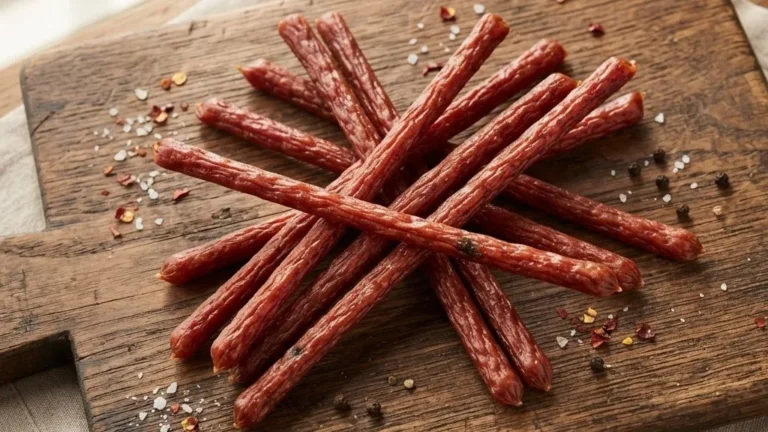
Against biltong, a South African air-dried beef, jerky is often sweeter and saltier because biltong relies on vinegar and air rather than sugar-heavy glazes. Meat sticks, a smaller and more processed cousin of jerky, tend to pack more fat per gram since they are often made from ground meat and fat rather than whole muscle, so their calorie density is usually higher for the same protein amount.
The honest verdict: no single snack is best, and jerky’s role is the high-protein, zero-refrigeration option you rotate in, not the one you lean on daily.
If you compare it to fast food on a macro basis, the contrast is stark. The Maruchan ramen sodium breakdown shows another shelf-stable snack where salt, not protein, is the defining number, and it makes jerky’s protein density look generous by comparison.
Frequently Asked Questions
Is beef jerky healthy or not?
It depends on portion and frequency. One ounce gives protein plus iron and zinc, which is genuinely useful. The downside is 590 to 627 mg of sodium per ounce and the World Health Organization processed-meat classification. Occasional jerky fits most diets; a daily half-pack habit does not.
How much sodium is in beef jerky?
A lot relative to its size. One ounce carries 590 to 627 mg of sodium, which is 24 to 27 percent of the FDA Daily Value of 2,300 mg. A full 100 grams reaches roughly a large percentage of the daily ceiling. The American Heart Association’s ideal target of 1,500 mg makes this even more significant.
Does beef jerky have too much sugar?
Some brands do. USDA reference jerky lists 11 grams of carbohydrate per 100 grams, but sweet styles add far more. Great Value Original packs 6 grams of added sugar into a 35-gram serving. Zero-sugar and carnivore-style jerky avoid this almost entirely, so the label, not the category, decides.
Is jerky good for a keto or low-carb diet?
Zero-sugar jerky fits well; sweet jerky does not. Plain and carnivore-style strips keep carbohydrate very low while delivering complete protein, which suits keto and paleo eating. Teriyaki and honey varieties carry added sugar that can quietly break a low-carb day, so check the added-sugar line before buying.
Is the cancer risk from beef jerky real?
The classification is real but the effect is modest. The International Agency for Research on Cancer placed processed meat in Group 1 in 2015, based on 22 experts reviewing over 800 studies. Each 50 grams eaten daily was linked to an 18 percent higher relative risk of colorectal cancer. Occasional intake keeps that risk theoretical.
Is homemade jerky healthier than store-bought?
It can be, because you control the salt and sugar. Making your own lets you skip added sugar and reduce sodium below commercial levels. The trade-off is safety: USDA’s Food Safety and Inspection Service requires meat to reach a safe internal temperature before or during drying, so warm air alone is not enough.
Is “uncured” jerky actually free of nitrites?
Not necessarily. “Uncured” jerky typically replaces synthetic sodium nitrite with celery powder or celery juice concentrate, which naturally contains nitrates that convert to nitrites during curing. The nitrite level can end up close to conventionally cured jerky, so the label describes the ingredient source, not the absence of nitrites.
Does grass-fed jerky have better nutrition than grain-fed?
The difference is real but small. Grass-fed beef tends to carry a somewhat better omega-3 to omega-6 ratio and more antioxidants like vitamin E than grain-fed beef, though calories and protein stay roughly the same either way. It is a quality bonus inside the fat, not a reason to overlook sodium or added sugar on the label.