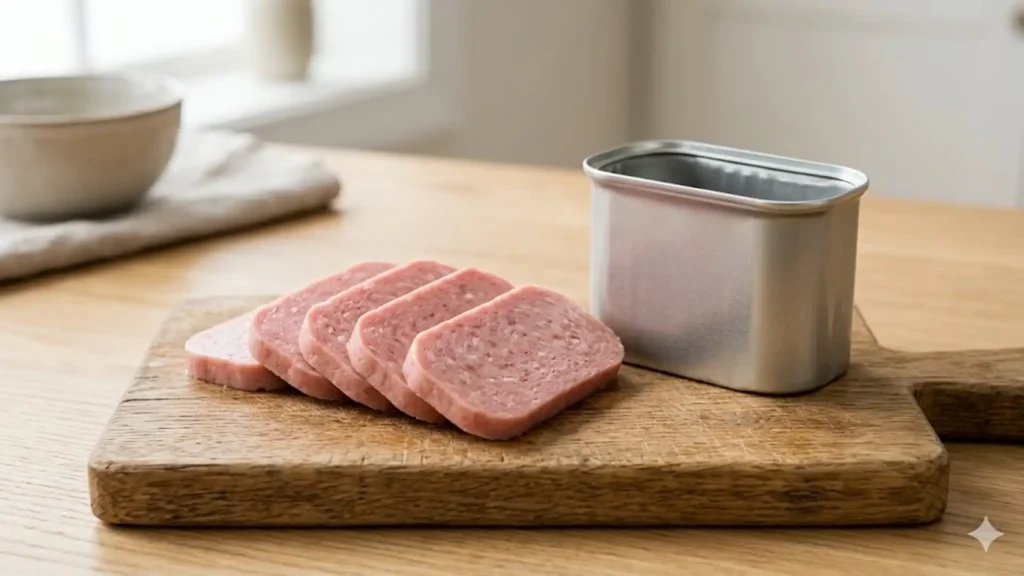
A standard 2-ounce serving of Spam Classic, which is one-sixth of the can, has 180 calories, 16 grams of fat, 7 grams of protein, and 790 milligrams of sodium, with 40 milligrams of cholesterol and just 1 gram of carbohydrate. That is the short answer. The longer answer, the one that actually decides whether Spam fits your plate, is about the balance of that profile: a lot of fat and a lot of sodium wrapped around a modest amount of protein, in a shelf-stable form that does not spoil.
I read a lot of canned-food labels for this site, and Spam is one of the most misunderstood. People either treat it as junk or defend it as a protein source, and the truth sits in between. The protein is real but not large; the fat is the dominant macro; and the sodium is the line that does the most work in the day’s budget. So let me walk through the full panel, lay the varieties side by side, explain what is actually in the can, and put Spam next to the other canned and breakfast meats people compare it to.
Spam Classic Nutrition Facts
Here is the complete panel for one labeled serving of Spam Classic. A serving is 56 grams, or 2 ounces, which is one-sixth of the standard 12-ounce can.
| Nutrient | Per 2 oz (56 g) serving | % Daily Value* |
|---|---|---|
| Calories | 180 kcal | – |
| Total fat | 16 g | 21% |
| Saturated fat | 6 g | 30% |
| Trans fat | 0 g | – |
| Cholesterol | 40 mg | 13% |
| Sodium | 790 mg | 34% |
| Total carbohydrate | 1 g | 0% |
| Dietary fiber | 0 g | 0% |
| Total sugars | 0 g | – |
| Protein | 7 g | 14% |
| Potassium | 170 mg | 4% |
| Zinc | 1 mg | 7% |
*Percent Daily Values are based on a 2,000-calorie diet. Your own values may be higher or lower depending on your calorie needs.
The number that defines Spam is sodium. At 790 milligrams, a single 2-ounce slice uses up about 34 percent of the 2,300-milligram daily ceiling that federal guidance recommends, and that is before anything you serve it with. The fat is the next headline: 16 grams, including 6 grams of saturated fat, which means fat supplies roughly 80 percent of the calories in the serving. The protein, at 7 grams, is genuine but modest, less than you would get from a couple of eggs. The carbohydrate is almost nothing, which is why Spam shows up in low-carb cooking. Spam also carries small amounts of zinc, potassium, and iron from the pork, though not enough to count it as a meaningful source of any of them.
So the honest summary of the panel is a fat-and-salt-forward meat with a side of protein. That is not a verdict, it is a description; whether it fits depends entirely on the rest of your day and how much you eat.
How the Spam Varieties Compare

Spam is not one product. The lineup spans a Classic, a reduced-sodium version, a lower-fat Lite, and several flavored cans, and the differences on the label are large enough to matter. Here is how the main varieties stack up per 2-ounce serving.
| Spam variety (2 oz) | Calories | Total fat | Sodium | Protein |
|---|---|---|---|---|
| Spam Classic | 180 kcal | 16 g | 790 mg | 7 g |
| Spam 25% Less Sodium | 180 kcal | 16 g | 580 mg | 7 g |
| Spam Lite | 110 kcal | 8 g | 580 mg | 9 g |
| Spam Hickory Smoke | 170 kcal | 15 g | 790 mg | 7 g |
| Spam with Tocino (flavored) | 180 kcal | 15 g | 820 mg | 7 g |
The two varieties worth knowing are Spam Lite and Spam 25% Less Sodium. Spam Lite cuts the fat roughly in half and drops the calories to 110, which is the single biggest nutritional improvement in the lineup; it does this by using a blend of pork and chicken and trimming the fat. The 25% Less Sodium version keeps the Classic fat and calories but pulls sodium down to about 580 milligrams, which is the version to reach for if salt is your main concern. The flavored cans, such as Hickory Smoke or the jalapeno style, sit close to Classic on fat and calories and sometimes run slightly higher on sodium. If you eat Spam regularly, switching from Classic to Lite or Less Sodium is a far bigger lever than changing your portion by a slice.
One detail that trips people up is that none of the varieties is genuinely low in sodium in absolute terms. The 25% Less Sodium can is lower than Classic, but at roughly 580 milligrams per serving it still delivers about a quarter of the day’s ceiling in one slice. Spam Lite lands at the same sodium level as the reduced-salt can while also cutting fat and calories, which arguably makes Lite the most balanced all-around choice if you want both numbers down at once. The takeaway is that there is no version of Spam you can eat without accounting for the salt; the cans only differ in how much salt, not in whether it matters.
What Is Actually in a Can of Spam
The panel makes more sense once you know the ingredients, and Spam Classic has a famously short list: pork with ham, salt, water, modified potato starch, sugar, and sodium nitrite. The pork and ham supply the protein and most of the fat. The salt is the second ingredient by weight, which is exactly why the sodium number is so high; salt is doing double duty as flavor and as a preservative. The modified potato starch binds the loaf and accounts for that single gram of carbohydrate. The pinch of sugar balances the salt, and the sodium nitrite is a curing agent that keeps the color stable and inhibits bacterial growth, the same compound used in ham, bacon, and other cured meats.
That nitrite is the ingredient that draws the most concern, and it is worth a clear-eyed note. Cured and processed meats are classified by health authorities as a group linked to higher risk of certain cancers when eaten frequently over time, and Spam falls squarely in that category. The NIH MedlinePlus overview of dietary sodium also flags processed and canned foods as a leading driver of excess salt intake. None of this makes an occasional serving dangerous, but it does mean Spam belongs in the occasional-food column rather than the daily-staple column for most people, and the reasoning is the processing and the sodium, not the protein.
For anyone judging ingredient quality rather than just macros, the takeaway is that Spam is a cured, salted pork product, not a slice of fresh pork. The protein is real, but it comes packaged with a fat and sodium load that is baked into the format and cannot be drained or rinsed away in any meaningful amount. The variables you control are the variety you buy and how much you put on the plate.
The Protein Question
Because Spam is shelf-stable and cheap, it gets treated as a convenient protein, and it is worth measuring that claim. Seven grams of protein in a 2-ounce serving is decent but not high, and it arrives alongside 16 grams of fat, so the protein-to-calorie return is poor compared with leaner options. For context, two large eggs deliver about 12 grams of protein for 140 calories and a fraction of the sodium, and a 2-ounce serving of plain chicken breast offers far more protein for far less fat. The MedlinePlus guide to protein in the diet is a clear primer on how much protein a typical adult actually needs and where it is best sourced.
That does not make Spam worthless as a protein. In a meal that already leans on vegetables, rice, or eggs, a slice or two adds savory flavor and some protein for a low price and zero prep. The trouble is using it as the main protein anchor of a meal, because to hit a real protein target you would have to eat enough Spam to take on a heavy fat and sodium load. As a flavor-and-texture component it earns its place; as the centerpiece it costs more than it returns.
How Spam Compares to Other Canned and Breakfast Meats
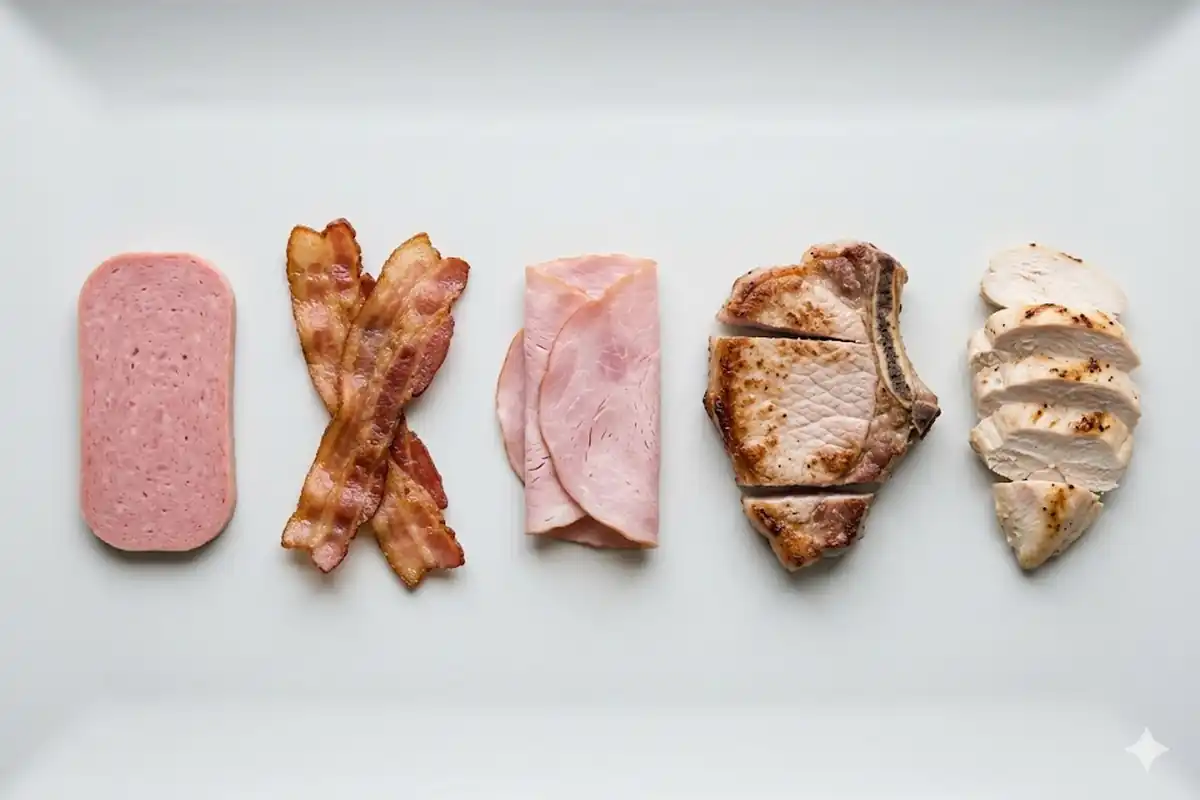
Numbers only mean something next to alternatives, so here is how a 2-ounce serving of Spam Classic lines up against the meats people most often weigh it against.
| Meat (2 oz) | Calories | Total fat | Sodium | Protein |
|---|---|---|---|---|
| Spam Classic | 180 kcal | 16 g | 790 mg | 7 g |
| Bacon (cooked) | 180 kcal | 14 g | 740 mg | 12 g |
| Deli ham | 70 kcal | 2 g | 760 mg | 10 g |
| Pork chop (fresh, cooked) | 120 kcal | 5 g | 45 mg | 18 g |
| Chicken breast (cooked) | 95 kcal | 2 g | 45 mg | 18 g |
The comparison that surprises people most is Spam versus regular bacon. Slice for slice, bacon is saltier and fattier per gram, but you tend to eat less of it, so a typical bacon portion can land lower in total sodium than a 2-ounce Spam slice. Against deli ham, Spam carries far more fat for similar sodium, because ham is leaner. Against a fresh pork chop or chicken, there is no contest on fat and sodium; the fresh meats win easily, which is the cleanest illustration of what the canning and curing add. Spam’s edge is not nutrition; it is shelf life, price, and the specific fried-edge flavor that fresh meat does not replicate.
The deli-ham line in the table is the one worth dwelling on, because it shows where the calories really live. Ham and Spam carry almost the same sodium, but ham is around 70 calories per 2 ounces while Spam is 180, and that 110-calorie gap is almost entirely fat. If your reason for buying Spam is the salty, savory, sliceable quality rather than the fried texture, lean deli ham or Canadian bacon gives you a similar role on the plate for a fraction of the fat and calories. If it is specifically the crisped, dense, pan-fried Spam experience you are after, nothing else quite matches it, and that is a flavor preference worth paying the calorie cost for occasionally rather than daily.
Cooking Spam and Keeping the Numbers in Check
How you cook Spam changes the eating experience more than the label. Pan-frying renders some fat out of the slice, which drains into the pan rather than your plate, so a crisped slice can end up slightly lower in fat than the raw label suggests, though the difference is modest and the sodium does not go anywhere. The bigger lever is what you pair it with. Spam works in fried rice, in a breakfast scramble, in the Hawaiian musubi tradition, and as a sliced addition to soups and stews, and in every one of those uses it functions best as a salty accent rather than the bulk of the dish.
Because Spam is so low in carbohydrate, it slots neatly into low-carb and keto cooking, where its fat content is a feature rather than a flaw; the lighter keto dinner ideas in this keto dinners collection show how a salty cured meat can anchor a low-carb plate without adding starch. On the other end, a thin slice or two stirred into a brothy pot is a classic way to stretch flavor across a meal, and the hearty bean soups from our network are a natural home for it, where the beans bring the fiber and bulk that Spam lacks. The principle in both cases is the same: let Spam season the dish, and let something else carry the volume.
Fitting Spam Into a Daily Plan
If you log your food, Spam Classic is easy to account for once you respect the serving: 180 calories, 16 grams of fat, 7 grams of protein, and 790 milligrams of sodium per 2-ounce slice. The discipline is the sodium, which is the budget that tightens fastest. A single serving uses a third of the day’s ceiling, so a two-slice breakfast plus any other salty food can push you past the limit before dinner. If you know a salty meal is coming later, the 25% Less Sodium can is the version that keeps the day in range.
For a roughly 2,000-calorie day, one serving of Spam fits comfortably as part of a meal that also brings vegetables, eggs, or a starch. Two or three slices as the protein of a meal is where the fat and sodium start to dominate. The simplest rule is to treat Spam like a cured meat, which it is: a flavorful accent eaten in modest amounts, not a lean protein eaten by the plateful. Drinking water with a salty meal and balancing it with lower-sodium foods across the day keeps a slice of Spam from running the whole sodium budget.
It also helps to think about Spam in the context of the whole can rather than the single slice, because that is how it is usually eaten. A 12-ounce can is six servings, which means a can split between two people at one meal is three slices each, or roughly 540 calories and nearly 2,400 milligrams of sodium per person, the entire daily ceiling in one sitting. That arithmetic is not a reason to never open a can; it is a reason to portion it. Slicing the can thin, using two slices rather than three, and saving the rest for later meals turns a single high-sodium event into several modest ones, which is far easier on the day’s budget and on anyone managing blood pressure.
Where These Numbers Come From
The figures here reflect Hormel’s published nutrition data for Spam sold in the United States. Values can shift slightly when a recipe or supplier changes, so the panel on the can is always the final word for a specific product. For the underlying nutrient data behind pork and cured meats, the USDA FoodData Central database is the reference standard, and the FDA’s interactive Nutrition Facts label explains how to read every line on the panel above. For why restaurant and packaged foods drive so much of the average sodium intake, the CDC’s overview of sodium and health is a useful primer.
For more protein breakdowns in the same format, see our look at the sausage patty nutritional info and the full Big Mac nutrition facts panel.
Frequently Asked Questions
How many calories are in a serving of Spam?
A 2-ounce serving of Spam Classic, one-sixth of the can, has 180 calories. Spam Lite drops to 110 calories per serving by cutting the fat roughly in half, while the flavored varieties stay close to Classic at around 170 to 180 calories.
How much sodium is in Spam?
Spam Classic contains 790 milligrams of sodium per 2-ounce serving, about 34 percent of the recommended daily limit of 2,300 milligrams. The 25% Less Sodium version brings that down to roughly 580 milligrams, which is the better choice if you are watching salt.
Is Spam a good source of protein?
Spam provides 7 grams of protein per serving, which is modest and comes packaged with 16 grams of fat. It is a fine flavor accent in a meal, but it is an inefficient protein anchor compared with eggs or chicken, which deliver more protein for far less fat and sodium.
Is Spam healthy?
Spam is best treated as an occasional food rather than a daily staple. It is high in fat and sodium and is a cured, processed meat, a category linked to higher health risk when eaten frequently. Eaten in a modest serving as part of a balanced meal, it fits most diets; eaten daily or in large portions, the fat and sodium add up quickly.