Nutrition information for goldfish crackers starts with one number the bag rarely prints in plain sight: a single serving is 30 grams, or about 55 of those little baked fish. Everything else on the panel follows from that measure. Pepperidge Farm lists 140 calories in that serving, 20 grams of total carbohydrate, and 250 milligrams of sodium for the classic Cheddar variety. Read the way it is meant to be read, the nutrition information for goldfish crackers is not a mystery. It is a set of five figures you can act on.
Those figures come from the manufacturer’s own label. The context, the part that tells you whether 250 milligrams is a lot, comes from the U.S. Food and Drug Administration (FDA) and its Percent Daily Value system. Put the two together and a bowl of Goldfish stops being a guess.
Quick answer: nutrition information for goldfish crackers, in the Cheddar version, means 140 calories per 30-gram serving of about 55 pieces. That serving carries 20 grams of total carbohydrate (7 percent of the Daily Value), 250 milligrams of sodium (11 percent), and 0 grams of both total and added sugars. By the FDA’s own yardstick, where 5 percent Daily Value counts as low and 20 percent as high, the sodium sits squarely in the middle. Goldfish are a moderate-sodium, sugar-free, carbohydrate-forward snack best measured by the handful, not the box.
What a 30-Gram Serving of Cheddar Goldfish Really Holds
A 30-gram serving of Cheddar Goldfish holds 140 calories, 20 grams of total carbohydrate, and 250 milligrams of sodium, with 0 grams of sugar of any kind. Pepperidge Farm counts that serving as roughly 55 individual crackers. Those are the anchor numbers.
The sodium line is the one to watch, and it behaves much like the number in our breakdown of Club Crackers sodium: moderate per serving, easy to stack across a day. Read against the Percent Daily Value column, carbohydrate comes in at 7 percent and sodium at 11 percent. That tells you the snack spends more of its daily budget on salt than on anything else it declares. The calorie figure, 140, is the one parents eyeball first. On the panel, sodium does more work.
Two things make the serving easy to misjudge. First, 55 pieces disappears fast when a handful is 20 or 30 fish. Second, the panel describes plain Cheddar, not the flavor-blasted or graham versions, which carry their own numbers. Anchor to Cheddar and you have a fixed reference. Stray to a different bag and the whole panel shifts underneath you.
Nutrition Information for Goldfish Crackers, Read Line by Line
Reading the panel top to bottom turns a wall of numbers into a short story. The serving size sits first: 30 grams, about 55 pieces. Calories come next at 140. Then the macronutrient lines, led by 20 grams of total carbohydrate at 7 percent of the Daily Value.
Total sugars read 0 grams, and added sugars read 0 grams, which is rarer than it sounds for a salty snack. Sodium closes the headline figures at 250 milligrams, or 11 percent of the Daily Value. The FDA standardized this order and the Percent Daily Value column so a shopper can compare a cracker to a cookie without a calculator. Every figure here is per serving, not per bag, and the bag holds many servings. That single distinction is where most misreadings begin. A pour is not a serving.
Here is the same panel laid flat, using the Cheddar figures Pepperidge Farm publishes on its official Cheddar Goldfish nutrition page.
| Nutrient | Amount per 30 g | Percent Daily Value |
|---|---|---|
| Total carbohydrate | 20 g | 7 percent |
| Total sugars | 0 g | – |
| Added sugars | 0 g | – |
| Sodium | 250 mg | 11 percent |
The Percent Daily Value column is the shortcut. It converts grams and milligrams into a share of a full day, so 7 percent carbohydrate and 11 percent sodium tell you at a glance where the snack leans. Nutrition.gov, the federal consumer nutrition portal, points shoppers to that same column when they want to compare two products fast. Read the fish that way and the verdict writes itself. Light on carbohydrate load. Silent on sugar. Middling on salt.
The 250 mg Sodium Question: Moderate, Not Alarming
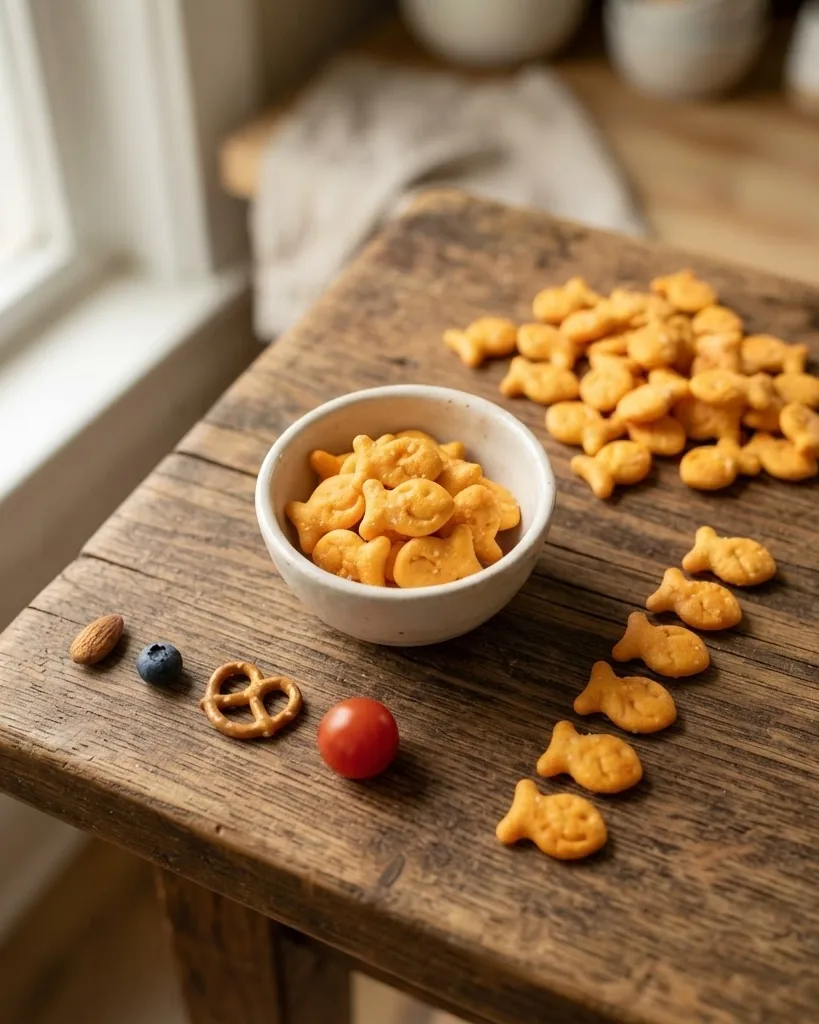
At 250 milligrams per serving, the sodium in Cheddar Goldfish reaches 11 percent of the Daily Value. The FDA draws two lines that make sense of that figure: 5 percent Daily Value or less is low, and 20 percent or more is high. Eleven percent falls between them.
That places Goldfish sodium in the moderate band, closer to low than to high, but not negligible. One serving will not blow a daily sodium budget. Three or four servings, poured without measuring, can quietly claim a large share of it. The number itself is fixed by the manufacturer. The meaning comes from where it lands on the FDA scale. This is why the sodium line, not the calorie line, is the one worth tracking for anyone counting salt across a full day of meals and snacks.
The FDA spells out this framework in plain language on its guide to high and low Percent Daily Values, the same benchmark that applies to every packaged food in a U.S. store. It is not a Goldfish rule. It is the rule for the shelf.
The Centers for Disease Control and Prevention (CDC) treats sodium as a population-level concern, watching how much of it Americans get from packaged and restaurant foods rather than from the shaker. Snack crackers are exactly the kind of everyday item that adds up in that accounting. That does not make a single serving of Goldfish a problem. It makes the fifth handful the one to notice.
Keeping the 250 milligrams honest is mechanical:
- Pour one 30-gram serving into a bowl instead of eating from the bag, so 250 milligrams stays 250 milligrams.
- Pair the crackers with a low-sodium food, such as plain fruit, to balance the snack.
- Track the 11 percent against the rest of the day, not against the snack alone.
Zero Grams of Sugar: What the Carbohydrate Line Hides
Cheddar Goldfish list 0 grams of total sugars and 0 grams of added sugars, which is unusual for a snack this crave-able. All 20 grams of carbohydrate in a serving come from starch, not sweetener. The flavor people read as moreish is salt and cheese.
That matters because added sugars now carry their own Daily Value line on every U.S. label, and Goldfish contribute nothing to it. For a parent scanning for hidden sugar, the fish clear that particular bar cleanly. The carbohydrate itself, 20 grams at 7 percent of the Daily Value, still counts toward the day. It simply arrives without the sugar spike a sweetened snack delivers. A savory carbohydrate load behaves differently on the palate and on the panel than a sweet one.
That is the opposite of what a sweetened cereal shows. Set the fish beside our look at the Fruit Loops label and its sugar grams and the contrast is stark. One leans on sugar for flavor. The other leans on salt and cheese. Neither is a health food. They spend their carbohydrate budget in different places, and the panel shows exactly where.
55 Fish in a Bowl: Turning Grams Into Handfuls
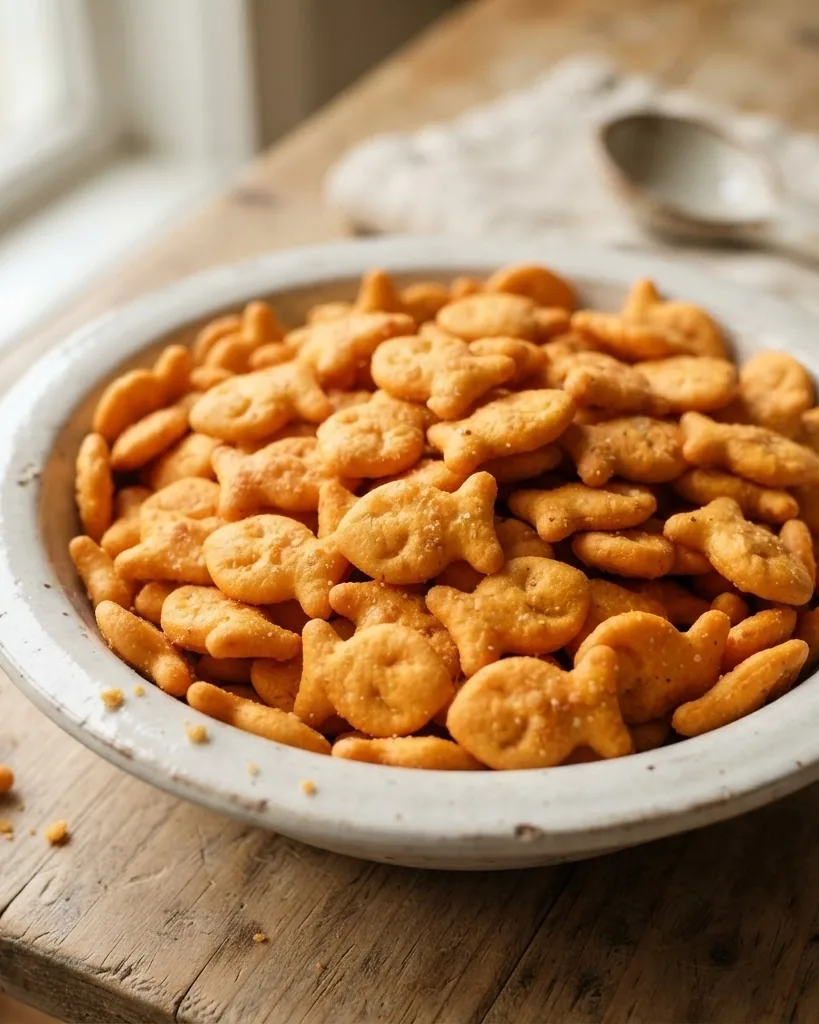
A 30-gram serving is about 55 Goldfish, and 55 is fewer than it feels. A loose adult handful runs 20 to 30 fish, so two handfuls already pass one serving and its 250 milligrams of sodium.
A child’s bowl filled to the brim can hold two or three servings without looking like much. This is the gap between the panel and the pour. The label describes 55 pieces. Real life describes a pour nobody counts. If you want the 140 calories and 250 milligrams on the panel to match what actually gets eaten, the fix is simple: measure the 30 grams once, see what 55 fish looks like in your bowl, and use that picture from then on. The eye learns the portion faster than the scale does.

Enriched Wheat Flour, Real Cheddar, and Annatto on the Ingredient Line
The ingredient line behind the numbers starts with enriched wheat flour and real cheddar cheese, colored with annatto, a plant-based extract. Enriched wheat flour is why the 20 grams of carbohydrate lead the panel. Real cheddar is why sodium and savory flavor run high while sugar stays at 0.
Annatto, drawn from the seeds of the achiote tree, gives the fish their orange color without synthetic dye. Those three ingredients do most of the work you taste. Because wheat flour is the base, Goldfish contain gluten. Because real cheese is in the recipe, they contain milk. The crackers are baked, not fried, which shapes the fat and calorie profile differently than a fried chip of the same size. None of this changes the headline figures. It explains why they land where they do.
For anyone managing allergens, two lines matter most. Wheat puts gluten on the label, so Goldfish are not celiac-safe. Milk from the cheddar rules them out for a dairy allergy or a strict dairy-free diet. The United States Department of Agriculture (USDA) maintains the national nutrient reference data that standardizes how ingredients like enriched flour and cheese get reported, which is why the same cheddar cracker reads consistently from one database to the next.
The short version for label-scanners:
- Contains wheat, so it carries gluten.
- Contains milk from real cheddar cheese.
- Baked, not fried.
- Colored with annatto, not synthetic dye.
Goldfish in a Kid’s Daily Diet: Where the Sodium Adds Up
For a child, one 30-gram serving of Goldfish delivers 140 calories and 250 milligrams of sodium, and the question is not the single serving but the count over a day. A young child eats less total food than an adult, so 11 percent of the adult Daily Value for sodium represents a larger slice of a small eater’s day.
That does not make the snack unfit for kids. It makes portion the deciding factor. One measured serving alongside fruit and water is a reasonable snack. A bag handed over in the car and refilled twice is where the sodium stops being moderate. The sugar side is easy: 0 grams total and 0 added means no sweetener to worry about at all. The lever parents actually control is how many of the 55 fish land in the bowl.
Balance is the frame that fits. Goldfish are a carbohydrate-and-salt snack with no sugar, a better profile than many sweetened alternatives and a worse one than plain produce. Federal nutrition guidance keeps returning to the same idea: a single food is rarely the problem, and moderation across the day is the tool. Set the fish inside a snack rotation, watch the sodium tally, and the 250 milligrams stays a footnote rather than a headline.
Cheddar vs Original vs Whole Grain: Why the Panels Differ
Every Goldfish flavor carries its own Nutrition Facts panel, and the figures in this guide are the Cheddar ones: 140 calories, 20 grams of carbohydrate, 250 milligrams of sodium, and 0 grams of sugar per 30-gram serving. Original, Whole Grain, and the Crisps line are formulated differently.
Their calorie, sodium, and carbohydrate numbers do not automatically match Cheddar’s, so carrying the Cheddar figures across the whole range is a mistake. The one detail that does hold true across flavors is the method: they are baked, not fried. For any specific flavor, the move is the same one that works for Cheddar. Find the 30-gram serving. Read the sodium and carbohydrate lines. Check each against the Percent Daily Value column. The flavor changes the taste and the exact numbers. It does not change how you read the label.
Frequently Asked Questions
How many calories are in a serving of Goldfish crackers?
A single 30-gram serving of Cheddar Goldfish contains 140 calories, according to Pepperidge Farm. That serving is about 55 crackers. Because the bag holds several servings, a casual pour easily doubles or triples the 140 figure. Measure the 30 grams once and the calorie count stays predictable across snacks.
How much sodium is in Goldfish crackers?
One 30-gram serving of Cheddar Goldfish carries 250 milligrams of sodium, which is 11 percent of the Daily Value. On the FDA scale, where 5 percent is low and 20 percent is high, that lands in the moderate band. It is the number worth tracking most across a full day of meals and snacks.
Do Goldfish crackers have sugar?
No. Cheddar Goldfish list 0 grams of total sugars and 0 grams of added sugars per 30-gram serving. All 20 grams of carbohydrate come from starch in the enriched wheat flour, not from sweetener. That makes the nutritional information for goldfish crackers unusual among crave-able snacks, which often lean on sugar for their pull.
How many Goldfish crackers are in one serving?
A standard serving is 30 grams, which Pepperidge Farm counts as roughly 55 individual crackers. A loose adult handful runs smaller than that, around 20 to 30 fish, so two handfuls clear a serving. Measuring 30 grams once shows you what 55 pieces looks like in your own bowl, and the eye takes over after that.
Are Goldfish crackers baked or fried, and do they contain allergens?
Goldfish are baked, not fried. They are made with enriched wheat flour and real cheddar cheese, so they contain both wheat gluten and milk. That rules them out for celiac and dairy-free diets. Annatto, a plant extract from the achiote tree, supplies the orange color instead of a synthetic dye.
Are Goldfish crackers healthy for kids?
In measured portions, they fit a balanced diet. One serving brings 140 calories, 250 milligrams of sodium at 11 percent of the Daily Value, and 0 grams of sugar. The sugar side is clean. The sodium is the part to watch when handfuls multiply. Pair a single serving with fruit and water.
The Bottom Line on the Goldfish Panel
The panel is short, and the read is simple. It comes down to five figures: 140 calories, 20 grams of carbohydrate, 250 milligrams of sodium, and 0 grams of both total and added sugars, all per 30-gram serving of about 55 pieces. The sodium is the line that moves, sitting at 11 percent of the Daily Value, moderate on the FDA scale but easy to multiply by the handful. The sugar is a non-issue. The carbohydrate is starch, not sweetener.
If you want the numbers on the bag to match the numbers in the bowl, measure the 30 grams once and let your eye do the rest. For a nearby cheese comparison, our piece on what a single cheese slice label really buys uses the same read-the-panel approach on a very different food.