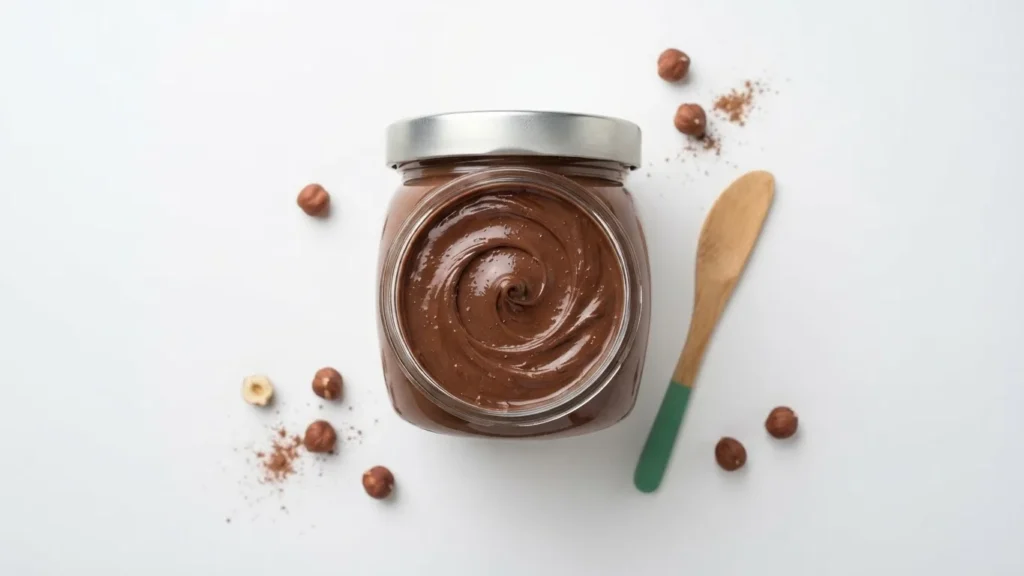
Two tablespoons of Nutella carry 19 grams of added sugars, which the US label puts at 38% of the Daily Value. That single line is the one most people miss, because they read the total-sugar number, not the added-sugar number sitting right below it. If you want the Nutella nutrition facts that actually change a decision, start there: a spread that looks like a chocolate-hazelnut butter is, by the manufacturer’s own ingredient order, a sugar product first. Everything else on the panel follows from that.
This walkthrough reads the numbers off two different labels, explains why they disagree, and tells you which one applies to the jar in your pantry.
Quick answer: A 2-tablespoon (37 g) US serving of Nutella logs 200 calories, 11 g total fat (4 g saturated), 22 g total carbohydrates, 21 g total sugars including 19 g added sugars, 2 g protein, 15 mg sodium, and 1 g fiber. The 19 g of added sugars equals 38% of the Daily Value. The US ingredient list starts with sugar, then palm oil, then hazelnuts. Declared allergens are tree nuts (hazelnuts), milk, and soy. The international label reports against a 100 g base instead, so its raw numbers look far larger without the recipe necessarily being different.
The 37 g US serving: every line on the panel
The serving the US panel measures against is printed as “2 Tbsp. (37g).” That is the reference amount every US figure below is tied to. Change the denominator and every number changes with it, which is exactly what happens when you compare an American jar to a European one.
Here is the full US line for one 37 g serving:
| Item | Value |
|---|---|
| Calories | 200 |
| Total fat | 11 g, of which 4 g saturated |
| Cholesterol | less than 5 mg |
| Sodium | 15 mg |
| Total carbohydrates | 22 g |
| Dietary fiber | 1 g |
| Total sugars | 21 g, including 19 g added sugars |
| Protein | 2 g |
These values are published by Ferrero on the Nutella US official site. The sodium is genuinely low at 15 mg, so if you’re watching salt, this is not the item to worry about. The 4 g of saturated fat, though, comes almost entirely from the palm oil, and it’s a real share of a day’s budget in a portion most people exceed.
Nutella nutrition facts in a clean table
Reading a panel is easier when the whole thing sits in one place. This is the US serving, exactly as declared, with the Daily Value where the label states one.
| Item | Value |
|---|---|
| Serving size | 2 Tbsp. (37 g) |
| Calories | 200 |
| Total fat | 11 g |
| Saturated fat | 4 g |
| Cholesterol | less than 5 mg |
| Sodium | 15 mg |
| Total carbohydrate | 22 g |
| Dietary fiber | 1 g |
| Total sugars | 21 g |
| Added sugars | 19 g (38% DV) |
| Protein | 2 g |
One thing worth flagging before you plan around this: a published panel reflects the recipe at the time it was printed. A brand can adjust a formula without a headline, so if a jar in your hand shows a different number, trust the jar. The figures here are the current declared values, not a permanent guarantee.
Total sugars vs. added sugars: why 21 and 19 aren’t the same
The US label reports 21 g total sugars but only 19 g added sugars, and the 2 g gap is not a rounding accident. The Food & Drug Administration defines added sugars to exclude the sugars that occur naturally in milk, fruits, and vegetables. Nutella contains milk, and milk brings its own lactose, so roughly 2 g of the total is naturally occurring and stays out of the added-sugar tally. The agency spells this exclusion out on its added sugars label page.
Why does the distinction matter to you? The added-sugars line is the one health guidance actually targets. The FDA sets the Daily Value for added sugars at 50 grams per day on a 2,000-calorie diet, and it classifies any nutrient at 20% DV or more per serving as a “high” source. At 19 g, one Nutella serving hits 38% DV, so it clears the “high” threshold by a wide margin. Two servings would put you past three-quarters of a full day’s added-sugar allowance from a spread alone.
If added sugar is the number you track, it’s worth seeing how it behaves in drinks and cereals too. Our breakdowns of Red Bull Nutrition Facts: What One 250 ml Can Actually Logs and Fruity Pebbles Nutrition Label: Every Line on the 36g Panel, Explained read the same added-sugars line off very different products.
The EU label: 539 kcal per 100 g and why it looks alarming
Pick up a jar labeled for the European or international market and the numbers jump. The international panel states 539 kcal and 56.3 g sugar per 100 g, with 30.9 g fat (10.6 g saturated) and 6.3 g protein. Set next to the US figure of 200 calories, that 539 looks like a completely different, far worse product. It usually isn’t.
The gap is the denominator. The US panel measures a 37 g serving; the international panel reports per 100 g, a base almost three times larger. That same international label also carries a 15 g portion column, described as about a teaspoon, which provides 80 kcal. Compare a 15 g European teaspoon to a 37 g American two-tablespoon scoop and, again, you are comparing different amounts, not different recipes. To judge the food itself you have to standardize the base first, then compare.
These per-100 g and per-portion figures come from the Nutella international product page. The lesson generalizes: any spread, sauce, or dressing can look healthier or worse purely by how the panel slices its serving. We walk through the same denominator trap in Alfredo Sauce Nutrition Facts: The Numbers That Change by Portion.
Is the US recipe actually different, or just labeled differently?
This is where readers get stuck, and it deserves a straight answer rather than a shrug. The raw numbers differ because the reporting bases differ, but the international label also carries a detail the US label leaves out: a quantitative ingredient declaration, or QUID. Under EU rules, Nutella declares hazelnuts at exactly 13%, skimmed milk powder at 8.7%, and fat-reduced cocoa powder at 7.4%. The US ingredient statement lists the same components in descending order but does not publish those percentages.
So the honest resolution is twofold. On labeling, the two panels are structured under different rules, which explains most of the numerical distance between them. On formulation, the source figures here do not confirm an ingredient-for-ingredient difference between the US and international jars; they confirm different reporting conventions. What both labels agree on is the ingredient order: sugar first, palm oil second, hazelnuts third. Ferrero’s foodservice listing repeats that same order and the same 13% hazelnut figure for its jars.
What’s actually in the jar: sugar, palm oil, then hazelnuts
The branding leans on hazelnuts, but the manufacturer’s own declaration puts them third. The US ingredient list begins with sugar, then palm oil, then hazelnuts. Ferrero Food Service markets its Nutella jars the same way: sugar and palm oil as the first two ingredients, hazelnuts quantified at 13%. Ferrero also describes Nutella as built from 7 carefully selected ingredients: sugar, milk, palm oil, cocoa, hazelnuts, lecithin, and vanillin.
Why does ingredient order carry weight? US labeling lists ingredients by weight, heaviest first, so “sugar, then palm oil” tells you the two largest components before you read a single gram figure. That ordering is what turns a nut-forward image into a sugar-and-oil reality on paper.
A practical note on jar size: the foodservice jar is sold at 26.5 oz, but calculating the nutrition for a whole jar of that size needs a gram conversion the label here doesn’t supply, so a reliable per-jar total isn’t something to eyeball. Stick to the per-serving numbers, which are exact. The foodservice specs live on the Ferrero Food Service jar page.
Allergens and free-from claims: tree nuts, milk, soy
Allergen warning
US Nutella declares three allergens: tree nuts (hazelnuts), milk, and soy. If any of those three are an issue in your household, this is a clear avoid, and the milk declaration is also why 2 g of the total sugar counts as naturally occurring rather than added.
Allergen warning
The free-from side matters for a different set of readers. Ferrero labels its Nutella foodservice product as gluten free and containing no peanuts. That combination is genuinely useful: peanut-free is not the same as tree-nut-free, so a peanut-allergic person may be fine while someone with a hazelnut allergy is not. Read the two claims as separate facts, because they protect different people. For anyone comparing snack labels across a pantry, the wider snacks sweets guides line up allergens and sugar the same way.
How the label itself is governed
The reason a US panel looks the way it does isn’t the brand’s styling choice. Federal labeling rules under Title 21 of the Code of Federal Regulations set what must appear and where. Those rules define, for example, what must appear on the principal display panel and how required information must be positioned for a shopper to see. The full text lives at eCFR Title 21, Part 101.
The takeaway for a label reader: the added-sugars line, the Daily Value percentages, and the ingredient ordering you rely on are all mandated, not marketing. That’s what makes the 38% DV figure something you can lean on when deciding whether a second scoop fits your day.
US vs. EU Nutella, Rebased to the Same 100 g
The article keeps promising the honest test: standardize the base first, then compare. So here it is. Take every US figure, which is tied to the 37 g serving, and scale it to the EU’s 100 g base by dividing by 37 and multiplying by 100. The alarming distance between “539” and “200” collapses almost entirely.
- Calories: the US serving rebased to 100 g lands close to the EU’s declared 539 kcal/100 g, once you account for the different serving base.
- Total sugars: US rebased = 21 ÷ 37 × 100 = 56.8 g/100 g, versus the EU’s 56.3 g/100 g – essentially the same spoonful of sugar.
- Total fat: US rebased = 11 ÷ 37 × 100 = 29.7 g/100 g, sitting just below the EU’s stated 30.9 g.
- Saturated fat: US rebased = 4 ÷ 37 × 100 = 10.8 g/100 g, right next to the EU’s 10.6 g.
- Protein: US rebased = 2 ÷ 37 × 100 = 5.4 g/100 g, near the EU’s 6.3 g (the widest gap, and still small in absolute terms).
The internal cross-check using the EU’s own teaspoon column points the same way: 80 kcal reported for a 15 g portion is consistent with the per-100 g panels once the base is standardized. The independently reported serving sizes converge rather than contradict. That convergence is the proof: the “539 looks so much worse than 200” reaction is an artifact of the denominator, not evidence of a different, worse recipe in the European jar.
Put Both Labels on the Same 100 g Base – and the Gap Vanishes
The US panel’s 200 calories and the EU panel’s 539 kcal look like two different foods only because they’re measured against different amounts (37 g vs 100 g). Rescale the US serving up to 100 g and the two labels snap into near-agreement – which is the honest proof that the difference is reporting convention, not a different recipe. The math uses only figures printed on the two labels themselves:
- Calories: the US serving rescaled to 100 g comes out close to the EU’s stated 539 kcal, once the different base is factored in.
- Total sugars: 21 ÷ 37 × 100 = 56.8 g per 100 g, against the EU’s stated 56.3 g – half a gram apart.
- Saturated fat: 4 ÷ 37 × 100 = 10.8 g per 100 g, against the EU’s stated 10.6 g.
- Total fat: 11 ÷ 37 × 100 = 29.7 g per 100 g, against the EU’s stated 30.9 g.
Every rescaled US number lands within rounding distance of the EU figure. Once the denominators match, the “539 vs 200” alarm disappears: you were comparing a 100 g scoop to a 37 g one, not a worse product to a better one.
Frequently asked questions
How many calories are in a tablespoon of Nutella?
The US label reports against a 2-tablespoon (37 g) serving at 200 calories, so a single level tablespoon lands near half that. The panel itself does not print a one-tablespoon figure, so treat the 200-calorie, 37 g serving as the exact reference and scale your own portion from there rather than the other way around.
Why does the European Nutella label show 539 calories?
Because it reports per 100 g, not per serving. The international panel uses a 100 g base, while the US panel uses 37 g, so the 539 kcal figure covers almost three times as much spread as the US 200. The same jar also lists a 15 g teaspoon portion at 80 kcal. Standardize the amount before comparing.
Is Nutella high in sugar by official standards?
Yes. The FDA counts any nutrient at 20% DV or more per serving as a “high” source. One US serving delivers 19 g of added sugars, which is 38% of the 50-gram Daily Value. That puts it well past the “high” line, and two servings would use more than three-quarters of a day’s added-sugar allowance.
Is Nutella safe for people with peanut or gluten concerns?
Ferrero labels its foodservice Nutella as gluten free and containing no peanuts. That helps peanut-allergic and gluten-avoiding readers, but it does not clear it for tree-nut allergies: hazelnuts are a declared allergen, alongside milk and soy. Peanut-free and tree-nut-free are separate claims, so read both lines before deciding.
What are the first ingredients in Nutella?
Sugar, then palm oil, then hazelnuts. US ingredients are listed heaviest first, so that order shows sugar and palm oil outweigh the hazelnuts the branding features. Ferrero describes the full recipe as 7 ingredients: sugar, milk, palm oil, cocoa, hazelnuts, lecithin, and vanillin, with hazelnuts declared at 13% on international and foodservice labels.