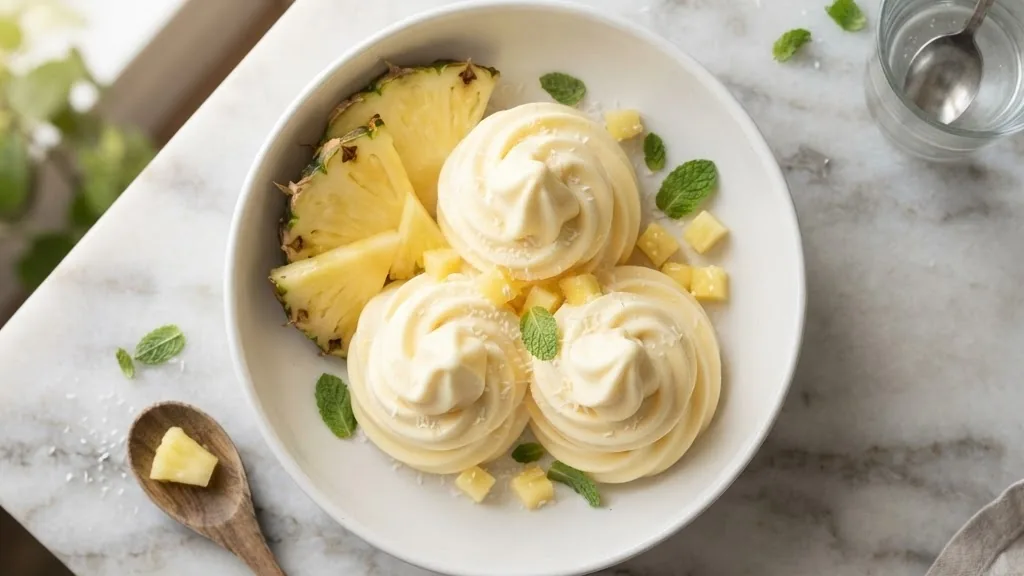
The dole whip nutrition facts hold a few surprises once you actually read the label instead of just enjoying the swirl. A classic pineapple Dole Whip cup lands at about 110 calories, carries 0 g of fat, and packs roughly 25 g of sugar into a small serving. It is dairy-free, vegan, and gluten-free, which makes it feel like a light choice. The catch is simple: fat-free does not mean low-sugar, and this frozen treat is basically sweetened pineapple. This one is worth a slow look.
Below is a breakdown of the real numbers, where the “90 versus 110 versus 330 calories” confusion comes from, and how the at-home mix stacks up against the Disney park cup and a float. If you like knowing what is in your food, the way you might compare a carton of heavy cream nutrition against a lighter swap, you will get a clear picture here.
Quick answer: A prepared 2/3-cup (117 g) serving of pineapple Dole Whip has about 110 calories, 0 g fat, 10 mg sodium, roughly 26 g of carbohydrate, and about 25 g of sugar, nearly all of it added sugar. That sugar figure is close to 50% of the FDA Daily Value in a single small cup. The dessert is fat-free, cholesterol-free, and dairy-free, but its calories come almost entirely from sugar, so it reads as a sweet treat, not a health food.
Dole Whip nutrition facts at a glance
Here is the label for a standard prepared serving of the classic pineapple flavor, based on the Dole Soft Serve mix used to make it. A serving starts as 2 Tbsp (28 g) of dry mix and whips up into about 2/3 cup (117 g) of soft serve once blended with water. The numbers below are for that prepared cup, which is the closest match to a small home portion. Bigger portions scale up from here, and the park-size swirl is covered in a moment.
| Nutrient | Per serving (2/3 cup, 117 g) | % Daily Value |
|---|---|---|
| Calories | about 110 calories | – |
| Total fat | 0 g | 0% |
| Cholesterol | 0 mg | 0% |
| Sodium | 10 mg | 0% |
| Total carbohydrate | about 26 g | roughly 9% |
| Total sugars | about 25 g | – |
| Added sugars | about 25 g | about 50% |
| Protein | 0 g | 0% |
A few things jump out. There is no fat and no cholesterol at all. Sodium is tiny at 10 mg, which is 0% of the daily target. Protein is zero. The carbohydrate line does almost all the work, and inside that line, sugar is nearly the whole story. When a food’s carbohydrate and its sugar count sit within a gram or two of each other, you are looking at a sweet, low-fiber product.
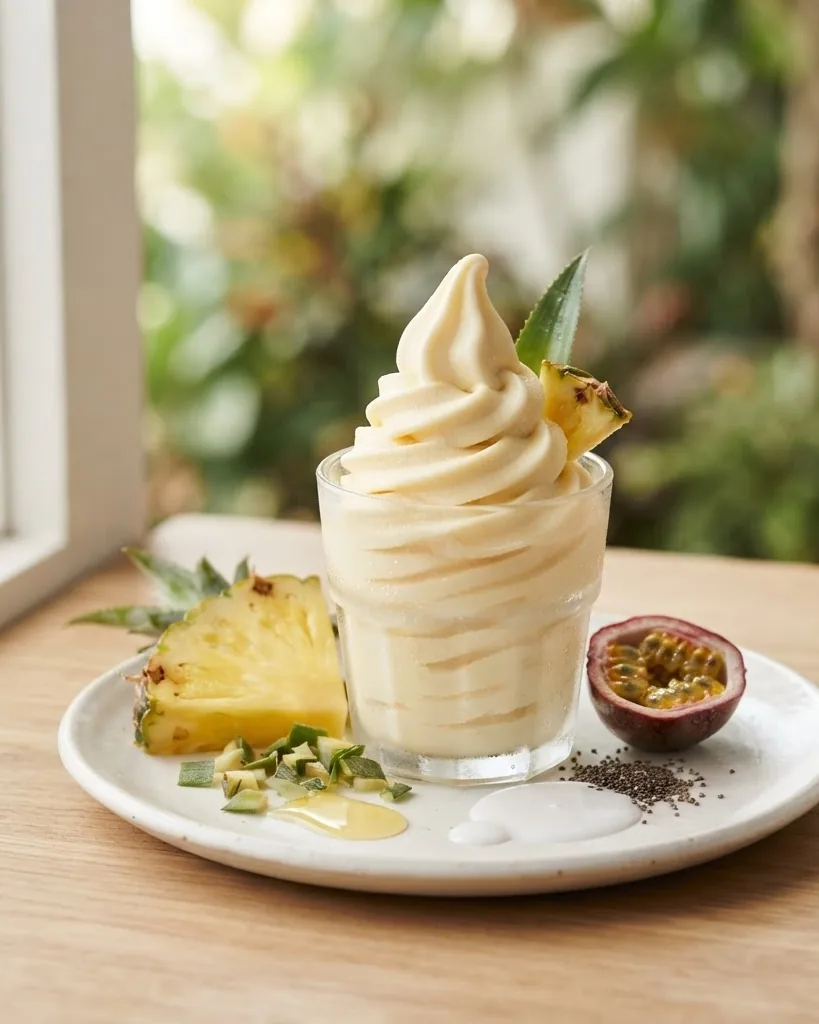
The sugar reality: fat-free but almost pure sugar
This is the part that databases skip. Dole Whip is fat-free, and that word makes people relax. But calories have to come from somewhere, and here they come from sugar. With about 25 g of sugar in a 110-calorie serving, roughly 90% of the calories in that cup are sugar. The FDA sets the Daily Value for added sugars at 50 g per day, so one small cup uses about half of that budget. Eat a larger swirl, add a float, or grab a second one, and you can pass a full day’s added sugar before dinner.
Context helps. The AHA suggests keeping added sugar under about 25 g (6 tsp, 100 calories) per day for women and about 36 g (9 tsp, 150 calories) per day for men. Read that again next to the label: one serving of Dole Whip can equal an entire day’s added-sugar allowance for a woman under the AHA guideline. That is not a reason to panic. It is a reason to count it as dessert and plan around it.
The sugar comes from pineapple juice concentrate and added sweeteners, not from high-fructose corn syrup in the classic pineapple mix. That is a small plus for people avoiding HFCS. Still, your body processes the sugar the same way regardless of the label’s marketing shine. If you are tracking carbs closely, this treat is not a fit for a low-carb plan. Compare it with the near-zero sugar of a fatty dairy swap and you can see why a keto diet plan would flag Dole Whip fast.
Dairy-free and vegan: what the label does and does not mean
Dole Whip has been made with only vegan ingredients since 2013, and it has always been gluten-free. There is no milk, no cream, no eggs, and no soy in the classic pineapple version. For anyone with a dairy allergy or lactose trouble, that is a genuine benefit, and it is a big reason the treat has such a loyal following at theme parks and at home.
Here is where it pays to slow down, though. Dairy-free and vegan describe what is not in the food. They say nothing about the sugar. It is easy to treat “vegan” as a green light and eat two large cups back to back, then wonder about the crash an hour later. The label is honest; the assumption is the problem. A plant-based dessert can still be a sugar-forward dessert.
The USDA FoodData Central database is a good habit if you want to sanity-check any product against a neutral source. You can look up pineapple, frozen desserts, and similar items and see the sugar and carbohydrate ranges for yourself. Cross-checking store labels against the USDA numbers is worth doing when something looks too good, and Dole Whip’s profile lines up: light on fat, heavy on sugar. You can browse those entries at https://fdc.nal.usda.gov/.
At-home mix versus Disney park cup versus a float
Most of the calorie confusion online comes from mixing up three different servings. Here they are separated clearly, because the same name hides very different portions.
- At-home mix, small cup: about 110 calories for a 2/3-cup (117 g) prepared serving. This is the label figure and the smallest common portion.
- Disney park cup: a standard theme-park serving is around 5 oz and lands near the same 110-calorie mark, but portions there are not standardized. A large swirl can climb to about 330 calories, which is roughly three label servings in one cup.
- Dole Whip float: pour pineapple juice over the swirl and you add about 150 calories of extra sugar, pushing a float toward 260 calories or more depending on the pour.
So when one site says 90 calories and another says 330 calories, both can be right. They are describing different amounts of the same dessert. The at-home mix gives you the most control because you decide the scoop size. The park version is a treat you are buying by the swirl, and the swirl is generous. None of this is a knock on the flavor. It just means the honest answer to “how many calories in a Dole Whip” is “it depends on the cup.”
Toppings, floats, and how the numbers climb
The base swirl is simple. The add-ons are where a light-sounding dessert turns into a heavy one. A classic Dole Whip float sets the pineapple soft serve into a cup of pineapple juice, and that juice brings roughly 150 calories and another big slug of sugar. Popular park variations layer on rum, spiced flavors, or a second scoop, and each of those pushes the total higher.
Here is the rough math to use when deciding how to order:
- Plain small swirl: about 110 calories, about 25 g sugar.
- Float with pineapple juice: about 260 calories, sugar well past 40 g.
- Large swirl, no float: about 330 calories, sugar near or above a full day’s added-sugar limit.
Fiber does not enter the picture here, which is part of why the sugar hits fast. There is essentially no fiber to slow it down. If steady energy matters to you, pairing sweets with fiber-rich food helps, and it is worth knowing your foods high in fiber so a sugary treat is not flying solo. None of this means skipping the Dole Whip. It means knowing what the extras cost before you order the deluxe version.
Who should watch the sugar
Plenty of people can enjoy a small Dole Whip with zero worry. Others have a good reason to be careful, and the reason is always the sugar, never the fat or salt. The CDC notes that most Americans already eat more added sugar than recommended, and that added sugars are linked to higher risk of weight gain, type 2 diabetes, and heart disease over time. A single dessert will not cause any of that. A daily habit of large sugary servings is the pattern that matters.
People managing blood sugar should treat this as a fast-acting carbohydrate. With about 26 g of carbohydrate and almost no fat, protein, or fiber to blunt the spike, Dole Whip can move glucose quickly. If you have diabetes or prediabetes, it is smart to fit it into your carb count and pair it with a meal rather than eating it alone on an empty stomach. The CDC and your care team can help you set targets that fit your own numbers.
Anyone tracking an added-sugar budget should log the whole serving, not a guess. Because the AHA daily limits are so close to a single serving’s sugar, the treat is easy to underestimate. A simple approach: one small cup, counted honestly, and no float on days that already included other sweets. That way it stays a treat without pretending to be something it is not.
Children are a group worth a special note. Kids love this treat, and a single small cup is fine as an occasional dessert. The CDC recommends that children under 2 years get no added sugar at all, and that older kids stay well under the adult limits. A large park swirl can hand a small child more than a full day’s sugar in a few minutes. You can read the agency’s added-sugar guidance at https://www.cdc.gov/ and set a portion that fits your family. For most kids, sharing one cup between two people keeps the sugar reasonable.
How Dole Whip compares to other frozen treats
Against regular dairy ice cream, Dole Whip usually wins on fat and calories. A half-cup of premium ice cream can run 250 to 300 calories with 15 g or more of fat, while the Dole Whip serving sits near 110 calories with 0 g of fat. On sugar, though, the gap narrows. Many ice creams carry a similar 20 to 28 g of sugar per serving, so trading ice cream for Dole Whip cuts fat and calories more than it cuts sugar.
Against sorbet, the two are close cousins. Both are dairy-free, fruit-forward, and sugar-heavy. Against frozen yogurt, Dole Whip has less protein, since froyo usually keeps some from the milk. The honest summary is that Dole Whip is a smart pick when you want a dairy-free, fat-free frozen dessert, and a poor pick when your main goal is cutting sugar. For that reason it belongs with sorbet and Italian ice rather than with lighter, protein-carrying options.
It also helps to think in trade-offs rather than good-versus-bad. If a dairy-free dessert is what you need, whether for an allergy or a plant-based diet, Dole Whip does that job with 0 g of fat and only 10 mg of sodium. If your main target is fewer grams of sugar, a bowl of fresh fruit does better, since whole pineapple carries fiber and water that this frozen mix strips out. A cup of fresh pineapple chunks runs about 80 calories with 16 g of sugar and around 2 g of fiber, so it lands lighter on sugar and adds fiber that Dole Whip lacks. Neither choice is wrong. They just serve different goals, and knowing the numbers lets you pick on purpose instead of by habit.
For any product, checking the label yourself still beats trusting a headline. The FDA runs the Nutrition Facts panel rules, and you can read how serving sizes and the added-sugars line are defined at https://www.fda.gov/. When a marketing claim and a label seem to disagree, the label wins. That single habit catches a lot of “healthy” desserts that are mostly sugar in a nice cup.
Making Dole Whip at home with fewer surprises
One upside of the at-home version is control. When you make the soft serve yourself, or blend a copycat from frozen pineapple, you set the portion and you can lighten the sugar. A common home method blends frozen pineapple with a splash of juice and a little sweetener, then freezes briefly for the swirl texture. That route lets you dial the sugar down from the 25 g label figure if you want, though you trade away some of the signature smoothness the commercial mix gives.
If you use the real Dole Soft Serve mix at home, the label numbers hold: about 110 calories and 25 g of sugar per 2/3-cup serving. Measuring the scoop is the whole game. A rounded, generous portion can quietly double the calories and sugar without feeling like much more food. A 2/3-cup measure kept near the freezer keeps a “small cup” a small cup. It is a low-effort way to keep the treat honest.
How to read the added-sugars line yourself
The added-sugars line is the number to look at first on any dessert, and Dole Whip is a clean example of why. The FDA added an added-sugars row to the Nutrition Facts panel so shoppers could separate natural sugar from sugar mixed in during processing. On this product, total sugars and added sugars sit at nearly the same figure, about 25 g, which tells you the sweetness is mostly built in rather than coming along with whole fruit and its fiber.
To do the quick check at home, find the added-sugars gram count, then compare it to the 50 g FDA Daily Value and to your own target. One serving at 25 g is about 50% DV, so two servings hit the whole daily value with nothing left for the rest of the day. Glance at the serving size in the same breath, because a panel can look modest until you notice the serving is small. A 2/3-cup serving is not a large bowl, so a real-life scoop often counts as more than one serving.
The other habit that pays off is checking fiber and protein next to the sugar. Here both are near zero, so nothing slows the sugar down. High sugar with no fiber and no protein means the food will hit fast and fade fast, so it works better planned as a treat than as a snack meant to hold you over. That three-second scan tells you more than any front-of-package claim, and it works on every product, not just this one.
Frequently asked questions
How many calories are in a Dole Whip?
A standard prepared serving of pineapple Dole Whip has about 110 calories in a 2/3-cup (117 g) portion. A typical theme-park cup is similar per ounce, but the park swirl is larger and a big one can reach about 330 calories. Add a pineapple-juice float and you tack on roughly 150 calories more.
Is Dole Whip dairy-free and vegan?
Yes. Dole Whip has been made with only vegan ingredients since 2013 and it is dairy-free and gluten-free, with no milk, eggs, or soy in the classic pineapple mix. It is fat-free and cholesterol-free too. The one thing to watch is sugar, not dairy, since a serving carries about 25 g of added sugar.
How much sugar is in Dole Whip?
About 25 g per 2/3-cup serving, and nearly all of it is added sugar. That is close to 50% of the FDA Daily Value of 50 g and near the full AHA daily limit of about 25 g for women. Larger swirls and floats push the sugar well past a single day’s recommended amount, so portion size matters a lot here.
Is Dole Whip healthy?
It is fat-free, dairy-free, and low in sodium at 10 mg, but it is high in sugar and has 0 g of protein and essentially no fiber. It is best treated as a dessert rather than a health food. The CDC and AHA both flag added sugar as the nutrient to limit, so a small, occasional cup fits most plans while a daily large float does not.
Does the Disney version differ from the at-home mix?
The recipe base is the same Dole Soft Serve product, so per-ounce numbers are close. The difference is portion and add-ons. Disney serves a larger swirl and offers floats and toppings, which raise the calories and sugar above the small at-home cup. The at-home mix gives you portion control the park version does not.