The Goldfish nutrition facts you actually need are simple once you fix the serving size: a standard handful of 55 cheddar Goldfish crackers, about 30 grams, has roughly 140 calories, 5 grams of fat, 250 milligrams of sodium, 20 grams of carbohydrate, and 3 grams of protein. Goldfish are the smiling little baked crackers that have been a lunchbox and snack-cabinet staple for decades, and most of the confusion around their nutrition comes not from the numbers themselves but from how big a portion you are really eating. A small carton bag, a movie-theater handful, and the back-of-package serving are three very different amounts.
If you pack them for your kids, snack on them at your desk, or just want to know where they land against other crackers, this guide breaks down the real numbers. We will cover the standard serving, the difference between the flavors and varieties, how Goldfish compare to Cheez-It and Ritz, what a sensible portion looks like for a child, and the sodium and refined-carbohydrate picture. The goal is not to label Goldfish good or bad but to give you the honest figures so you can portion them with your eyes open.
Goldfish nutrition facts at a glance
The values below are for one standard serving of original Cheddar Goldfish, which the package defines as 55 pieces, or about 30 grams. These figures come from the Pepperidge Farm nutrition label. They are stable and well-documented, but remember that 55 crackers is a measured handful, not a whole bag, so the totals climb quickly if you pour straight from a large carton.
| Nutrient | Amount per serving (55 pieces, 30g) | Percent Daily Value* |
|---|---|---|
| Calories | 140 | — |
| Total fat | 5 g | 6% |
| Saturated fat | 1 g | 5% |
| Trans fat | 0 g | — |
| Cholesterol | 5 mg | 2% |
| Sodium | 250 mg | 11% |
| Total carbohydrates | 20 g | 7% |
| Dietary fiber | 1 g | 4% |
| Total sugars | 0 g | — |
| Protein | 3 g | — |
*Percent Daily Values are based on a 2,000-calorie diet. Your own needs may be higher or lower. For independent reference values you can cross-check against the USDA FoodData Central database, which lists the same baked-cracker profile.
Calories in Goldfish crackers
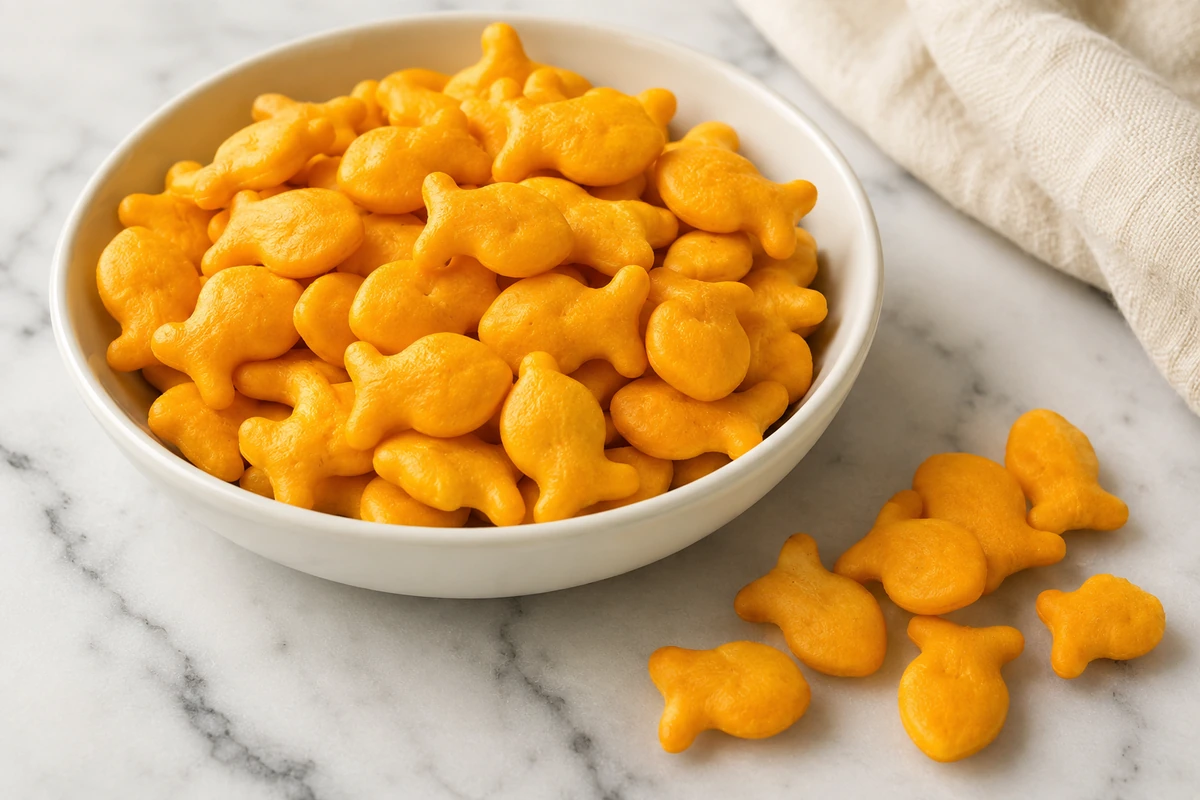
A standard 55-piece serving of cheddar Goldfish has about 140 calories. That is a moderate snack on its own, roughly 7 percent of a 2,000-calorie day. The catch is that 55 crackers is a smaller pile than most people pour, especially out of a big family carton, so the real-world calorie count is often double the label.
To put portions in perspective, a single-serve 1-ounce bag is about 150 calories, the small snack cartons sold in multipacks are usually one serving each, and a movie-theater-style handful poured from a large box can easily be 80 to 100 crackers, which lands around 220 to 250 calories. None of this makes Goldfish a high-calorie food, but it explains why a snack that looks light can add up. The crackers are small and easy to eat without counting, which is exactly the trap with any handheld snack.
Where the calories come from
Most of a Goldfish cracker’s calories come from refined carbohydrate, with fat in second place. The base is enriched wheat flour, so the carbohydrate is the dominant macro at 20 grams per serving. The fat comes from the vegetable oils used to bake them, and the small amount of cheddar contributes a little of the fat and most of the savory flavor. There is almost no sugar, which sets Goldfish apart from sweet snacks, but the refined flour means the carbohydrate digests fast.
The macros: carbs, fat, and a little protein
Per 55-piece serving, Goldfish deliver about 20 grams of carbohydrate, 5 grams of fat, and 3 grams of protein. This is a carbohydrate-forward snack, and understanding that shape tells you how it behaves.
Carbohydrate: the main macro
The 20 grams of carbohydrate are mostly refined wheat flour with only 1 gram of fiber. That low-fiber, refined profile means the crackers digest quickly and do not keep you full for long, which is part of why it is easy to eat more than a serving. There is no added sugar, so the carbohydrate is starch rather than sweetness, but it is still a fast-digesting carb rather than a slow, filling one. If you are pairing Goldfish with something to make a more balanced snack, a protein or a piece of fruit slows the whole thing down.
Fat and sodium: modest but worth watching
The 5 grams of fat is moderate, and only 1 gram is saturated, which is reasonable for a baked cracker. The number to keep an eye on is sodium. At 250 milligrams per serving, a single handful is about 11 percent of the daily limit, and since snacks like this are easy to eat in multiples, the salt adds up. For a child eating two or three handfuls across an afternoon, the sodium can quietly reach a meaningful share of a small body’s daily allowance.
Protein: small by design
At 3 grams, the protein is minor. Goldfish are a carbohydrate snack, not a protein source, so they pair well with something that brings protein, like a cheese stick, yogurt, or a hard-boiled egg. On their own they are a quick energy snack rather than a satisfying mini-meal, and treating them that way keeps portions sensible.
How much sodium is in Goldfish?
One 55-piece serving of cheddar Goldfish contains about 250 milligrams of sodium. For an adult, that is a small fraction of the 2,300 milligram daily ceiling the American Heart Association recommends, and you can read their full guidance on how much sodium to eat per day. The picture changes with portion size and with age. For a young child, whose daily sodium target is well below an adult’s, a couple of generous handfuls can reach a notable share of the day’s salt, especially alongside other packaged snacks.
This is the practical takeaway most nutrition listings skip. The per-serving sodium is not high, but Goldfish are an easy-to-overeat snack, and the salt scales with the pile, not with the label. Portioning into a small cup or a snack bag rather than letting kids graze from the carton is the simplest way to keep the sodium in check.
Goldfish nutrition by the handful
Because the label serving of 55 pieces rarely matches what ends up in the bowl, it helps to see the numbers scaled to the amounts people actually eat. A single Goldfish cracker is tiny, around 2.5 calories, so the totals only become meaningful once you count by the handful. The table below translates common real-world portions into calories and sodium so you can size your snack without doing math in your head.
| Amount | Approx. calories | Approx. sodium |
|---|---|---|
| 10 crackers | 25 | 45 mg |
| 25 crackers (kid snack) | 65 | 115 mg |
| 55 crackers (label serving) | 140 | 250 mg |
| 1 oz single-serve bag | 150 | 250 mg |
| 100 crackers (big handful) | 250 | 450 mg |
The jump from a label serving to a big handful is where the snack quietly doubles. A hundred crackers, which is easy to pour from a family carton in one sitting, lands at about 250 calories and 450 milligrams of sodium, nearly twice the panel you read on the back. None of these amounts are alarming for an occasional snack, but seeing them side by side makes it obvious why measuring matters more than the per-serving label suggests. If you snack straight from the box, you are almost certainly eating closer to the bottom rows of this table than the middle one.
Goldfish flavors and varieties compared
Not all Goldfish are the same. The flavors and the whole-grain line shift the numbers, though never dramatically. The table below compares a standard serving across the common varieties.
| Variety | Calories | Fat | Sodium | Carbs |
|---|---|---|---|---|
| Cheddar (original) | 140 | 5 g | 250 mg | 20 g |
| Colors (cheddar) | 140 | 5 g | 250 mg | 20 g |
| Baked with Whole Grain | 140 | 5 g | 250 mg | 20 g |
| Flavor Blasted Xtra Cheddar | 150 | 6 g | 260 mg | 19 g |
| Pretzel Goldfish | 130 | 3 g | 360 mg | 23 g |
The cheddar, Colors, and whole-grain versions are nearly identical on the big numbers, so picking Colors for a child is a flavor and fun choice, not a nutritional one. The whole-grain line does add a bit more fiber, which is a small real benefit. Flavor Blasted runs slightly higher in fat and sodium from the extra seasoning, and the pretzel version is lower in fat but noticeably higher in sodium because of the salty pretzel coating. If sodium is your concern, the pretzel style is the one to watch.
Goldfish vs Cheez-It vs Ritz
Goldfish do not live in a vacuum, and the most common question is how they stack up against the other cheese and butter crackers in the aisle. The table below compares a roughly equal 30-gram serving of each.
| Cracker (about 30g) | Calories | Fat | Sodium | Protein |
|---|---|---|---|---|
| Goldfish Cheddar | 140 | 5 g | 250 mg | 3 g |
| Cheez-It | 150 | 8 g | 230 mg | 3 g |
| Ritz | 150 | 8 g | 230 mg | 2 g |
| Saltines | 120 | 2.5 g | 270 mg | 3 g |
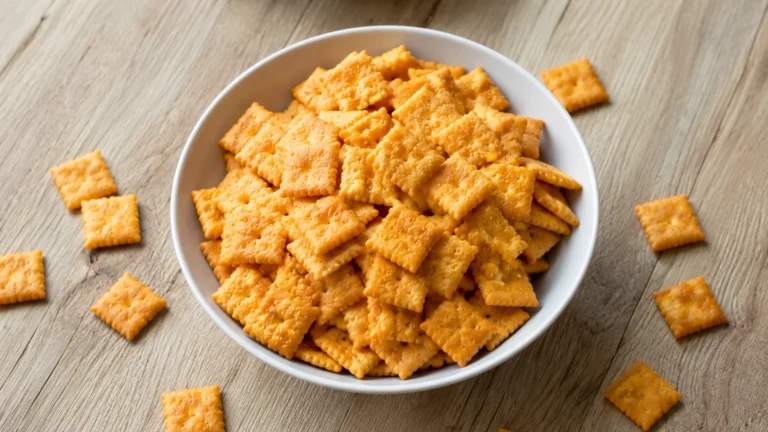
Goldfish come out slightly leaner than Cheez-It and Ritz, mainly because they carry a little less fat per serving, while the sodium across all four is broadly similar. None of these are health foods, and the differences are small enough that flavor and portion matter more than the brand you pick. For a closer look at one of the lowest-fat options here, our breakdown of saltine crackers nutritional value shows where a plainer cracker lands, which is a useful baseline against the cheesier choices.
What are Goldfish made of?
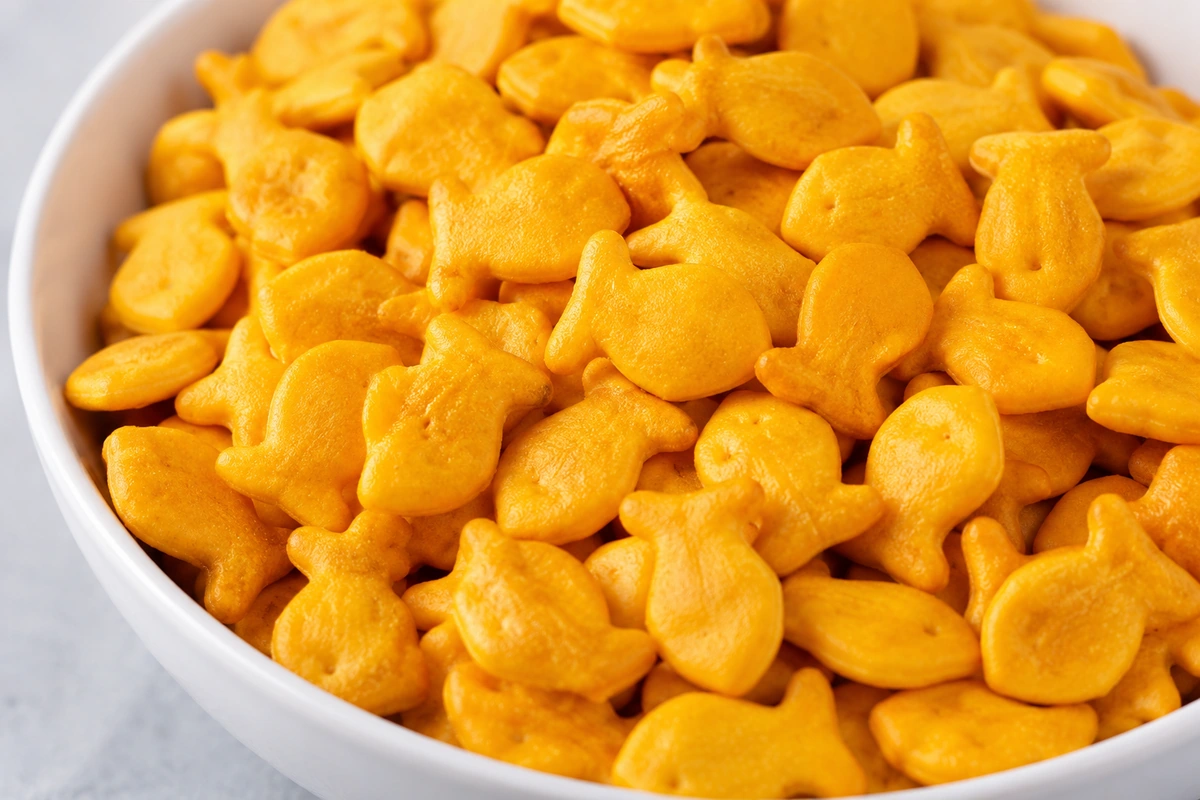
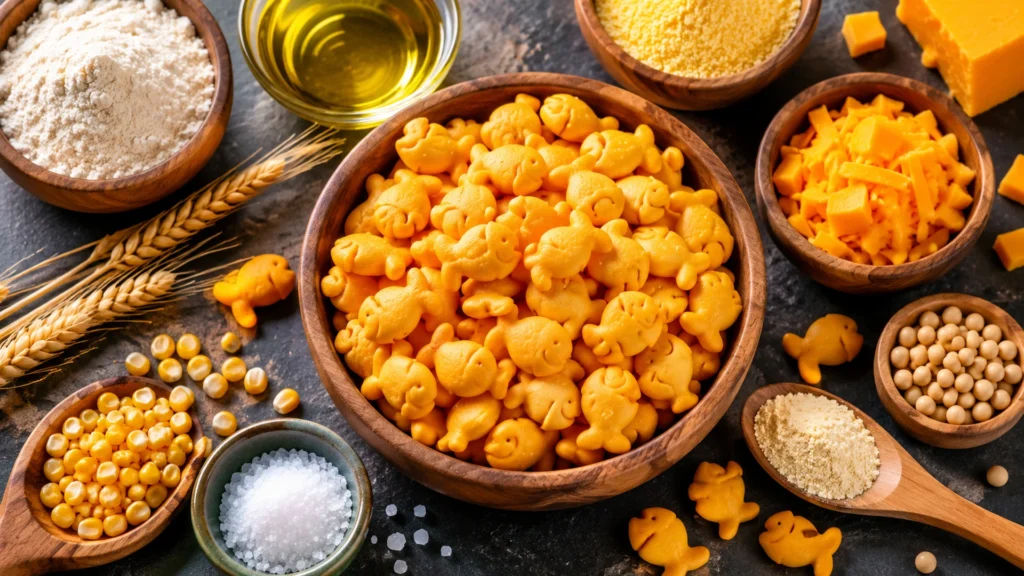
Cheddar Goldfish are built on enriched wheat flour, vegetable oils, and real cheddar cheese, with salt, leavening, and a touch of seasoning rounding out the recipe. The “made with real cheese” claim on the box is accurate, though the cheese is a small share of the cracker by weight, which is why the protein and saturated fat stay low. The crackers are baked rather than fried, which is part of why the fat is moderate compared with some other snack crackers.
The signature shape and the smile are pressed into the dough before baking, and the crackers puff slightly in the oven, which gives them their light, crisp bite. That airy texture is part of why a serving is as many as 55 pieces: each cracker weighs very little, so it takes a real handful to add up to 30 grams. It also means the crackers are easy to eat quickly, which loops back to the portion issue. A denser cracker would feel more substantial per piece, but Goldfish are engineered to be light and snackable, and the nutrition profile follows from that design.
Allergens and dietary notes
Goldfish contain wheat and milk, so they are not gluten-free or dairy-free, and anyone with a wheat or dairy allergy should avoid the standard varieties. They are vegetarian but not vegan, since they contain cheese. The whole-grain version uses whole wheat flour for a little extra fiber, which is the only meaningful nutritional upgrade in the lineup.
How to portion Goldfish for kids
The honest answer to “are Goldfish okay for my kid” is that they are fine in a portioned amount and easy to overdo from the bag. A sensible single snack for a child is roughly half an adult serving, around 25 to 30 crackers, which keeps the calories near 70 to 75 and the sodium near 125 milligrams. The trick is to pre-portion into a small cup or snack bag rather than handing over the carton, because grazing straight from a big box is where a 140-calorie snack turns into 300 calories without anyone noticing.
Pairing them with a protein or a fruit also turns a quick carbohydrate hit into a more balanced snack that holds a child longer. A small handful of Goldfish next to a cheese stick and some apple slices is a far steadier afternoon snack than Goldfish alone. The crackers themselves are not the problem; the open bag is.
Where Goldfish fit in a day of eating
One serving of Goldfish is a reasonable snack slot in most adult days, costing about 140 calories and leaving plenty of room for the rest of your meals. The thing to watch is not the single serving but the pattern. If Goldfish are one of several refined-carbohydrate snacks across the day, the fast carbohydrates and the sodium stack up without much fiber or protein to show for it. Building the rest of the day around foods that bring what the crackers lack keeps the balance sensible.
That is easy to do in practice. Pairing a portioned handful with a protein-forward food turns a quick carbohydrate hit into a steadier snack, and leaning the day’s meals toward fiber and protein offsets the refined snack. A bowl of beans is one of the cheapest ways to add both, and our breakdown of refried beans nutrition shows how a single serving brings the fiber and protein that a cracker snack does not. Treating Goldfish as the fun, light part of an otherwise balanced day, rather than the main event, is the whole game.
Is Goldfish a healthy snack?
Goldfish are a refined-flour snack cracker, not a health food, but they are also not a junk-food disaster. The pluses are that they are baked rather than fried, contain no added sugar, and carry only 1 gram of saturated fat per serving. The minuses are that they are made from refined flour with almost no fiber, so they do not keep you full, and the sodium adds up when you eat several handfuls. In a portioned amount, as an occasional snack rather than an all-day grazing food, Goldfish fit reasonably into most diets. As with most packaged snacks, the issue is rarely one serving. It is the open carton and the unmeasured handful that turn a light snack into a heavy one.
Frequently Asked Questions
How many calories are in a serving of Goldfish?
A standard serving of 55 cheddar Goldfish crackers, about 30 grams, has roughly 140 calories. A 1-ounce single-serve bag is about 150 calories.
How many Goldfish are in a serving?
The package defines a serving of cheddar Goldfish as 55 pieces, which is a measured handful. Most people pour more than that, so the real portion is often closer to 80 or 100 crackers.
Are Goldfish high in sodium?
A single serving has about 250 milligrams of sodium, which is moderate for an adult. Because Goldfish are easy to eat in multiples, the sodium adds up, and it is more significant for young children with lower daily limits.
Are Goldfish healthier than Cheez-It?
Goldfish are slightly leaner, with about 5 grams of fat per serving versus 8 grams in Cheez-It, while the sodium is similar. The differences are small, so portion size matters more than the brand.
Do Goldfish have protein?
Only about 3 grams per serving, which is minor. Goldfish are a carbohydrate snack, so pairing them with a protein like cheese, yogurt, or an egg makes a more balanced and filling snack.
Are whole grain Goldfish better for you?
The whole-grain version has nearly the same calories, fat, and sodium but uses whole wheat flour for a little more fiber. That extra fiber is a small but real upgrade over the original cheddar.
How many calories is one Goldfish cracker?
A single cheddar Goldfish is about 2.5 calories. The crackers are so small that the totals only matter by the handful, which is why the serving size is 55 pieces and why grazing from the box adds up faster than it feels like it should.