The nutritional value of Snickers fun size comes down to one clean number: about 80 calories per bar, with 4 grams of fat, 10.5 grams of carbohydrate, 8.5 grams of sugar, and 1 gram of protein, per the Mars label and USDA FoodData Central. The catch is that the printed panel often describes two bars, not one, and the bag never tells you that three bars quietly equal a full size Snickers. The most common mistake with candy labels is judging the wrapper size instead of the wrapper count. This guide runs the per-bar math, the mini-to-king size ladder, the added-sugar budget against breakfast-aisle sugar, and the honest portion psychology.
The per-bar label, line by line
Here is a single fun size Snickers bar, about 15 to 17 grams depending on the production run, using Mars label data cross-checked against the USDA FoodData Central branded foods entry (fdc.nal.usda.gov).
| Nutrient | Per bar (~17 g) | % Daily Value |
|---|---|---|
| Calories | 80 | – |
| Total fat | 4 g | 5% |
| Saturated fat | 1.5 g | 8% |
| Sodium | ~40 mg | 2% |
| Total carbohydrate | 10.5 g | 4% |
| Total sugars | 8.5 g | – |
| Added sugars | 8 g | 16% |
| Protein | 1 g | 2% |
The macro split works as the bar’s fingerprint: it lands near 50 percent carbohydrate, 43 percent fat, and 7 percent protein by calories. That small protein line is worth a sentence, because it is unusual for candy. The peanuts and the milk-based nougat put real protein in the bar, which is why a Snickers reads slightly less like pure sugar than a gummy or a hard candy of the same weight. It is still candy; the peanuts just soften the spike, they do not cancel it.
Fun size bars also drift in weight: bars from different bags can range from 15 to 17 grams, which moves the true count between roughly 75 and 85 calories. The 80-calorie figure is the honest midpoint, and no decision worth making hinges on the missing 5 calories.
The two-bar serving trick
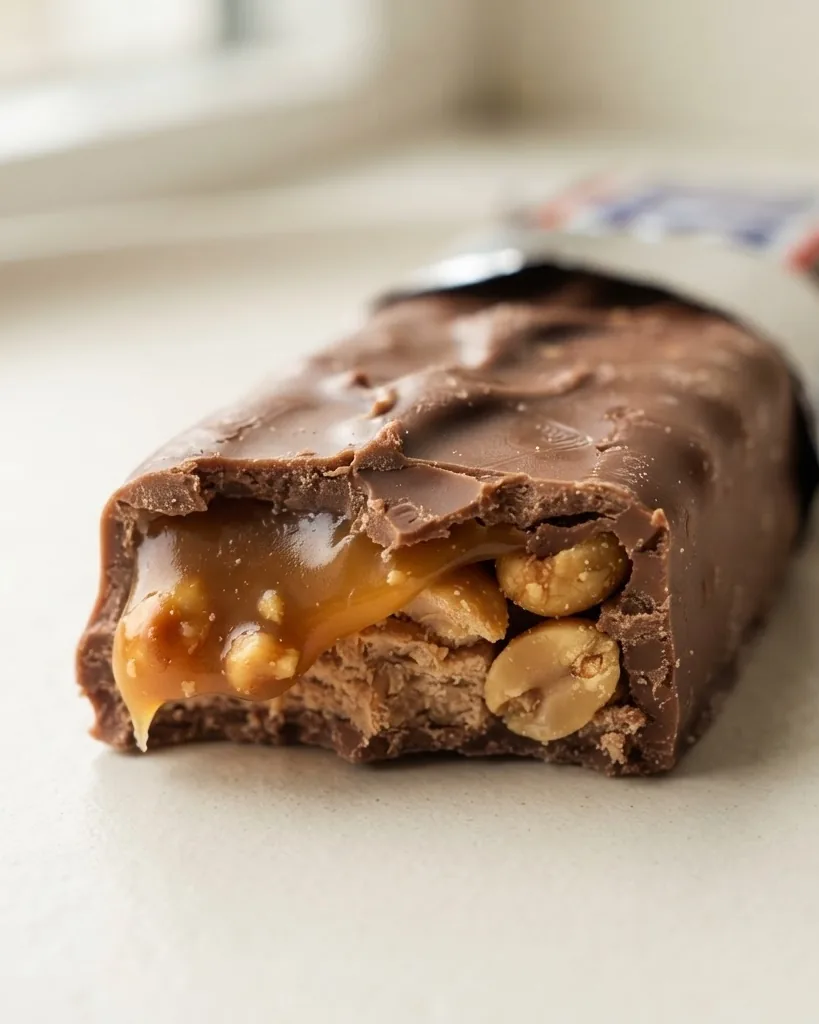
Flip a fun size bag over and the panel frequently lists the serving as 2 pieces, about 160 calories. This is legal and even reasonable under FDA serving-size rules, which peg servings to amounts customarily consumed, and two small bars is a fair guess at customary. But it produces the single most common misreading of this label: people see 160, assume it describes one bar, and conclude fun size is worse than it is.
The fix is simple division. Every line on a two-piece panel is double the single-bar figure: 160 calories becomes 80, 17 grams of sugar becomes 8.5, 8 grams of fat becomes 4. This halving step is the one readers find most useful, because the bag itself never spells it out. Check the servings per container line too: a typical 10.59 ounce bag holds about 18 bars, which is 9 label servings and roughly 1,440 calories of total bag.
The size ladder: mini to king
Snickers sells the same recipe in at least four sizes, and the names are less helpful than the gram weights. According to Mars label data, the ladder per piece looks like this.
| Size | Weight | Calories | Sugar | Fat |
|---|---|---|---|---|
| Mini (unwrapped bite) | ~9 g | ~42 | ~4.5 g | ~2 g |
| Fun size | 15-17 g | ~80 | 8.5 g | 4 g |
| Full size | 52 g | 250 | 27 g | 12 g |
| King size (2 pieces) | ~85 g total | ~440 total | ~46 g total | ~21 g total |
Read the ladder per gram and the recipe is flat: every size runs close to 4.8 calories per gram, because it is the same chocolate, caramel, nougat, and peanuts in different molds. The overlooked detail is the conversion math between rungs. Two minis roughly equal one fun size. Three fun size bars, about 240 calories, essentially equal a full size at 250. A king size package equals five and a half fun size bars. Nobody feels like they ate a candy bar after three fun sizes, but the label says they did.
That per-gram flatness is also why fun size is neither a diet food nor a trap by itself. The bar does not change; only the stopping point does. The size ladder just moves the decision from the middle of a big bar, where nobody stops, to the space between wrappers, where some people genuinely do.
The added-sugar budget math
The added sugars line is where one small bar carries real weight. A fun size Snickers holds 8 grams of added sugar, which is 16 percent of the FDA daily value of 50 grams, the reference set in the labeling regulation at 21 CFR 101.9 (ecfr.gov). The American Heart Association draws tighter lines: about 25 grams of added sugar per day for women and 36 grams for men (heart.org). Against those targets, one bar is roughly a third of a woman’s daily budget and about a quarter of a man’s.
Run the multiples and the budget disappears fast. Two bars cost 16 grams of added sugar, most of the AHA women’s line. Three bars, the full-size equivalent, cost 24 grams, essentially all of it. The candy bowl’s real risk is not any single bar; it is that fun size resets the mental counter to zero after every wrapper, while the sugar total keeps climbing in 8-gram steps.
For calibration, the same 8 grams of added sugar sits in about three-quarters of a serving of frosted breakfast cereal, and a single 20-ounce sports drink can carry four bars’ worth; our Gatorade nutrition label breakdown runs that math. Candy is at least honest about being candy.
Fun size Snickers vs other Halloween candy
The fair comparison is per fun size piece, because that is how the bowl serves them. Using manufacturer labels and USDA branded entries, the usual suspects line up like this.
| Candy (fun size piece) | Calories | Sugar | Fat | Protein |
|---|---|---|---|---|
| Snickers | 80 | 8.5 g | 4 g | 1 g |
| Milky Way | ~80 | ~10 g | ~3 g | <1 g |
| 3 Musketeers | ~63 | ~10 g | ~2 g | <1 g |
| Reese’s cup (1 cup) | ~110 | ~10.5 g | ~6.5 g | ~2.5 g |
| M&Ms fun size pack | ~73 | ~9.5 g | ~3 g | <1 g |
The spread is narrower than the marketing suggests: everything sits between 63 and 110 calories per piece, and the sugar lines are nearly identical at 8 to 11 grams. Snickers and Reese’s carry the most protein because of the peanuts, and 3 Musketeers is the lightest only because whipped nougat is mostly air. There is little point in choosing candy by these gaps at all; a 17-calorie difference between wrappers is noise next to the difference between eating two pieces and eating five.
What is actually in the bar
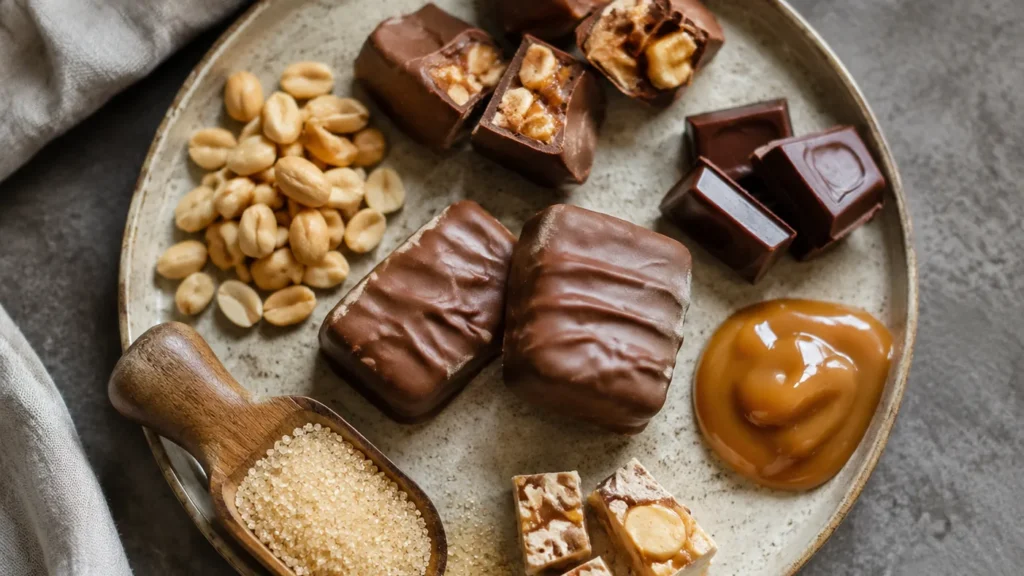
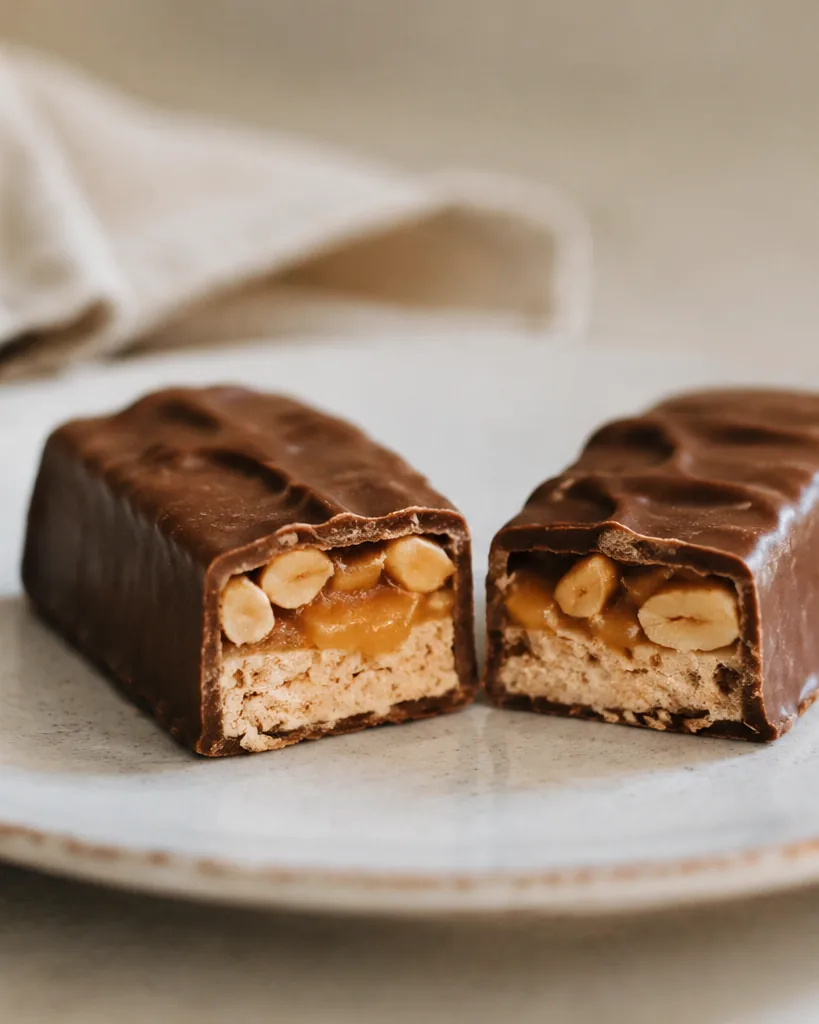
The ingredient list reads: milk chocolate (sugar, cocoa butter, chocolate, skim milk, lactose, milkfat, soy lecithin), peanuts, corn syrup, sugar, palm oil, skim milk, lactose, salt, egg whites, artificial flavor. Translated into the bar’s four layers, that is a nougat built on egg whites and sugar, a caramel built on corn syrup and milk, roasted peanuts, and a milk chocolate coat.
Two composition notes matter for the label. First, the saturated fat, 1.5 grams per bar, comes from three directions at once: cocoa butter, milkfat, and palm oil, which is why a light-tasting bar still posts 8 percent of the saturated fat daily value. Second, the sugar arrives as sugar, corn syrup, and lactose combined; the 0.5 gram gap between total sugars and added sugars is mostly the lactose that came with the milk, the same naturally occurring sugar covered in our 2% milk nutrition facts guide.
When fun size works, and when it backfires
Fun size is sold as portion control, and sometimes it genuinely is. The honest version of the argument: a wrapper is a decision point. Research on unit bias and mindless eating, including the Cornell work on package size, consistently finds people eat in units first and grams second. One wrapped 80-calorie unit, eaten deliberately, is a better outcome than freehand progress through a 250-calorie bar, and for eaters who stop at one, fun size does exactly what the name promises.
It backfires through the same psychology. Small units feel exempt from counting, so the bowl empties three wrappers at a time. “Just one more” tends to land at three or four bars, 240 to 320 calories, without any sensation of having eaten a candy bar. The wrappers are the fix as well as the trap: keep them in sight, count them, and the label math stays honest.
Timing also earns a sentence. An 80-calorie bar with 1 gram of protein and half a gram of fiber has no staying power; it is a fast carbohydrate hit with a fat cushion. As dessert after a meal, that profile is harmless. As a hungry-afternoon snack, it invites the second and third wrapper, which is exactly the scenario the size ladder punishes.
Allergens and the gluten question
The bar’s allergen statement is short and serious: peanuts, milk, soy, and egg are all in the standard recipe. For peanut-allergic households, Snickers is a hard no in every size, and the fun size format raises the stakes at Halloween because the bars scatter into mixed bowls where wrappers get separated from warnings.
Gluten is the nuanced one. The standard fun size Snickers lists no wheat, barley, or rye ingredients, and Mars publishes allergen information at mars.com. But the bar is not certified gluten free, and shared manufacturing lines are the reason cautious celiac guidance treats uncertified candy as a risk rather than a safe default. Sensitive readers get the plain version: probably fine on ingredients, not guaranteed on process.
How the bar earns its 80 calories
Splitting the calories by macronutrient makes the bar’s structure visible. The 4 grams of fat contribute about 36 calories at 9 calories per gram. The 10.5 grams of carbohydrate contribute roughly 42 calories at 4 per gram. The single gram of protein adds 4. That 36-42-4 split is the arithmetic behind the 50-43-7 percentage breakdown, and according to USDA FoodData Central the same proportions hold within a point or two across every Snickers size, because the recipe never changes, only the mold.
The exercise translation is the version of this math people ask for most. At a brisk 3.5 mile-per-hour walk, a 160-pound adult burns roughly 4 to 5 calories per minute, so one fun size bar costs about 16 to 20 minutes of walking. Three bars, the stealth full-size, cost about an hour. Exercise-as-penance accounting is a poor habit for daily eating, but as a one-time calibration of what 80 calories means in body terms, the walking clock is more honest than any percentage.
Blood sugar behavior earns a sentence, because the peanuts change it. According to the FDA’s labeling framework, no candy label reports glycemic response, but the fat and protein in a Snickers slow gastric emptying relative to pure-sugar candy of equal grams, which is why hard candy hits faster than a nougat bar. The practical reading for anyone watching glucose: a fun size Snickers is a gentler curve than a fun size pack of straight sugar candy, and still a curve.
Storage changes nothing nutritionally, and the freezer trick is worth knowing. A frozen fun size Snickers carries the same 80 calories while taking two to three times longer to eat, which is the cheapest portion-pacing tool the label never mentions. Freezing the Halloween surplus tends to cut the number of bars eaten per sitting compared with a counter bowl, purely because thawing time interrupts the wrapper chain.
What a bar contributes to a day
Placed against standard label daily values, one fun size Snickers is small everywhere except sugar.
- Calories: 80, about 4% of a 2,000-calorie day.
- Added sugar: 8 g, 16% of the FDA 50 g daily value, the bar’s biggest single claim on a budget.
- Saturated fat: 1.5 g, 8% of the daily value.
- Sodium: ~40 mg, 2% of the daily value, negligible.
- Protein: 1 g, 2% of the 50 g label reference, a rounding error with a peanut accent.
The pattern is the classic candy signature: nutritionally invisible in every column except added sugar, where one small wrapper spends a sixth of the day. Multiply by wrappers, because the bowl will.
Frequently asked questions
How many calories are in one fun size Snickers?
About 80 calories per 15 to 17 gram bar, per Mars label data and USDA FoodData Central. If your bag’s panel says 160, it is describing a two-bar serving; halve every line for a single bar.
How many fun size Snickers make a full size bar?
Three. At roughly 80 calories each, three fun size bars total 240 calories against the full size bar’s 250, with essentially matching sugar and fat. King size equals about five and a half fun size bars.
How much added sugar is in a fun size Snickers?
About 8 grams, which is 16 percent of the FDA’s 50 gram daily value, roughly a third of the American Heart Association’s 25 gram guideline for women, and about a quarter of the 36 gram guideline for men.
Is Snickers fun size a good portion-control choice?
It can be, if the wrapper is a real stopping point for you. The bar itself is identical to full size per gram; the only difference is where the decision to stop lands. Count wrappers, not intentions.
Does a fun size Snickers contain peanuts?
Yes. Peanuts, milk, soy, and egg are all in the standard recipe, in every size. The bar has no wheat ingredients but is not certified gluten free.
About the author and sources
Tastybend Nutrition Desk writes nutrition label breakdowns for TastyBend, working directly from manufacturer panels, USDA FoodData Central entries, and FDA labeling rules. This guide draws its figures from Mars label data for Snickers fun size, mini, full size, and king size, the USDA FoodData Central branded foods database, FDA added-sugar daily values, and American Heart Association added-sugar guidance. Where bar weights vary by production run, the text shows the honest range.
This article explains label information and is not medical or dietetic advice. Individual needs vary, especially for children, diabetes management, and food allergies; a registered dietitian or physician is the right resource for personal guidance.