

York peppermint patty nutrition has no single calorie number, and that is the first thing to fix. The figure on the label depends entirely on which package you picked up: a fun-size piece weighs 13g and lands at 50 calories, while a single classic package weighs 39g and reads 150 calories. Both are correct. They describe different amounts of the same candy. This guide from the Tastybend Nutrition Desk lays out all six reported serving formats against one another, so you know which number applies to the piece actually in your hand – and which “less fat” claim is doing quiet work on the front of the wrapper.
The desk assembles these figures from manufacturer declarations, retailer label reproductions, and public food databases, structured into one reference table below.
The Answer: Calories and Sugar by Serving Format

The calories depend entirely on portion. A fun-size piece (13g) has 50 calories. A two-piece 27g serving has 100 calories, 18g total sugars, 2g total fat, and 10mg sodium. One full 1.4 oz single package (39g) has 150 calories and 26g sugars. A USDA-derived 1.5 oz patty gives 165.12 kcal and 27.43g total sugars. Three Minis (41g) reach 150 calories with 27g added sugars. Almost all carbohydrate here is added sugar. The Zero Sugar variant is a separate product at 80 calories per 24g.
Why “Calories in a York Peppermint Patty” Has Six Answers
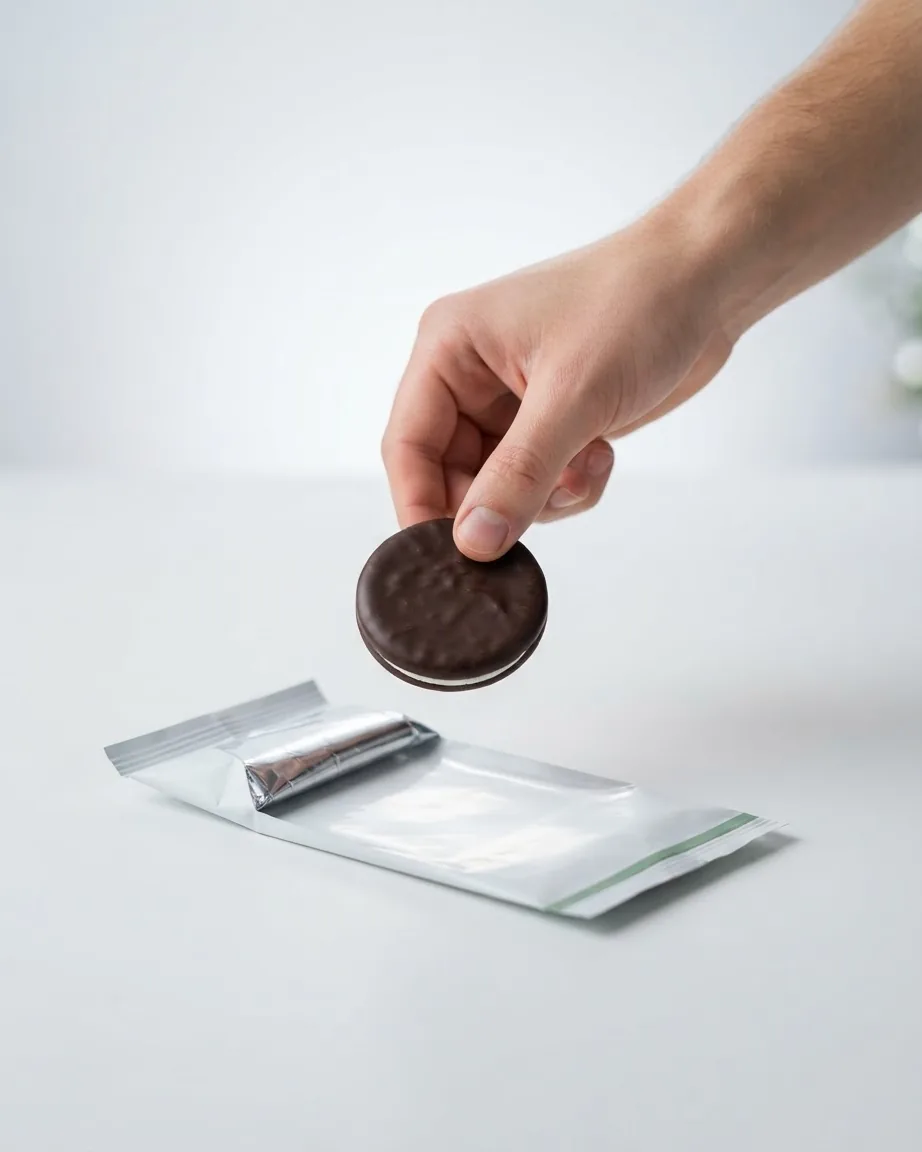
The confusion is real and it has a boring cause: the brand and its retailers report against different serving weights, and nobody publishes them together. Comparing 50 to 165 without noting the grams is comparing a fun-size piece to a patty nearly three times its weight.
Here is the full per-format spread, drawn from the individual panels named in the following sections:
- Fun size, 13g: 50 calories, 1g fat, 11g carbs, 0g protein.
- Share pack / SmartLabel serving, 2 pieces (27g): 100 calories, 18g total sugars, 2g total fat.
- Single package, 1.4 oz (39g): 150 calories, 26g sugars, 1.5g saturated fat.
- Vendor 1.3 oz serving: 150 calories, 2.5g total fat, 31g total carbohydrate, 27g sugars.
- USDA-derived, 1.5 oz patty: 165.12 kcal, 34.83g carbohydrate, 27.43g total sugars, 3.08g fat.
- Minis, 3 pieces (41g): 150 calories, 3g total fat, 27g total sugars, 27g added sugars.
Reading down that list, the “27g serving = 18g sugar” line and the “39g package = 26g sugar” line look like they disagree. They do not. The larger package weighs more, so it carries more sugar. Once you tie each figure to its gram weight, the two agree. The practical takeaway: read the serving size before the calorie count, every time, because the wrapper decides which row you are on.
York Peppermint Patty Nutrition Facts per 27g Serving

The Hershey Company publishes the reference panel for the standard two-piece portion. Per the SmartLabel entry, a 27g serving carries 100 calories, 22g total carbohydrate with 1g dietary fiber, 18g total sugars all counted as added sugars (35% DV), 2g total fat, 1g saturated fat, 10mg sodium, and 1g protein.
That 18g of added sugar in a 27g piece of candy is the number worth sitting with. It means roughly two-thirds of the weight you are eating is sugar. The fat line is genuinely low – 2g – but low fat and low sugar are not the same claim, and only one of them is true here.
| Nutrient (per 27g, 2 pieces) | Amount | % DV |
|---|---|---|
| Calories | 100 | – |
| Total Fat | 2g | 2% |
| Saturated Fat | 1g | – |
| Sodium | 10mg | 0% |
| Total Carbohydrate | 22g | 8% |
| Dietary Fiber | 1g | – |
| Total Sugars | 18g | – |
| Added Sugars | 18g | 35% |
| Protein | 1g | – |
What “70% Less Fat” Actually Compares

The front-of-pack “70% less fat” line is a real manufacturer claim, but it is narrow, and it says nothing about sugar or calories. It compares this candy’s fat only to the fat in unnamed competitors – a marketing baseline, not a health grade.
The comparison also shifts with serving weight. On the 39g single package, Giant Food reproduces the claim as 2.5g of fat per 39g serving against 10g of fat in the average leading chocolate candy brand. On the share pack, Lowes Foods states it as 2g of fat per 27g versus 7g in the average leading brand. Same claim, two baselines, because the serving weights differ.
Both are true and both dodge the same point. Fat was never where this candy’s calories came from. The energy is in the sugar. So “70% less fat” can be accurate while the piece remains, by weight, mostly sugar – a distinction that matters if you reached for York thinking “less fat” meant “lighter treat.”
The 67% Sugar-by-Weight Figure, and Why It Reframes the Candy
The independent scoring group Environmental Working Group publishes a figure the panels do not. In its food-score entry, EWG calculates that the product is 67% sugar by weight and contains 5 teaspoons of added sugar per serving. It classifies the item as an unhealthy ultra-processed food with added sugar as the number-one ingredient.
That 67% is the single figure a “70% less fat” reader is most likely to miss. It reframes the whole package: this is not a low-fat chocolate so much as a peppermint-flavored sugar center in a thin chocolate shell. The ingredient list backs the ordering – sugar comes first, then corn syrup, then chocolate, then cocoa, invert sugar, milk fat, egg whites, cocoa butter, soy lecithin, oil of peppermint, PGPR, and natural flavor. Three of the first five entries are sweeteners.
Allergens, Gluten-Free Status, and the Dairy Question
Allergen warning
A common assumption trips people up here: gluten-free does not mean allergen-free. Giant Food lists the classic product as gluten free and kosher, and in the same breath declares Contains: milk, eggs, soy.
That milk and egg content is not incidental. The ingredient list names milk fat and egg whites outright, which settles the dairy and vegan question the label itself never spells out: the classic York peppermint patty is not dairy-free and is not vegan. No official or retailer page reviewed here carries a vegan designation, so anyone avoiding animal products should treat the absence as a no, not an unknown.
- Contains: milk, eggs, soy.
- Gluten free: yes, per the retailer label.
- Kosher: yes, per the retailer label.
- Vegan / dairy-free: no – contains milk fat and egg whites.
The Zero Sugar Variant: 80 Calories, No Sugar, a Real Trade-Off
York’s Zero Sugar patty is a different product with a different math. Per the EWG Zero Sugar entry, a 24g serving has 80 calories, 16g total carbs, 0g sugars, 5g total fat, and 3g saturated fat. The sugar is replaced by the low-calorie sweeteners maltitol, isomalt, and maltitol syrup.
The swap is not consequence-free. That same entry flags the Zero Sugar variant as containing a high level of saturated fat – 3g, or 15% of the Daily Value, in a 24g piece. So the trade is a plain one: you drop the added sugar and gain saturated fat and sugar alcohols. Maltitol and isomalt are the kind of sweeteners that, eaten in quantity, are known to cause digestive upset for some people, which is worth knowing before you treat “zero sugar” as a green light to eat several.
For readers weighing candy against other packaged snacks, our snacks sweets section keeps the same per-serving format.
The Sodium Discrepancy Nobody Reconciles
One inconsistency across the labels is worth naming plainly, because it is a genuine discrepancy and not a rounding quirk. Sodium is reported differently across retailers and formats for what is described as roughly the same candy.
- SmartLabel: 10mg per 27g serving.
- Giant Food: 10mg per 39g package.
- Lowes Foods share pack: 0mg per 27g serving.
- Nuts to You 1.3 oz listing: 70mg per serving.
- Pearls Candy Minis: 15mg per 41g serving.
Those do not fully square, even after adjusting for weight – a 0mg reading and a 70mg reading cannot both describe the identical formula at the same portion. Sodium is a minor line in a candy like this, so the discrepancy changes nothing about how the food fits a day. But if you are tracking sodium tightly, log the number from the exact package you bought rather than any single source above. Labels get updated at different times across retailers, which is the most likely cause.
Two Close Comparisons for Context
A number means little in isolation. Set the 27g York serving (100 calories, 18g added sugar) beside the Minis: Pearls Candy reproduces the Minis panel at 150 calories for three pieces (41g), 3g total fat, 27g total sugars, 27g added sugars (54% DV), 15mg sodium, and 0g fiber. Three little Minis carry more added sugar than the standard two-piece serving – the “small” format encourages eating more, not less.
Against a full-size peppermint patty, the USDA-derived entry from the University of Rochester Medical Center puts a 1.5 oz patty at 165.12 kcal, 34.83g carbohydrate, 27.43g total sugars, 3.08g fat, and 0.86g dietary fiber. The database figures run slightly higher than the brand panel because the patty is heavier and the values are calculated, not rounded to the label’s whole grams.
The Realistic Portion Problem
The two-piece 27g serving is the honest place to anchor, because that is what most panels report against. But the format you buy nudges the amount you eat. The FatSecret per-piece entry lists a single fun-size piece, and the small format makes it easy to eat several without noticing. The 1.3 oz serving that Nuts to You lists lands at 150 calories, 2.5g total fat, 31g total carbohydrate, and 27g sugars for a single vendor portion.
If you are counting, the move is to pour a portion and put the bag away, since every format here scales sugar faster than it scales fat. For readers comparing sweet packaged items generally, see also our rice cream nutrition guide and the Big Mac nutrition values breakdown.
Calorie and Sugar Density: What Each Format Actually Packs per 100g
The six calorie numbers on this page look like they disagree, but once you divide each one by its own gram weight they collapse into a single candy. The math below uses only the figures already reported for each format – nothing imported – to show that a fun-size piece and a full package have essentially identical energy density, and that sugar, not fat, is what fills the wrapper.
- Energy density is nearly flat across formats. Fun size: 50 kcal ÷ 13 g × 100 = 385 kcal/100g. Single package: 150 kcal ÷ 39 g × 100 = 385 kcal/100g. Share-pack serving: 100 kcal ÷ 27 g × 100 = 370 kcal/100g. The “50 versus 150” gap is portion size, not a lighter candy.
- Two-thirds of the weight is sugar. On the 27g serving, 18 g sugar ÷ 27 g = 66.7% sugar by weight. On the 3-Minis (41g) serving, 27 g ÷ 41 g = 65.9%. This is the internal check on the “70% less fat” wrapper claim: less fat, but still mostly sugar.
- Almost all the carbohydrate is sugar. On the USDA-derived patty, 27.43 g total sugars ÷ 34.83 g carbohydrate = 78.8% of the carbs are sugar.
- One package ≈ three fun-size pieces. 150 kcal ÷ 50 kcal = 3× – grabbing a single 39g package is the calorie equivalent of eating three 13g fun-size pieces.
The practical takeaway: because density barely moves between formats, the only lever the reader controls is grams. Read the serving weight first; the calorie count follows almost linearly from it.
Frequently Asked Questions
Is the York Zero Sugar patty actually lower in calories?
Only a little. Its 24g serving lists 80 calories versus 100 for a 27g classic serving – close once you adjust for the smaller weight. The real change is qualitative: 0g sugar swapped for maltitol, isomalt, and maltitol syrup, plus 3g saturated fat flagged as a high level. It is a sugar-alcohol product, not a low-energy one.
How much added sugar is in three York Minis?
A 41g serving of three Minis logs 27g of added sugars, which is 54% of the Daily Value in one small handful. That is more added sugar than the standard two-piece 27g portion delivers. The Minis also show 0g dietary fiber and 15mg sodium, so nothing offsets the sweetener load.
Can someone with a dairy allergy eat a York peppermint patty?
No. The ingredient statement names milk fat and egg whites, and the allergen declaration reads Contains: milk, eggs, soy. Gluten free and kosher both apply, but neither protects against a milk, egg, or soy allergy. Anyone managing those three allergens should skip this candy regardless of the gluten-free flag.
Why does one label show 0mg sodium and another shows 70mg?
Different retailers reproduce labels captured at different times, and one lists 0mg per 27g while another lists 70mg per 1.3 oz serving. Those readings cannot both describe the same formula at the same portion, so it points to a labeling inconsistency rather than a true recipe difference. Trust the panel printed on your own package.