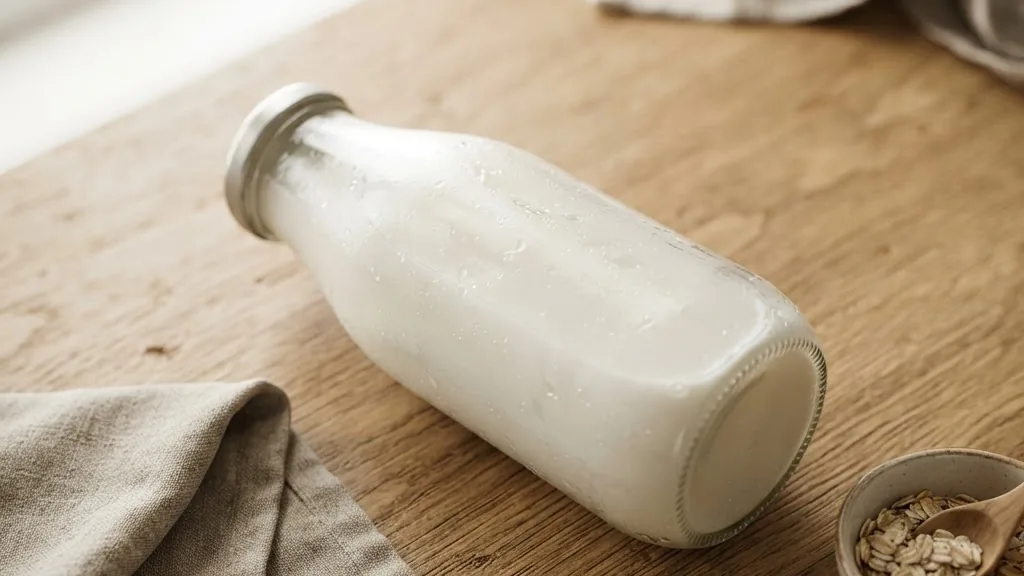
Fairlife milk nutrition facts split cleanly along one line most people miss: all three unflavored cartons carry the same 13 grams of protein and 6 grams of sugar per cup, so the only real differences between 2%, whole and fat-free are calories and fat. That single fact settles more grocery-aisle debates than any marketing line on the box, and it holds only when you read the United States 52-ounce carton at its 1-cup serving. Grab a 14-ounce bottle instead and the numbers roughly double, not because the milk is different but because the whole bottle counts as one serving.
The figures below use current US labels published by Fairlife, LLC, the manufacturer that answers for every panel, ingredient list and storage rule on the product. Formulations change, so the physical package always wins a tie.
Quick answer: Per 1 cup (240 mL) of the US 52-ounce carton, Fairlife 2% has 120 calories, whole has 150, fat-free has 80, and chocolate 2% has 140. All four list 13 grams of protein and 380 milligrams of calcium per cup. The three unflavored versions each carry 6 grams of sugar with no added sugar; chocolate carries 12 grams of total sugar including 6 grams of added sugar plus 280 milligrams of sodium against 120 in the plain cartons. Fat differs: 4.5 grams in 2%, 8 in whole, 0 in fat-free. For a deeper label read, see the section-by-section breakdown below.
The four US 52-ounce cartons compared cup for cup
Per 1 cup (240 mL) of the US 52-ounce carton, the four Fairlife varieties line up like this: 2% has 120 calories, whole 150, fat-free 80 and chocolate 2% 140. Protein is identical across all four at 13 grams, and calcium is identical too at 380 milligrams, which the label marks as 30 percent Daily Value. Sugar separates the flavored from the plain: the three unflavored cartons each list 6 grams and no added sugar, while chocolate lists 12 grams total with 6 grams added. Fat is the other divider, running 4.5 grams in 2%, 8 in whole and 0 in fat-free.
Here is the side-by-side, all per 1 cup:
- 2% reduced fat: 120 calories, 13 g protein, 6 g sugar, 4.5 g fat, 3 g saturated fat, 120 mg sodium, 380 mg calcium.
- Whole: 150 calories, 13 g protein, 6 g sugar, 8 g fat, 5 g saturated fat, 120 mg sodium, 380 mg calcium.
- Fat-free (skim): 80 calories, 13 g protein, 6 g sugar, 0 g fat, 0 g saturated fat, 120 mg sodium, 380 mg calcium.
- Chocolate 2%: 140 calories, 13 g protein, 12 g total sugar (6 g added), 4.5 g fat, 280 mg sodium, 380 mg calcium.
The numbers come straight from Fairlife’s own 2% product page and its whole milk page. If you want the same nutrient-per-serving logic applied to a dairy staple that behaves differently under heat, our Half And Half Nutrition Facts guide walks through the fat math in the same style.
Fairlife whole milk nutrition facts down to the micronutrient
A US 1-cup serving of Fairlife Whole Ultra-Filtered Milk carries 150 calories, 8 grams total fat, 5 grams saturated fat, 6 grams carbohydrate, 6 grams total sugar and 13 grams protein. On the micronutrient side the same cup lists 120 milligrams sodium, 380 milligrams calcium, 400 milligrams potassium and 5 micrograms vitamin D. Those last two are where whole milk quietly pays off: the potassium and vitamin D ride along regardless of which fat level you pick, so the choice between whole and skim is really a choice about calories and richness, not about the vitamins.
Whole is the pick when a recipe wants body.
Fairlife whole milk nutrition facts also help explain why the saturated fat climbs to 5 grams here. The US Food and Drug Administration frames saturated fat as a nutrient to limit, and its label guidance treats 20 percent Daily Value or more per serving as high. Whole milk’s 5 grams sit below that line but well above the 3 grams in 2%.
Fairlife chocolate milk nutrition facts and the bottle-versus-carton gap
For the US 52-ounce carton, 1 cup of Fairlife chocolate milk contains 140 calories, 13 grams protein, 12 grams total sugar including 6 grams added sugar, 4.5 grams fat, 280 milligrams sodium and 380 milligrams calcium. So Fairlife chocolate milk nutrition facts keep the protein identical to the plain cartons but double the sugar and more than double the sodium. The 280 milligrams of sodium against 120 in the 2% carton is the number that surprises people, and it comes from added salt and the dipotassium phosphate in the formula.
The bigger trap is serving size. The 14-ounce chocolate bottle counts the whole 414-milliliter bottle as one serving, so it lists 250 calories, 23 grams protein, 21 grams total sugar, 10 grams added sugar, 8 grams fat and 350 milligrams sodium. Same drink, roughly double the numbers, because you are reading a bottle-sized serving instead of a cup.
The chocolate ingredient list runs longer than the plain cartons and includes:
- Reduced-fat ultra-filtered milk, sugar and alkalized cocoa.
- Lactase enzyme, dipotassium phosphate, salt and carrageenan.
- Acesulfame potassium and sucralose, two high-intensity sweeteners.
- Flavors, vitamin A palmitate and vitamin D3.
That is why “50 percent less sugar than regular chocolate milk” never means sugar-free. The carton still carries 6 grams of added sugar on top of the sweeteners. Fairlife publishes the full panel on its chocolate milk page. For a cereal that plays the same total-sugar-versus-added-sugar game, our Fruit Loops Nutrition Facts piece shows how the two numbers diverge on a label.
Fairlife protein milk nutrition facts across five different products
“Fairlife protein milk” is not one product, and mixing their numbers is the fastest way to get a wrong answer. The phrase can point to at least five separate items, each with its own serving size and intended use. Fairlife protein milk nutrition facts only make sense once you name the exact package, because a regular carton, a single-serve bottle and a Core Power shake are engineered for different jobs and are labeled accordingly.
Here is how the five break down, each at its own labeled serving:
- Regular 52-ounce carton: 13 grams protein per 1-cup serving.
- Single-serve 14-ounce 2% bottle: 23 grams protein and 210 calories per bottle.
- Core Power Chocolate: 26 grams protein and 170 calories per 14-ounce bottle, with 5 grams total sugar and 0 grams added sugar.
- Core Power Elite Chocolate: 42 grams protein and 230 calories per 14-ounce bottle.
- Nutrition Plan: 30 grams protein, 2 grams sugar and 150 calories per bottle.
Notice the spread. The Core Power Elite bottle at 42 grams packs more than three times the protein of a single carton cup, and the Nutrition Plan bottle keeps sugar down to 2 grams where a plain carton cup sits at 6. None of these figures belong in one unlabeled “Fairlife nutrition” summary. Fairlife lists each on its own page, including the Core Power Chocolate shake. If you like seeing the label separated from the marketing on a very different product, our Nutrition Tito’s Vodka breakdown takes the same no-spin approach.
Why the 14-ounce bottle numbers dwarf a carton cup
The 52-ounce carton lists nutrition per 1 cup, which is 240 milliliters. The 14-ounce bottle lists the entire 414-milliliter bottle as a single serving. That difference alone explains the whole jump. A 14-ounce 2% bottle shows 210 calories, 23 grams protein, 10 grams sugar and 8 grams fat because you are pouring nearly two cups’ worth into one serving line, not because the recipe changed. Read a cup, get carton numbers; read a bottle, get bottle numbers.
This matters most when you are comparing a shake to a carton on a nutrition app or a store shelf. Convert to a common serving before you judge. The bottle is a grab-and-go format, so its serving basis is built around finishing the whole thing at once.
Calories in 1 cup of fat-free Fairlife and how to read the Daily Values
One US cup (240 mL) of Fairlife Fat-Free Ultra-Filtered Milk contains 80 calories, 0 grams fat, 6 grams sugar and 13 grams protein. It is the lowest-calorie and lowest-fat carton in the lineup, yet it holds the same 13 grams of protein and 380 milligrams of calcium as whole. Fairlife labels this product “fat-free” or “skim,” and the Canadian version reads “skim (0%).” When minimizing fat is the whole point, this is the carton to reach for.
The label context comes from the FDA. Its Daily Value guidance treats 5 percent Daily Value or less as low and 20 percent or more as high. By that framework the 2% carton’s 30 percent Daily Value for calcium, 25 percent for vitamin D and 26 percent for protein all read as high per serving, while its 5 percent Daily Value for sodium sits right at the low threshold. You can read the FDA’s own explanation on its lows and highs of Percent Daily Value page.
Percent Daily Value is a reference point, not a personal prescription. It compares a serving to a general benchmark, so use it to spot which nutrients run high or low rather than as a target for your specific day. For the same math applied to a snack, our Club Crackers Nutrition Facts guide reads a sodium line the same way.
What ultra-filtration actually does, and why lactose-free is not dairy-free
Fairlife says ultra-filtration concentrates the protein already present in milk while removing some of its natural sugar. That is the mechanism behind the “more protein, less sugar” claim: nothing is bolted on, the components are separated and concentrated. The company states it does not add protein powder or protein concentrate to its regular ultra-filtered milk, and that the milk protein is roughly 80 percent casein and 20 percent whey, the same ratio you find in ordinary cow’s milk.
It helps to keep four processes distinct:
- Ultra-filtration: separates and concentrates components already in the milk.
- Lactase treatment: the added enzyme that breaks down lactose so the milk reads lactose-free.
- Fortification: vitamin A palmitate and vitamin D3 appear in every carton’s ingredient list.
- Added protein powder: Fairlife says none is used in the regular ultra-filtered milk.
Lactose-free is not the same as dairy-free, and the difference is a safety issue for some readers. Fairlife’s milk is lactose-free thanks to ultra-filtration plus the lactase enzyme, and the National Institute of Diabetes and Digestive and Kidney Diseases notes that lactose-free and lactose-reduced milk can help people lower dietary lactose, as it explains in its eating and nutrition guidance for lactose intolerance. But the product is still made from cow’s milk. Every label reads “Contains Milk,” and the FDA counts milk among the major food allergens in US labeling law. Anyone with a milk-protein allergy should never read “lactose-free” as clearance to drink it.
Storage, spoilage and one-for-one cooking swaps
Fairlife says opened ultra-filtered milk should be refrigerated and consumed within 14 days, while also telling you to follow the date and storage directions printed on your specific package. Refrigeration rules differ by format: the refrigerated 52-ounce bottle must stay cold even before opening, while unopened 14-ounce bottles may sit at room temperature and only need refrigeration after opening. Fairlife does not recommend freezing its ultra-filtered milk, because freezing can change the taste and texture.
For the kitchen, Fairlife says its ultra-filtered milk can replace regular milk one-for-one in most cooking and baking. That covers sauces, soups, smoothies, pancakes, custards and baked goods. The trick is choosing the variety on purpose rather than grabbing whatever is open.
- Whole when a recipe benefits from more fat and richness, like custards or cream sauces.
- 2% as the general-purpose default for everyday baking and drinking.
- Fat-free when trimming fat is the priority and you can accept a thinner body.
- Chocolate only where cocoa and extra sweetness genuinely suit the dish.
To spot spoilage, trust the package date and storage directions plus your senses. Off smell, a sour taste or a change in texture means it is done, even inside the 14-day window if the milk was left warm. For independent, government-published composition data on conventional milk to compare against, the USDA Agricultural Research Service maintains FoodData Central, and the FDA’s standard of identity for milk sets what “milk” legally means before any filtration happens.
US versus Canadian labels: why the numbers do not match
US and Canadian Fairlife labels use different serving sizes, so the numbers will not line up even for the same milk. The US carton pages use a 240-milliliter serving and list 13 grams of protein for 2%. Coca-Cola’s Canadian page uses a 250-milliliter serving and lists 14 grams of protein, along with 130 calories for its 2%. Neither is wrong; they simply measure a slightly larger pour. Canadian whole milk is even labeled “3.25%” where the US page just calls it “Whole Ultra-Filtered Milk.”
The practical rule is simple. If you are shopping and cooking in the United States, use the US carton figures and treat the Canadian 250-milliliter numbers as a regional footnote, not a correction. Mixing a 250-milliliter Canadian protein figure into a US 240-milliliter meal plan quietly inflates every total.
The label-verification rule that overrides everything above
Nutrition facts shift by flavor, bottle size, country and reformulation, which is why the printed package on your counter is the final authority. Check the physical carton or bottle you are about to consume, paying special attention to allergens, serving size, added sugars and storage directions. A number that was accurate on last year’s carton can change without fanfare when a formula is tweaked.
FDA regulations require packaged-food nutrition information to be declared relative to a serving, which is exactly why the 1-cup carton and the whole-bottle formats read so differently. Same brand, same milk, different serving basis. When in doubt, match the serving size on the label to the amount you are actually pouring before you trust any total. For a milk with a different protein story worth reading against Fairlife, our A2 Cow Milk Nutrition Facts guide covers the label in the same detail.
Frequently asked questions
Is Fairlife milk safe for people with a milk allergy?
No. Fairlife is lactose-free, not dairy-free, and it is made entirely from cow’s milk. Every label reads “Contains Milk,” and the FDA lists milk among the major food allergens under US labeling law. The lactase enzyme only addresses lactose sugar, not the milk proteins that trigger an allergy. Anyone with a milk-protein allergy should avoid it.
How much protein is in a cup of Fairlife milk?
Every US 52-ounce carton, whether 2%, whole, fat-free or chocolate, lists 13 grams of protein per 1-cup serving. The single-serve formats differ: the 14-ounce 2% bottle has 23 grams per bottle, Core Power Chocolate has 26 grams, and Core Power Elite Chocolate reaches 42 grams, each measured over a larger bottle-sized serving rather than a cup.
Why does the 14-ounce bottle have so many more calories?
Serving size, not recipe. The 52-ounce carton lists nutrition per 1 cup (240 mL), while the 14-ounce bottle counts the whole 414-milliliter bottle as one serving. That is why a 14-ounce 2% bottle shows 210 calories and 23 grams protein against the carton’s 120 calories and 13 grams per cup. Convert both to the same volume before comparing.
How long does Fairlife milk last after opening?
Fairlife says opened ultra-filtered milk should be refrigerated and consumed within 14 days, and it tells you to follow the date and storage directions on your package. The refrigerated 52-ounce bottle needs to stay cold even unopened, while unopened 14-ounce bottles can sit at room temperature and only require refrigeration once opened.
Can I bake and cook with Fairlife the same as regular milk?
Yes. Fairlife states its ultra-filtered milk can replace regular milk one-for-one in most cooking and baking, including sauces, soups, pancakes, custards and baked goods. Choose the variety on purpose: whole for richness, 2% as an all-purpose default, and fat-free when you want to keep fat at 0 grams per cup.
Is Fairlife chocolate milk high in sugar?
The US carton lists 12 grams of total sugar per cup, including 6 grams of added sugar, plus acesulfame potassium and sucralose. That is double the 6 grams in the plain cartons, and the sodium jumps to 280 milligrams from 120. The “50 percent less sugar than regular chocolate milk” line does not mean sugar-free or free of added sugar.